

Current Doctrinal Issues: EFCA Ordination (Part 11 of 11)
Marriage, divorce, and remarriage; abortion, infanticide, and euthanasia; role distinctions in the church of men and women; and several more.
In the fall, I began my longest blog series ever, a series sharing my ordination paper for the Evangelical Free Church of America (EFCA). If you’d like to read about what the process of ordination looks like in the EFCA, check out the first post in the series (here).
The ordination paper engages with our denomination’s 10-point statement of faith. I know these posts are dense. Please hang with me; this week’s post is the final in the series. It’s a miscellany on current doctrinal issues and issues related to lifestyle.
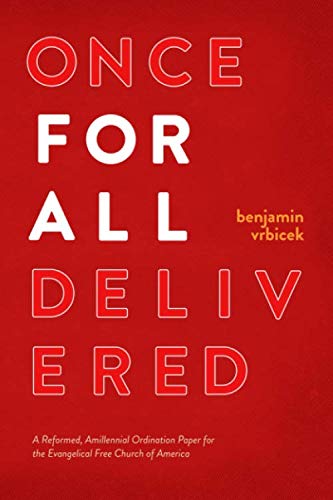
If you’ve found these posts helpful, please pick up the entire paper, which is now available on Amazon in both paperback and ebook formats under the title Once for all Delivered: A Reformed, Amillennial Ordination Paper for the Evangelical Free Church of America.
Thank you for the prayers and encouragement along the way,
Benjamin
PS: I posted a few pictures to Instagram from my ordination service last Sunday night.
{Previous posts in this series: God, The Bible, The Human Condition, Jesus, The Work of Christ, The Holy Spirit, The Church, Christian Living, The Return of Christ, Response and Eternal Destiny}
* * *
Current Doctrinal Issues
Marriage, Divorce, and Remarriage
God desires that Christians marry only other Christians. This follows from the prudent extension of 2 Corinthians 6:14–18 to marriage (cf. 1 Cor 7:39 “only in the Lord” and 1 Cor. 9:5 “a believing wife”) and the OT passages about marrying those from other nations, which weren’t so much about differing ethnicities or nationalities but religions (Dt 7:3–4; 1 Kg 11:1–8). It’s a great evil to delegitimize interracial marriages, as some have done in the past and some continue to do in our own day. But based on these passages, I would not officiate the marriage of one person who professes faith and one who does not. Prudence also suggests that Christians enter the covenant of marriage only with Christians of similar conviction and maturity. The issues surrounding marriage of a previously divorced person are more complicated. The Bible presents two grounds for a divorce that could open up the possibility of a remarriage, namely, infidelity (Mt 5:32; 19:8–9) and desertion (1 Cor 7:10–11). The ideal is always repentance, forgiveness, and reconciliation, but these are not always possible. Thus pastors must take into consideration situational specificity while at the same time giving serious weight to what Scripture teaches, especially God’s hatred of divorce and the way the permanence of marriage portrays the permanence of God’s love (Mal 2:16; Eph 5:21).
Because questions often arise about the definition of sexual immorality and desertion, allow me to discuss each briefly. I take Jesus’s use of the word porneia (sexual immorality) in the exception clause in Matthew 5:32 and 19:9 to be a sort of “junk drawer” term incorporating many variations of sexual sin, especially when the specific word for adultery, moichatai, is used in close proximity (5:27 and 19:9). This is not to say I’d encourage a woman to divorce her husband because last year he infrequently and repentantly looked at pornography. In fact, I’d never lead with the encouragement to get divorced. But I am saying a spouse in habitual, intense, and unrepentant porneia might qualify. Through study of God’s word and devoted prayer, I could very well imagine the pastor-elders of our church coming to the conclusion that a man who spent a decade at strip clubs and consuming internet pornography, even if he had not consummated an affair in sexual intercourse, could be divorced under the exception clause. Related to this, the desertion clause in 1 Corinthians 7 doesn’t only mean a spouse has moved to Vegas without a forwarding address. There are probably multiple ways to desert your spouse. But saying, “He won’t go shopping with me” or “She won’t watch football with me,” certainly do not constitute desertion. However, I consider habitual, unrepentant violence inflicted on one’s spouse to be a form of desertion. We must hold strictly to God’s commands, feeling the weight of Scripture far more than cultural trends. And it’s wise for pastor-elders to have a clear understanding of how we define sexual immorality and desertion before cases of each arise. As a final comment, my discussion in this paragraph should not be understood as an attempt to create new categories for divorce but to give definition and application to what the two categories encompass.
Abortion, Infanticide, and Euthanasia
God values life (Gen 9:6) and takes no pleasure in death (Ez 18:32). Thus, so should his people. Because abortion and euthanasia are sins, our views of them transcend political party lines and our solutions for them will not merely be political ones. No individual Christian or local church can participate in every meaningful cause, but I do long and pray for more who labor to advance this biblical worldview so that it gives birth to life-affirming deeds.
Role Distinctions in the Church of Men and Women
God can, and does, give both men and women extraordinary gifts for ministry, but God has left the office of pastor-elder-overseer to men. Biblical support for this is seen in the following:
the responsibilities given by God to Adam before and after the fall (Gen 2–3; Rm 5:12ff);
the pattern of OT and NT spiritual leadership being placed mainly among men;
the parallels between male leadership in the church and the headship of men in the home as taught in places like Ephesians 5, Colossians 3, and Titus 2;
no explicit mention of women pastor-elders in the NT;
and, finally, specific passages like 1 Timothy 2:8–3:7 and Titus 1:5–9 which require male pastor-elders, something Paul even sees rooted in creation in the 1 Timothy passage.
At the same time, however, women can and should be encouraged to participate in significant Christian ministry.
Homosexual Belief and Conduct
Today, the church has a tremendous challenge but also opportunity when speaking about what the Bible teaches about sexuality. The challenge is to speak with humility and compassion and at the same time fidelity to the Word. Homosexual practice is against God’s good design. It is a sin (Lev 18:22, 20:13; Rm 1:24–27; 1 Cor 6:9–11; 1 Tim 1:8–11), and must be called such (Is 5:20). However, alongside this truth, the church must do a better job of explaining the positive sexual design that God has established for society to flourish and winsomely invite people to participate in it.
Theology of Worship
All of life ought to be lived as worship (1 Cor 10:31), that is, living in obedient, glad esteem of the worthiness of God. It is appropriate that Christians gather regularly in local churches to both display and deepen their worship.
Speaking of the corporate gathering for worship, we endeavor to sings songs, preach sermons, and pray prayers that exalt what is true about God, faithful to Scripture, and celebrates the riches that are ours in the gospel. We seek to do all of this in an orderly way to build up the body with words intelligible to our people. The responsibility of leading corporate worship is so weighty to us that a few of us make time each Tuesday to debrief the previous week’s sermon and worship service, always striving to improve our ability to rightly handle the word of truth, asking for forgiveness where we’ve failed to speak as well as we ought, and praying that our church would more and more fall in love with God and his word.
Issues Related to Lifestyle
Spiritual Disciplines
God is pleased to supply his grace day by day and moment by moment to his people through spiritual disciplines. Therefore I actively pursue practices like evangelism, fellowship, prayer, service, and listening to the preached Word. I have my devotions in the morning before my family wakes up, attempting to read through the Bible cover to cover each year. As for prayer, I typically spend some time in prayer during my devotions. In conjunction with prayer, fasting—in both short and long durations—has been important to me.
Stewardship, Personal Finances, and Debt
God owns everything, yet he has entrusted humans with the care of creation (Ps 8; Heb 2); therefore, we should strive to be good stewards. The only debt my wife and I have is the mortgage on our house. We also intend to continue contributing to retirement funds. The Lord has been very gracious to us in these regards, and we feel blessed to extend God’s money generously to our local church, as well as to other ministries and missionaries.
Sexual Purity
The Bible tells us, “Be holy, because I am holy” (1 Pet 1:16). There are certain temptations that tend to tempt men more acutely, and pastors and Christian leaders are not immune. As such, I will continue to seek God’s help in regard to all areas related to personal holiness and trust Christ to give me continued victory and progress as I lean into the means he has appointed for such victory and progress. This is the heart behind the book I authored to help men struggle against porn, not with it.
Marriage and Family Priorities
God made it the duty of men to provide, protect, lead, and serve our families (Eph 5:22ff). It is not a role of entitlement but of sacrificial leadership. Thus, practically, Christ-like spiritual leadership in my home involves me being the one to initiate conflict resolution (as opposed to being passive), doing the dirty house-work jobs, providing financially, and, as needed, being the first to take responsibility and repent. God calls all men to embody these impulses, though the outworking will vary depending upon one’s circumstances. May God supply the grace to do it with increasing success and joy. With respect to pastoring, my family is a priority above the church. This has many practical implications such as coming home around 4:30 every day, even if I go back out for an evening meeting, as well as cutting the occasional sermon illustration that might bless the church but not my children or wife.
Social Drinking of Alcohol
Alcohol was seen as a blessing by the Jewish people and a sign of covenant celebration of God’s goodness and provision (Dt 14:26; Ps 104:15; Prov 3:7–10; Jn 2:1–12; Lk 22:20), but the use of alcohol in excess is strongly warned against throughout the Bible in both propositional statements and through sinful examples (Noah’s drunkenness in Gen 9 and Lot’s in Gen 19; Prov 20:1; Is 5:11; Gal 5:21; Eph 5:28; and many others).
In light of all these passages, I occasionally drink alcohol but always in moderation.
Accountability in Life and Ministry
There are several structures in place for personal and ministry accountability, including an engaged pastor-elder board and bi-weekly meetings with my best friend who asks hard questions.
* Photo by Désirée Fawn on Unsplash

The Doctrine of Response and Eternal Destiny: EFCA Ordination (Part 10 of 11)
What truths characterize our eternal destiny? And why do they matter?
In the fall, I began my longest blog series ever, a series sharing my ordination paper for the Evangelical Free Church of America (EFCA). If you’d like to read about what the process of ordination looks like in the EFCA, check out the first post in the series (here).
The ordination paper engages with our denomination’s 10-point statement of faith. I know these posts are dense. Please hang with me through just two more. This week’s post covers “Article 10: Response and Eternal Destiny.”
If you’ve found these posts helpful, please pick up the entire paper, which is now available on Amazon in both paperback and ebook formats under the title Once for all Delivered: A Reformed, Amillennial Ordination Paper for the Evangelical Free Church of America.
Thank you for the prayers and encouragement along the way,
Benjamin
{Previous posts in this series: God, The Bible, The Human Condition, Jesus, The Work of Christ, The Holy Spirit, The Church, Christian Living, The Return of Christ}
* * *
Response and Eternal Destiny
10. We believe that God commands everyone everywhere to believe the gospel by turning to Him in repentance and receiving the Lord Jesus Christ. We believe that God will raise the dead bodily and judge the world, assigning the unbeliever to condemnation and eternal conscious punishment and the believer to eternal blessedness and joy with the Lord in the new heaven and the new earth, to the praise of His glorious grace. Amen.
This next sentence is a mouthful, so take a deep breath. The gospel is the good news that Jesus, the long-awaited Messiah and heir of the Davidic monarchy, has come (Rm 1:1–5; 2 Tim 2:8), died, resurrected, ascended to his exalted throne, sits in heaven from whence he will come again to judge the living and the dead (Ps 110:2; Mk 12:36; 14:62; Acts 2:33–34; Eph 1:20; Heb 1:3, 13; 1 Tim 4:1), and by virtue of his atoning death and victorious resurrection, he graciously extends forgiveness, mercy, and righteousness to any and all persons who would come to God the Father through him in repentance and faith (Is 55:6–7; Lk 24:47; Acts 2:37–38; Rm 2:4; 3:22; 2 Cor 5:21; 1 Tim 1:16). To “receive Jesus as Lord,” as this article mentions (cf. Jn 1:12), means turning from our sins and trusting in Christ as Savior.
The gospel is both inclusive and exclusive at the same time. The gospel invites all people, no matter how wicked or vile, to experience grace (1 Tim 1:15). Whosoever wills may drink from the fountain. But God only appropriates the saving benefits of the gospel to those who place faith in Christ (Acts 4:12; 2 Thes 1:8). Ultimately many will persist in unbelief and so reject the saving benefits of the gospel. For them, an eternity of punishment in conscious torment awaits; this ought to grieve and motivate believers to manifold action. It is a sobering reality, repeatedly declared throughout the Bible and especially by the Lord Jesus himself, that hell is a place of unending torment in the full presence of God’s wrath and away from his grace, love, and mercy (Mt 25:46; Lk 16:26; 2 Thes 1:8–9; Rev 14:11; 21:8; 22:14, 15).
The Bible does not often speak of the time between an individual’s death and the final resurrection and judgment, or the intermediate state as theologians have often referred to it. However, the Bible is clear that believers will be in God’s presence. After death, the souls of believers go at once into the presence of Christ (Lk 23:43) and await their reunification with their glorified bodies in the resurrection (2 Cor 5:6–9). Similarly, upon death the souls of unbelievers go at once into hell, awaiting the final resurrection where they too will be reunited with their bodies (Jn 5:28–29).
The Bible indicates differing levels of reward and punishment based on how a person lived with the knowledge of God that they had (Lk 12:42–48; 1 Cor 3:12–15; Jam 3:1). As has been discussed previously, the connection between receiving salvific grace through faith and the producing of good works is so strong that the Bible often describes the final judgment based upon works, as it does in the account of the great white throne judgment in Revelation 20:11–15 (cf. 2 Cor 5:10). In this passage, those who did not have their name in the book of life are judged for not having good works, while those who have their name in the book do have good works and are not thrown into the lake of fire. Related to hell and the lost, it is important to say two things that have not been stressed yet. First, unbelievers do not go to hell because they didn’t know about Jesus; people go to hell because humans are condemned sinners, and hell is what sinners deserve (Rm 6:23; Gal 3:10). Second, as for those who have never heard of the gospel, we should go and tell them before they die so they may hear the gospel and might be saved. Now, it’s common to hear stories of how God is pleased to reach unbelievers through visions, especially among highly unreached people groups, such as those within the 10/40 window, but these visions are only salvific if and when they connect a person to the content of the gospel, which must then be believed. In other words, there might be more people being reached than we are aware of, but clearly the ordinary plan of God is to send human missionaries (Rm 10:14–17).
Several passages in the Bible either imply or state explicitly that there will be a great renewal of the earth in its physical condition to make a suitable place for resurrected, glorified believers to worship God forever (Is 65:17; 66:22; Jn 14:2, 3; Rm 8:19–21; Heb 12:26–27; 2 Pet 3:13; Rev 21:1; 22:1–3). Since God is infinite, and glorified people will always remain finite, the new heavens and the new earth will be a place of unending and ever-increasing joy and happiness as God displays forever “the immeasurable riches of his grace in kindness toward us in Christ Jesus” (Eph 2:7). While we formerly identified with the man of dust, in the gospel we now identify with the man from heaven and all the glory therein (1 Cor 15:47–49).
“Amen. Come, Lord Jesus!” (Rev 22:20).
Discussion Questions
God Commands All to Believe the Gospel, Repenting and Receiving the Lord Jesus Christ
1. What is the gospel? Is the gospel a universal message?
2. What does it mean to “believe the gospel,” viz. what is the importance of belief?
3. Define “repentance.” What is the role of repentance in conversion?
4. What does it mean to “receive the Lord Jesus Christ”?
5. What is the importance of the universal command to believe, the exclusivity of believing the gospel of the Lord Jesus Christ and the eternal consequences grounded in one’s response to Jesus?
Bodily Resurrection of the Dead and Judgment of All
6. What is the importance of the “bodily” resurrection of the dead (note Jesus’s bodily resurrection and bodily return), and what does this teach us about humanity?
7. What is your understanding of the Judgment Seat of Christ and the Great White Throne Judgment of Revelation 20?
8. Will believers face future judgment? Explain the meaning of 2 Corinthians 5:10, cf. 1 Corinthians 3:12–15.
Unbeliever Condemned to Eternal Conscious Punishment
9. What is the destiny of unbelievers? What is the destiny of the unevangelized? What does it mean that unbelievers are condemned?
10. What is the nature of Hell, and does “eternal conscious punishment” mean?
Believer to Eternal Blessedness and Joy with the Lord
11. What happens to a believer who dies before the return of Christ?
12. How do you describe “heaven” and “life after death”?
New Heaven and New Earth
13. What is the relationship of the “new heaven and new earth” to the millennial Kingdom of Christ?
To the Praise of His Glorious Grace (Doxology)
14. Why is it fitting to conclude a doctrinal Statement of Faith with a worshipful (doxological) note?
* Photo by Sasha • Stories on Unsplash

Reading List 2019
A list of every book I read last year.
My first post of each new year always contains the list of books I read the previous year (2014, 2015, 2016, 2017, and 2018). I do it for personal accountability; knowing I have to post my list helps me stay on track. Reading input decreased this year as writing output increased. I wrote a record number of blog posts on my website (47), a record number of guest posts (22), and published 3 books and 1 ordination paper.
In these “reading list” posts, I’ll often share a few anecdotes about favorite books from the year or other noteworthy items. I’ll just let the list be the list this year. As one year ends and another begins, I’m more tired than other years, and because of other writing projects across the winter I can’t seem to find the energy to analyze the last year—maybe that statement tells enough. In 2020, I gotta do better at keeping gas in the tank if I want the car to drive.
Let me know in the comments your favorite book from last year.
* * *
Books Read per Year
1. All The Light We Cannot See by Anthony Doerr (531 pages)
2. Expository Exultation: Christian Preaching as Worship by John Piper (336 pages)
3. Unsettled: Overcoming the Restless Search for Who You Are (The Story of Samson and His Father) by Chase Replogle (242 pages) (Currently Unpublished)
4. A Long Obedience in the Same Direction: Discipleship in an Instant Society by Eugene Peterson (216 pages)
5. Your Future Self Will Thank You: Secrets to Self-Control from the Bible and Brain Science (A Guide for Sinners, Quitters, and Procrastinators) by Drew Dyck (224 pages)
6. Letter from a Birmingham Jail by Martin Luther King, Jr. (80 pages)
7. Sunny Side Up: The Breakfast Conversation That Could Change Your Life by Dan DeWitt (112 pages)
8. A Gentleman in Moscow: A Novel by Amor Towles (480 pages)
9. Don’t Just Send a Resume: How to Find the Right Job in a Local Church by Benjamin Vrbicek (204 pages)
10. Enduring Grace: 21 Days with the Apostle Peter by Stephen R. Morefield and Benjamin Vrbicek (150 pages)
11. The Beginner’s Guide to Spiritual Gifts by Sam Strorms (200 pages)
12. The Paradigm: The Ancient Blueprint That Holds the Mystery of Our Times by Jonathan Cahn (272 pages)
13. A Restless Age: How Saint Augustine Helps You Make Sense of Your Twenties by Ausin Gohn (200 pages)
14. East of Eden by John Steinbeck (601 pages)
15. Five Smooth Stones for Pastoral Work by Eugene Peterson (251 pages)
16. The Solace of Water by Elizabeth Byler Younts (368 pages)
17. The Bible: Romans to Revelation, Part 6 of 6 by God (300 pages)
18. Humble Calvinism: And If I Know the Five Points, but Have not Love... by J.A. Medders (128 pages)
19. Air & Light & Time & Space: How Successful Academics Write by Helen Sword (280 pages)
20. Twenty Thousand Leagues Under the Sea by Jules Verne (524 pages)
21. Taking God At His Word: Why the Bible Is Knowable, Necessary, and Enough, and What That Means for You and Me by Kevin DeYoung (144 pages)
22. Dark Clouds, Deep Mercy: Discovering the Grace of Lament by Mark Vroegop (224 pages)
23. Does the Birth Control Pill Cause Abortions? by Randy Alcorn (197 pages)
24. The Bible: Genesis to Deuteronomy, Part 1 of 6 by God (300 pages)
25. Marriage and the Mystery of the Gospel by Ray Ortlund (128 pages)
26. The Passion of the King of Glory (Retelling the Story) by Russ Ramsey (240 pages)
27. The Deep Things of God (Second Edition): How the Trinity Changes Everything by Fred Sanders (304 pages)
28. Before You Open Your Bible: Nine Heart Postures for Approaching God’s Word by Matt Smethurst (96 pages)
29. Our Secular Age: Ten Years of Reading and Applying Charles Taylor by Collin Hansen and others (176 pages)
30. True Grit: A Novel by Charles Portis (240 pages)
31. Connected: Living in the Light of the Trinity by Sam Allberry (176 pages)
32. Competing Spectacles: Treasuring Christ in the Media Age by Tony Reinke (160 pages)
33. Dreyer’s English: An Utterly Correct Guide to Clarity and Style by Benjamin Dreyer (320 pages)
34. The War of Art: Break Through the Blocks and Win Your Inner Creative Battles by Steven Pressfield (192 pages)
35. Catch-22 by Joseph Heller (544 pages)
36. Called Together: A Guide to Forming Missional Communities by Jonathan K. Dodson and Brad Watson (100 pages)
37. The Bible and the Future by Anthony A. Hoekema (354 pages)
38. Three Views on the Millennium and Beyond by Darrell L. Bock (336 pages)
39. Echoes of Exodus: Tracing Themes of Redemption through Scripture by Alastair J. Roberts and Andrew Wilson (176 pages)
40. The Bible: Joshua to Esther, Part 2 of 6 by God (300 pages)
41. Enduring Grace: 21 Days with the Apostle Peter by Stephen R. Morefield and Benjamin Vrbicek (150 pages)
42. The Storm-Tossed Family: How the Cross Reshapes the Home by Russell Moore (320 pages)
43. Evangelical Convictions: A Theological Exposition of the Statement of Faith of the EFCA by EFCA Spiritual Heritage Committee (321 pages)
44. The Magician’s Nephew by C.S. Lewis (200 pages)
45. The Kite Runner by Khaled Hosseini (400 pages)
46. Draw Near: An Advent Devotional by Laura A. Pyne (110 pages)
47. Onward: Engaging the Culture without Losing the Gospel by Russell Moore (240 pages)
48. The Prodigal God: Recovering the Heart of the Christian Faith by Timothy Keller (192 pages)
49. He Numbered the Pores on My Face: Hottie Lists, Clogged Pores, Eating Disorders, and Freedom from It All by Scarlet Hiltibidal (192 pages)
50. Struggle Against Porn: 29 Diagnostic Tests for Your Head and Heart by Benjamin Vrbicek (171 pages)
51. Of Mice and Men by Steinbeck, John (120 pages)
52. Parenting in the Pastorate: “How-To” Faithfully Raise Kids in Full-Time Ministry by Paul Gilbert (110 pages)
53. Amusing Ourselves to Death: Public Discourse in the Age of Show Business by Neil Postman (208 pages)
54. 1–2 Thessalonians: A 12-Week Study by Matt Smethurst (96 pages)
55. The Bible: Psalms to Song of Solomon, Part 3 of 6 by God (300 pages)
56. 12 Years a Slave by Solomon Northup (248 pages)
57. Kingdom Come: The Amillennial Alternative by Sam Storms (592 pages)
58. Marriage, Divorce, and Remarriage: Critical Questions and Answers by Jim Newheiser (336 pages)
59. The Imperfect Pastor: Discovering Joy in Our Limitations through a Daily Apprenticeship with Jesus by Zack Eswine (272 pages)
60. Evangelical Convictions: A Theological Exposition of the Statement of Faith of the EFCA by EFCA Spiritual Heritage Committee (321 pages)
61. Between the World and Me by Ta-Nehisi Coates (176 pages)
62. How to Write Short: Word Craft for Fast Times by Roy Peter Clark (272 pages)
63. Writing Tools: 55 Essential Strategies for Every Writer by Roy Peter Clark (288 pages)
64. The Glamour of Grammar: A Guide to the Magic and Mystery of Practical English by Roy Peter Clark (320 pages)
65. Choose Love, Not Fear: How the Best Leaders Build Cultures of Engagement and Innovation That Unleash Human Potential by Gary Heil and Ryan Hail (240 pages) (Publishing in March of 2020)
66. The Old Man and the Sea by Ernest Hemingway (128 pages)
67. Help! For Writers: 210 Solutions to the Problems Every Writer Faces by Roy Peter Clark (320 pages)
68. Joy in the Sorrow: How a Thriving Church (and its Pastor) Learned to Suffer Well by Matt Chandler and Friends (240 pages)
69. The Culture Code: The Secrets of Highly Successful Groups by Daniel Coyle (304 pages)
70. The Writer’s Diet: A Guide to Fit Prose by Helen Sword (88 pages)
71. The Bright Unknown by Elizabeth Byler Younts (368 pages)
72. The Bible: Isaiah to Malachi, Part 4 of 6 by God (300 pages)
73. Once for all Delivered: A Reformed, Amillennial Ordination Paper for the Evangelical Free Church of America by Benjamin Vrbicek (115 pages)
74. When Narcissism Comes to Church: Healing Your Community from Emotional and Spiritual Abuse by Chuck DeGroat (200 pages)
75. The Bible: Matthew to Acts, Part 5 of 6 by God (300 pages)

What if Christmas Doesn’t Come from a Store?
In my favorite sermon from all of last year, I quoted my favorite Christmas movie.
Growing up, one of many favorite Christmas memories was watching the cartoon version of How the Grinch Stole Christmas at my Grandma and Grandpa’s house. We lived in Missouri and they lived in Iowa. It was always such a treat to make the five-hour drive to visit them for presents and sledding and hot chocolate and time with family and Christmas joy.
There’s that classic scene in the movie when the narrator says,
And the Grinch, with his Grinch-feet ice cold in the snow, stood puzzling and puzzling, how could it be so? It came without ribbons. It came without tags. It came without packages, boxes or bags. And he puzzled and puzzled ’till his puzzler was sore.
Then the Grinch thought of something he hadn’t before. What if Christmas, he thought, doesn’t come from a store. What if Christmas, perhaps, means a little bit more.
I quoted that line in a recent sermon. It was my favorite sermon from all of 2019. The sermon comes from Romans 8 and mentions that—in the words of Dr. Seuss—Romans 8 offers more than a little bit more. Romans 8 offers Christians the deeper joy and more gritty triumph of the gospel.
As one year closes and another begins, I’d love to leave you with the encouragement to forsake your sin and live more fully rooted in God’s love for you in Christ. I titled the sermon “The Sons Who Slay Their Sin and Live.” You can read or listen below.
Happy New Year,
Benjamin
* * *
The Sons Who Slay Their Sin and Live
Romans 8:12–17
Sermon Series: “Joyful and Triumphant: The Deeper Joy and More Gritty Triumph of Romans 8”
December 8, 2019
The song goes, “It’s beginning to look a lot like Christmas.” My first pastorate was in Tucson, AZ, and my first day of work was June 1. It started really hot, and for three months it only got hotter. I loved it. But when December came, it never really began to look a lot like Christmas. I didn’t love that. No leaves on the ground, no need for flannel and parkas, no way to cut down your own Christmas tree. Everything that grows in Tucson has needles, but not pine needles. I missed having the signs that told me Christmas was coming.
I don’t know whether you love the Christmas season or not. A pastor named Eric Schumacher recently wrote, “My parents divorced when I was 12. I haven’t had a holiday gathering with both my parents and all my brothers present for 31 years. I probably never will again. It is still incredibly painful every year. And I think I’ll mourn that until the day I die” (Twitter). For some of us, celebrating Christmas is hard because of hard past memories or hard present realities; for others celebrating Christmas is wonderful because of wonderful past memories and wonderful present realities. For most of us, it’s some of both.
My hope during the Advent season here at church is not different than my hope at any other time during the year: to point us to the wonder of the good news of Jesus Christ. We printed a flyer with our Christmas service times on them. I don’t want you to hang it on your fridge. Please give it to a friend, coworker, family member, or neighbor so they can hang it on their fridge. I’ll be preaching the week before Christmas and Christmas Eve, and I’d love to see our church point people to Jesus who don’t often give him much attention.
Scripture Reading
Please turn with me in your Bible’s to the letter we call Romans. It’s in the New Testament, which is the part of the Bible written after Jesus came to earth. It’s a letter written to a church in the city of Rome, a church full of people trying to do what we’re trying to do: make sense of the good news of Jesus for our everyday lives.
We’ll be in chapter 8 right where Pastor Ben left off last week. Follow along with me as I read Romans 8:12–17, and then we’ll pray that God would be our teacher.
12 So then, brothers, we are debtors, not to the flesh, to live according to the flesh. 13 For if you live according to the flesh you will die, but if by the Spirit you put to death the deeds of the body, you will live. 14 For all who are led by the Spirit of God are sons of God. 15 For you did not receive the spirit of slavery to fall back into fear, but you have received the Spirit of adoption as sons, by whom we cry, “Abba! Father!” 16 The Spirit himself bears witness with our spirit that we are children of God, 17 and if children, then heirs—heirs of God and fellow heirs with Christ, provided we suffer with him in order that we may also be glorified with him.
Prayer
This is God’s Word. Thanks be to God. “Heavenly Father . . .”
Introduction
Pastor Ben and I have said to each other that if you’re a preacher who is going to preach through the letter of Romans, you need to be over fifty years old. That’s only sort of a joke. The theology and complexity of thought are too rich for otherwise. One of my pastor heroes calls Romans 8 the greatest chapter in the greatest letter in the greatest book ever written. In my opinion, that might not be an overstatement. I did add it up, however. Pastor Ben and I and Davis Younts (who is preaching next week) are not over fifty, but between the three of us, we have 106 years, so we thought this might qualify us to attempt to summit Romans 8.
Christians commonly call the season leading up to Christmas, Advent. The word advent means coming or arrival. The advent season allows for focused attention backward on the first advent of Jesus as the man born to die and attention forward to his second advent as the king come to reign. We celebrate Christmas between these two advents, the advent of the man born to die and the king come to reign. But during Advent, while all the faithful come to sing about being “joyful and triumphant” as we adore our savior, sometimes our understanding of Christmas being “joyful and triumphant” can seem merely sentimental and nostalgic—good food and family and friends and presents.
There’s that classic scene in the cartoon version of How the Grinch Stole Christmas when the narrator says, “And the Grinch, with his Grinch-feet ice cold in the snow, stood puzzling and puzzling, how could it be so? It came without ribbons. It came without tags. It came without packages, boxes or bags. And he puzzled and puzzled ’till his puzzler was sore. Then the Grinch thought of something he hadn’t before. What if Christmas, he thought, doesn’t come from a store. What if Christmas, perhaps, means a little bit more.”
I believe Romans 8 offers more than a little bit more. In Romans 8, God calls the faithful to come to adore the deeper joy and the more gritty triumph of Jesus, which is the joy and triumph that will sustain the children of God in a world long in sin and error and pining until the second advent of Jesus. “[I]n all these things,” Paul writes near the end of the chapter, “we are more than conquerors through [Jesus] who loved us” (8:37). The “these things” that we are more than triumphant over include, Paul writes, tribulation and famine, distress and danger (v. 35), which means we have more joy and triumph than can be bought from a store.
As Pastor Ben opened the series last week with the first eleven verses, he held high the gospel of free, undeserved grace Christians receive in the gospel. The opening verse in the chapter and the great theme in his sermon came from v. 1, which reads,
1 There is therefore now no condemnation for those who are in Christ Jesus.
This means that everyone who is “in Christ” has no condemnation from God, not that we don’t deserve condemnation because of our sin but that we have no condemnation because God sent Jesus into the world to take our condemnation for us.
Some of you know that I went through the ordination process this fall. It involved a lengthy oral exam and the writing of a dense theological paper. One of the questions you’re required to answer in the paper asks, “What does it mean that you are in ‘union with Christ?’” This is the theme highlighted in verse one of Romans 8. For those “in Christ,” there is now no condemnation. So what does it mean to be “in Christ”? I wrote in my ordination paper,
Nearly one hundred times in the New Testament we read of believers being in Christ (e.g., 2 Cor 5:17; 1 Pet 5:14). Even more occurrences surface when we include variations of the phrase. In fact, sometimes the biblical authors even speak of Christ being in believers, not just believers being in Christ (Jn 15:4; Col 1:27). Union in Christ covers a range of aspects related to a believer’s salvation.
Simply put, to be in union with Christ is to have your life (now and into eternity) bound together with Christ in such a way that you receive all the saving benefits of the gospel (Col 3:3–4). To put it even more simply, union with Christ is like placing everything good about the gospel into a sack, labeling the sack “in Christ,” and handing it to a believer.
Last week Pastor Ben’s sermon took that sack of blessings, turned it upside down upon our heads, and shook for thirty-five minutes the glories of the gospel into our laps.
But the question hung out there, “What now?” If God has taken away all of our condemnation and corruption through Jesus because we are “in Christ,” do we have anything to do? Our passage this morning answers the question of “What now?” Because of the gospel reality that we are in union with Jesus and thus have no condemnation, in the power of the Spirit of God, Christians now begin to put our sin to death.
1. Put the flesh to death (by the power of the Spirit), vv. 12–14
Look with me at it in the words of our passage.
12 So then, brothers, we are debtors, not to the flesh, to live according to the flesh. 13 For if you live according to the flesh you will die, but if by the Spirit you put to death the deeds of the body, you will live. 14 For all who are led by the Spirit of God are sons of God.
Paul begins with, “so then.” In light of all the treasures of heaven promised to us in the gospel, what are we to do? Answer: We are to put our sin to death in the power of the Holy Spirit.
Paul proclaims that because Jesus has freed us from the prison of sin, we need to not stay in prison any longer. Jesus threw open the prison door, so walk out of prison. Don’t say in bondage. That’s what Paul is saying. And he uses violent language to do so. “For if you live according to the flesh,” he writes in v. 13, “you will die, but if by the Spirit you put to death the deeds of the body, you will live.” That’s violent language.
A pastor in the seventeenth century named John Owen wrote a book called The Mortification of Sin. I re-read it last year. The famous line in the book says, “Be killing sin or sin will be killing you.”
Jesus spoke often about this type of violence against our own sin, the war of the Christian life, the “be killing sin” part of Christianity. I’ll give one example from the gospel of Matthew. Jesus uses deliberate overstatement to make his point.
27 “You have heard that it was said, ‘You shall not commit adultery.’ 28 But I say to you that everyone who looks at a woman with lustful intent has already committed adultery with her in his heart. 29 If your right eye causes you to sin, tear it out and throw it away. For it is better that you lose one of your members than that your whole body be thrown into hell. 30 And if your right hand causes you to sin, cut it off and throw it away. For it is better that you lose one of your members than that your whole body go into hell. (Matthew 5:27–32)
Notice that the point of Jesus’s words in Matthew 5 and the words of Paul in Romans 8, do not command us to go on a “sin diet,” like we just sin less and then have some “cheat meals” here and there. God commands us to starve sin, not diet from sin. Christians don’t seek to limit our sin; we do whatever we have to do to eliminate our sin.
And the word “our” in “our sin” is key. Christian, be far more concerned about your greed than the greed of corporate America. Be far more concerned about the sex viewed on your smartphone than the sex filmed in Hollywood. Be far more concerned about the health of your marriage than the cheapening of marriage by our government. God’s view of sin is that of something dangerous, something that robs us of joy and God of his glory. We don’t have this view; sin is something we laugh at and coddle.
There a lot of young people at our church. I love that. I’m not old enough yet to be your father, I could be your older brother. By some accounts and depending on what chart you look at, I’m the oldest millennial, so I don’t like it when people pick on millennials, pick on us. So please hear this as a loving encouragement from a brother who cares: as much as we talk about authenticity, transparency, and brokenness, let us also show one another how much we hate our sin by the war we make against our sin.
When Paul uses the word flesh here doesn’t mean skin and meat and bones but that part of your nature that opposes God. The flesh is at war with God (v. 7). And in the power of the Spirit, we are to slay our sin. Don’t miss that connection with the Spirit. Romans 8 teaches that the Spirit of God in the life of the believer does more than one thing, more than simply telling you that God loves you. Yes, the Spirit of God works in Christians to remind us of all the good we have in the gospel—forgiven, reconciled, adopted. But the Spirit also points out the sinful places in your life that need to die. This isn’t about having a minimum level of holiness before God will love you. Look, I will always love my children. But for us to sit at the dinner table and fellowship with joy, my children can’t be cursing when they think I’m not listening.
The way Satan points out your sin and the way the Spirit of God points out your sin is different. I heard a preacher put it like this once. The condemnation of Satan is ambiguous and broad and hopeless. The conviction brought by the Spirit, however, is focused, narrow, and hopeful. Satan tells you that you’re a loser. That’s ambiguous, broad, and hopeless. If you take your finger and put it in your shoulder and press on it with increasing pressure, that’s like the work of the Spirit, that’s how the conviction of God works. “Do you feel that?” the Spirit asks us. “This particular thing needs to go. Let me help you” he says.
So, in last week’s sermon, Ben told us all the good things we have in the gospel when we are “in Christ.” And this week, we see that being in Christ leads us to run from sin. Let me illustrate last week’s passage and this week’s passage. Let’s just say, you lived in an apartment. A lousy, evil landlord runs the apartment complex, but at first you didn’t know he was evil because he promised you a great place to live. But when it came time to move in, things change. Your rent doubles. Your heat stops working. Your bathroom plumbing breaks. Your electricity cuts in and out. Rats scurry around at night.
So you say, “Mr. Landlord, you promised this, and you promised that, and now it’s different. I want you to fix it.” He says, “Tough.” And every month he proceeds to pound on your door demanding his rent. Oppressing. You can’t leave. You’re a captive.
And then one day, a new owner buys the apartment complex, and he himself becomes the landlord, and he throws the lousy, evil landlord off the property and begins to fix the plumbing and evict the rats and restore everything to its proper place. Thankfulness wells up inside you. However, after the initial euphoria is gone, the old landlord, keeps coming around. He keeps walking with his clipboard around the apartment complex. And he keeps pounding on your door every month. “Pay up. Your rent is due,” he says. “You’re mine. You’re a debtor to me.” Do you know what you say?
You say, “No, Mr. Evil Landlord. I have a new landlord who is kind and wise and powerful and loving and just as he has thrown you off before, so he will do again every time I come to him to ask for his help because he is the great liberator. Security, show this impostor the door.”
That’s last week’s sermon. This week, we’re pressed with the questions of why we would vandalize the newly renovated property, why we are not content with the apartment he gave us, why we get so angry with the other tenants, who, by the way, are all also recipients of his grace.
Church, what in your life needs to die? If that sounds hard to you, it should. But don’t miss the promise. Look again at vv. 13–14.
. . . if by the Spirit you put to death the deeds of the body, you will live. 14 For all who are led by the Spirit of God are sons of God.
As you kill your sin, you don’t earn sonship, you display it.
In passing before we go to the next point. Let me mention something about the word “sons” in the phrase “sons of God.” Later in the passage, which I’ll read in a moment, Paul uses the more general “children of God” not just “sons of God.” Those more critical to the Bible might take this to be evidence of patriarchal influence on the Bible. It’s actually the exact opposite.
In the first century, only a son would inherit the full and biggest blessing from the father. So, if Paul had spoken of “daughters of God,” many would have gone, “Well, that’s great, but daughters don’t get it all.” This is why Paul says “sons of God”; it’s not to slight what it means to be a “daughter of God” but to say that if you are a “child of God”—whether a son or daughter—you get the full inheritance of the father. Paul speaks of sons of God to celebrate the beautiful reality of adoption into God’s family, namely, that as a daughter of God, you have equal standing in the father’s house. All the children are sons, even when they are daughters.
2. Live as sons (in the assurance of the Spirit), vv. 15–17
Look with me again at the rest of the verses in our passage.
15 For you did not receive the spirit of slavery to fall back into fear, but you have received the Spirit of adoption as sons, by whom we cry, “Abba! Father!” 16 The Spirit himself bears witness with our spirit that we are children of God, 17 and if children, then heirs—heirs of God and fellow heirs with Christ, provided we suffer with him in order that we may also be glorified with him.
That word of Abba denotes tenderness and intimacy. I don’t think pastors have been wrong equating Abba with our name Daddy. One pastor said, “I don’t feel respected if my children call me Dr. Ortlund. I feel put off” (Ray Ortlund, “God’s Grace Is Better Than We Think” from Romans 8:12–16,” March 30, 2019). In the same way, my children don’t call me Reverend Vrbicek. They call me Daddy.
In the gospels we read of Jesus one time speaking to his Father as “Abba Father.” Do you know the context? Let me read it to you.
32 And they went to a place called Gethsemane. And he said to his disciples, “Sit here while I pray.” 33 And he took with him Peter and James and John, and began to be greatly distressed and troubled. 34 And he said to them, “My soul is very sorrowful, even to death. Remain here and watch.” 35 And going a little farther, he fell on the ground and prayed that, if it were possible, the hour might pass from him. 36 And he said, “Abba, Father, all things are possible for you. Remove this cup from me. Yet not what I will, but what you will.” (Mark 14:32–36)
The word Abba was squeezed out of Jesus during his greatest moments of suffering. Think about that. When our savior suffered, that’s when he cries, “Daddy!” That context should inform what we read here in Romans.
In contemporary, western Christianity we often have the assumption that we know our sonship best when we feel the most blessed. That’s not what this passage says, though. I’ll put it like this. We often assume as we stand in some alpine meadow with the sun shining and our bellies full and our bodies strong, we confidently cry out, “I am a child of God.” We’re joyful and triumphant.
But this cry of Abba Father is more like the helpless cry of a scared child in the dark who, rather than trying to find his own way out of the pain and rather than giving up in utter despair, instinctively shouts out “Daddy! Daddy! Are you there?”
That instinctive cry for Dad is not actually according to this passage an instinct but the work of the Spirit within the child of God. This is the deeper joy and gritty triumph of Romans 8.
When I first received my driver’s license in high school I was a pretty bad driver. I admit it. The number of my accidents reached the double digits. Most were at low speed and in parking lots, but one was not. It was an early Saturday morning in the spring. The roads were wet, and before you exit the highway you round a huge curve. The tires on my minivan slipped, the van fishtailed and scraped the guardrail. I stopped in the grass and got out. The headlight on the passenger side dangled like a detached eyeball. It was like someone took a knife in the side of the van and slashed.
I got back in, drove to the exit, and the other two minutes it took to get to the high school parking lot. I parked as far away as I could so no one would see. I was on the way to a track meet and had to catch the bus. In the locker room I called home to tell my father. We didn’t have cell phones. I remember staring at the red brick wall wondering what he would say. “Dad, I messed up,” and told him what happened. His first words were not, “You stupid son. How many times have we told you?” Instead, he said, “Are you okay?”
You can’t manipulate your impulses; they just sort of get squeezed out. When I whispered Daddy, love and care and concern squeezed out. He told me to get on the bus and we’d deal with it later. So I did. On the way out of the school campus, the bus full of my teammates drove by my minivan, and everyone laughed at me. But I knew my father loved me.
Conclusion
After Jesus was resurrected, he had numerous conversations with his disciples. In Luke 24, we read of Jesus speaking about how suffering comes before glory.
44 Then he said to them, “These are my words that I spoke to you while I was still with you, that everything written about me in the Law of Moses and the Prophets and the Psalms must be fulfilled.” 45 Then he opened their minds to understand the Scriptures, 46 and said to them, “Thus it is written, that the Christ should suffer and on the third day rise from the dead . . . (Luke 24:44–46)
For Jesus, the truest Son of God, suffering came before glory. This is what Paul says of us too.
16 The Spirit himself bears witness with our spirit that we are children of God, 17 and if children, then heirs—heirs of God and fellow heirs with Christ, provided we suffer with him in order that we may also be glorified with him.
If children, then heirs, Paul says. I don’t know what suffering you’re experiencing. I don’t know if you’re in high school, and everyone is laughing at you. I don’t know if slaying your sin is more difficult than you ever could have imagined. I don’t know if your parents divorced when you were twelve, and you’ve never had a Christmas as a complete family since. But I do know, that if you are a child, you are an heir. His inheritance becomes your inheritance. And if you are a child with a full inheritance coming, you can call God, Abba Father whenever you need him.
Prayer
Pray with me as the music team returns to lead us in our final song. Let’s pray . . .

Guests Posts Galore: Part 3 of 3
Some favorites articles from 2019.
Have a wonderful Christmas Eve tonight! I can’t wait to celebrate with our local church.
If you get some downtime over the break, I’d love for you to read a few of the posts I wrote for other websites. Below are the final links to all the guest posts I wrote this fall.
Merry Christmas,
Benjamin
“Men, the Women in Porn Bear God’s Image,” Gospel-Centered Discipleship, August 2, 2019
The man who told me the story said that when he first found out about the stripper, he was going to leave before she got there; he didn’t want to be a part of it. When she arrived, however, he didn’t leave. He stuck around—not because she was gorgeous but because, in his words, “she was so ugly.” The man told me he stayed to watch the other men make fun of her. When I heard this story, I didn’t know whether to shake my fists and scream, No! That’s not right! or to plant my palms on my cheeks and crumble to the floor and cry. Perhaps I should have done both.
“Run Like the Wind from Sexual Sin,” For The Church, September 3, 2019
My goal isn’t to tear down a biblical hero; my goal is to read the Bible well, and reading this passage well means acknowledging what Joseph himself would want us to learn from his life: all men are sinners and in need of God’s grace. It’s common for books on sexual sin to praise Joseph for running, but I think it’s clear he didn’t run soon enough!
“Don’t Let Sexual Shame Move You from Christ’s Mission,” ABWE International Blog, September 12, 2019
We often associate penance with Roman Catholicism, but as Protestants we have our own forms of penance. Do you ever find yourself in a flurry of good deeds to show God how sorry you are? I know a man who would randomly do hours and hours of hard labor on church construction projects. In hindsight, we learned the tornado of saw dust was his attempt to deal with his sexual sin. Or perhaps you find yourself pouting to show God how much you want to be forgiven. We can mope about our house or church, but by itself, presenting our sadness to God atones for zero sins (Hebrews 9:22).
“Corre como el viento del pecado sexual,” Coalición por el Evangelio (The Gospel Coalition Spanish Website), September 13, 2019
Don’t ask me how this happened.
Mi objetivo no es derribar un héroe bíblico. Mi objetivo es leer bien la Biblia, y leer bien este pasaje significa reconocer lo que José mismo quiere que aprendamos de su vida: todos los hombres son pecadores y necesitan la gracia de Dios. Es común que los libros sobre pecado sexual elogien a José por correr, pero creo que está claro que no corrió lo suficientemente pronto.
“Struggling Against Pornography, Not With It,” Evangelical Free Church of America Blog, EFCA NOW, October 15
Dr. Switzer, Newhart’s character, then asks if Katherine is ready to hear what she should do. She takes out a pen and paper, and Dr. Switzer leans forward with an impassioned voice and says, “Stop it!” After a quizzical look from Katherine, he repeats himself: “S-T-O-P, new word, I-T...I mean, you don’t want to go through life scared of being buried alive in a box, do you? I mean, that sounds frightening.”
“Pride Goes Before Porn,” The Gospel Coalition, October 17, 2019
Some might say there’s a sense in which men and women involved in producing pornography consent to voyeurism, but from a Christian worldview, discussions of consent often miss the point. Consent can’t be reduced to human-to-human permission. Ultimately, permission comes from God. He locked the garden, regardless of whether the woman on the screen seems to welcome your lust. As Jesus said, “Everyone who looks at a woman with lustful intent has already committed adultery with her in his heart” (Matt. 5:28).
“An Amillennial Ordination in the EFCA,” EDA MOVE, Evangelical Free Church of America, Eastern District Blog, October 30, 2019. (An audio reading of this post by Benjamin appeared on the EDA Move Podcast, here.)
The week I completed my ordination was a week like no other I’ve had in ministry. On Saturday I officiated a wedding. On Sunday I launched our church sermon series in the book of Acts. On Monday I crammed for my oral ordination exam by reading over my paper and most of the book Evangelical Convictions. On Tuesday I underwent my four-hour oral exam, being asked and attempting to answer 154 questions (per the transcript) about theology and pastoral ministry. The rest of Tuesday and Wednesday, like many of you, I enjoyed the EDA Move’s annual conference. On Thursday I was subpoenaed to testify in court related to an appeal of a former church member currently in prison. On Friday I had major reconstructive surgery on my shoulder. I’m not making this up. I wrote this post with my right arm still in a sling, where it will be for the next six weeks. When I started to put my children to bed on Tuesday night, the evening after my ordination, I collapsed on my own bed at 8 pm. I thought I’d just rest for five minutes to steel myself for the job of putting our six children to bed. My wife had to finish the job, as I woke up from my five-minute nap ten hours later. Again, it was a week like no other.
“Pastor, Don’t Interview like Michael Scott,” For The Church, November 22, 2019
In one episode of The Office, branch manager Michael Scott interviewed for a role at the corporate offices in New York. David Wallace, president of Dunder Mifflin, asked Michael, “What do you think are your greatest strengths as a manager?” To this, Michael answered, “Why don’t I tell you what my greatest weaknesses are? I work too hard. I care too much. And sometimes I can be too invested in my job.” In job interviews, it’s become cliché to ask about a person’s greatest strengths and weaknesses. The fact that The Office would spoof the questions tells you that. Still, if you’re a pastor considering a potential transition from one church to another, you’ll likely be asked. And when you are, please don’t interview like Michael Scott; do not answer the question about weaknesses with positive sounding “flaws.”
* Photo by Chad Madden on Unsplash

Guests Posts Galore: Part 2 of 3
Some favorites articles from 2019.
I’ve been blogging for five and a half years, and this post is the 250th blog post written for my website. That’s a lot of posts. Thanks for letting me invade your inbox.
In 2019, I wrote more guest posts for other websites than I ever have before. If you count the podcast interviews, I hit twenty-two in all. But I stopped telling you about them because I feared wearing you out with updates. Inbox fatigue is a blogger’s constant fear.
As we close the year, I’ll risk sharing recaps of my guest posts, because if you haven’t read it, it’s new to you.
Thanks,
Benjamin
“When Self-Preservation Becomes Our God,” For The Church, June 5, 2019
Safety is a good thing. Antilock brakes and side-impact airbags are good things. Hand sanitizer is a good thing. Tying one’s shoelaces is a good thing. Walking, not running, with scissors and getting flu shots are good things. They all arise from our desire for safety. And behind the desire for safety lies the desire for self-preservation, which is also a good thing. We are made in the image of God (Genesis 1:26–27; James 3:9). Therefore, our lives matter. In Ephesians 5, Paul assumes that “no one ever hated his own flesh, but nourishes and cherishes it,” a truism Paul then uses to help build his argument about caring for one’s spouse. Self-preservation is not a bad thing. In fact, when men and women act heroically, despite a certain danger to themselves, we are not saying that they didn’t care about their own lives. Of course they care about their lives. What we celebrate is that they valued something more than self-preservation; we celebrate that they put something ahead of their own safety.
“Book Review: Dark Clouds, Deep Mercy by Mark Vroegop,” 9Marks, June 6, 2019
When tragedy strikes, we often don’t know what to do next. Yet, when the Lord’s hand of judgment fell on Israel; when the temple was leveled by pagans; and when the most tender and refined of women resorted to cannibalism (cf. Deut. 28:56–57), Jeremiah knew what to do. He sat in ash and wrote an acrostic poem. Let that sink in. When all around his soul gave way, Jeremiah penned the book we call Lamentations, a series of highly structured and theologically dense poems. That response to tragedy might strike us as odd. But Jeremiah’s response is a gift to posterity. His laments illuminate the way out of the dark jungle of despair. He gives us a path to walk toward life, healing, and toward God himself.
“Was I Betraying My Church by Interviewing Elsewhere?” CTpastors.com, June 13, 2019
This below paragraph is probably my favorite paragraph I wrote all year.
The Qoheleth tells us in Ecclesiastes that there is a season for everything, a time for every matter under heaven. That doesn’t mean transitions won’t be lonely and full of conflicting desires. Seasons of pastoral transition feel antithetical to pastoral ministry in the same way engagements are antithetical to marriages. Engagements are meant to end; marriages are not. Pastoral transition is about yanking up roots; pastoring involves putting roots down. Engagements are filled with frenetic activity and wedding-day planning; marriages thrive on the slow burn of love anchored in vows. Pastoral transition implies movement; pastoring requires standing with both feet in one neighborhood among one flock.
“Summertime and the Lust Comes Easy,” EDA MOVE, Evangelical Free Church of America, Eastern District Blog, June 19, 2019. (An audio reading of this post by me appeared on the EDA Move Podcast, here.)
In other words, as pastors and ministry leaders — for all the relaxing changes during summertime — we must remember to encourage each other and the people we shepherd to not take a break from fighting against lust.
“Three Big Surprises When Interviewing for Missions,” ABWE International Blog, June 25, 2019
It seems like blog posts with catchy titles and practical tips make the best viral posts. You know what I mean, articles with titles like, 7 Interview Hacks to *Crush* Your Next Ministry Interview. But I don’t want to write that kind of post. And I’m not even sure we should aspire to crush a ministry interview anyway.
“Don’t Just Send a Resume to a Church—Or a Missions Agency,” The Missions Podcast Interview, June 30, 2019
Too often in pursuit of full-time ministry abroad or at home, ministry applicants simply email a church or missions agency their resume and leave the rest of the hiring process to chance. Whether you’re fresh out of seminary or transitioning to ministry after a full career in the outside workforce, such a haphazard approach is bound to fail. Maybe we need to learn more about how to conduct ourselves professionally during the onboarding processes into pastoral or cross-cultural ministry.
“Two Ways Every Christian Can Be Pastoral,” Unlocking the Bible, July 15, 2019
Almost no one read this article, but I loved writing it and was happy with how it turned out.
The last time I saw my grandfather alive he made fun of me for being a pastor. You’ve probably heard the jokes or even made them yourself. “What does a pastor do all week anyway? You only work like one hour.” I wanted to tell my grandpa we have two worship services on Sunday morning, and they go for three hours by themselves. But I didn’t think arguing would help. That’s one extreme view, the view of a pastor who works little. The other extreme is a pastor who works all the time, like 80 hours a week, and no one else in the congregation does anything because “real ministry” only counts as such when done by professionals. Yet there is no way most churches, my own church included, could exist if only a handful of pastors did all the pastoring.
* Photo by Tim Mossholder on Unsplash

Reruns & Guests Posts Galore: Part 1 of 3
Some favorites articles from 2019.
Back in the late 90s, when NBC aired sitcom reruns during the summer, it advertised using the slogan, “If you haven’t seen it, it’s new to you.” I thought that was clever.
This year I wrote more guest posts for other websites than I ever have before—if you count the podcast interviews, I hit twenty-two in all.
But I stopped telling you about them. Basically, I feared wearing you out with updates. Inbox fatigue is a blogger’s constant fear. This fall, for example, nearly every email I sent was followed by at least one unsubscribe. Far more discouraging was that my favorite place to be published rejected my last five consecutive articles. These are good reminders that life is not lived always up and to the right.
As we close 2019, I’ll risk sharing recaps of my guest posts, because, you know, if you haven’t read it, it’s new to you. For the next three weeks I’ll share a few articles a week and a favorite paragraph or two from each.
Thanks for letting me invade your inbox and build a home on this piece of Internet real estate,
Benjamin
“Reflections on The Pursuit of Writing,” Pastor Writer Podcast interview, November 10, 2018
This was actually a podcast interview from last November, but I really, really enjoyed being on this show. I love the work done by the host Chase.
“Porn: The Killer of Missions,” The Missions Podcast Interview, January 13, 2019
This was another podcast interview. I love the co-hosts Scott and Alex with ABWE. It was kind of them to have me on as a guest.
“Networking for Pastors who Hate Networking,” Gospel-Centered Discipleship, February 14, 2019
But for whatever reason, I hate the word networking. It feels greasy. When I hear it, I think cheap suits, slick hair, gaudy gold chains, and a guy who points with his index finger as he talks (cf., Prov. 6:12–13). Even if this is a cliché, at one point or another, we’ve all had the miserable experience of being used. I call it networking after Genesis 3, east of Eden.
“Clarity About Compensation,” Evangelical Free Church of America Blog (EFCA NOW), March 28, 2019
The Bible is replete with stories of those ensnared by the power of money. Consider the well-known Levite in Judges 17–18. To paraphrase, he is basically asked, “Young man, do you want a better preaching gig? If so, then come on up. Don’t be a priest to a family; be one to a whole tribe.” Previously he had worked for only a small wage, a set of clothes, and his living expenses (17:10). But when the Levite heard this new offer—albeit one made by 600 armed warriors—his “heart was glad” (Judges 18:20). Additionally, consider Balaam in Numbers 22, Gehazi in 2 Kings 5, the rich young ruler in Mark 10, Zacchaeus in Luke 19, and Ananias and his wife Sapphira in Acts 5.
“Christians and the Struggle Against Porn: Q&A with Benjamin Vrbicek,” Anchored in Christ – KevinHalloran.net, May 23, 2019
More than a few times the guys at our church office teased me about it. “Benjamin,” they’d ask, “how’s your pornography book going?” “It’s not a pornography book,” I’d respond. “It’s a book to help men struggle against it.”
“Is It Time to Change Churches? (Part 1 of 2),” Am I Called?, May 24, 2019
When I was a kid, my parents gave me a choice about a summer vacation. I couldn’t figure out what to do. My parents told me I could go with them on a short trip to visit my grandparents or I could stay home with a friend to attend a local basketball camp. I had no idea what God wanted me to do. One morning I distinctly remember staring at a small bowl of cereal and asking God this very question. As I twirled the last few Lucky Charms with my spoon, I asked God to make the cereal into the shape of the state—either Missouri (basketball) or Iowa (grandparents)—to indicate what I should do. I’m not encouraging you to go and do likewise. After all, when I was a child I thought like a child.
“Are We There Yet? Knowing the Steps in a Pastoral Transition (Part 2 of 2),” Am I Called? (May 30, 2019)
When I coach pastors during a season of transition, there’s something they often don’t understand but should: the steps involved in a search process and where you’re at within that process. It sounds simple, but it’s not always as simple as it sounds. And a lot of frustration ensues when the process is jumbled in the mind of a candidate. This confusion manifests itself when someone—a spouse or friend or family member—asks how close you are to being hired. The response goes something like, “You know, I’m not sure. The church said something about an interview weekend, but also something about a theology examination and calling references. But I don’t know exactly when and how all of this happens.”
* Photo by Matt Botsford on Unsplash

On Pastoral Prayer: It Should not Be so Difficult for Me but It Is
A pastoral prayer from a recent church service.
This summer the pastor-elders of our church listened to a 9Marks podcast about leading corporate prayers during church worship services (here). We found Jonathan Leeman and Mark Dever’s discussion both stimulating and convicting. We even made the change to incorporate more time for meaningful prayer during our worship services.
Now, each of our pastor-elders takes a Sunday to pray before the offering is collected, which is typically done right before the sermon. Sometimes teaching and travel schedules are such that an elder-qualified man who is not currently a pastor-elder may lead the prayer. But you get the idea. The prayer typically lasts around five minutes and often has overlap with the themes of the sermon. I’m so thankful Scott, one of our lay pastor-elders, initiated and maintains this ministry.
This weekend it was my turn to pray. We had a service less full than normal, so I took the opportunity to stretch us a bit by praying closer to ten minutes. It stretched me too. Because we’ve recently had an influx of newcomers, I used the opportunity to pray through our church’s five-year goals, which our leaders think and pray about often, but, admittedly, we do a poorer job of keeping in front of our people. For what it’s worth, we’re in year four of five.
Below is an edited version of the prayer I wrote Sunday morning before church. Jesus warned against praying in public to be seen by others (Matthew 6:1–4). But Jesus did not mean this as an indictment against all public prayer, for he immediately proceeded to teach us what we call the Lord’s Prayer. In this stream, I share below my pastoral prayer from last Sunday. I hope it encourages you to make prayer an increasingly important part of your local church services.
* * *
Heavenly Father, we pause when looking over our goals. We do not want to be like those described in the book of James, those who in their arrogance and self-reliance presumed that by simply putting in time and effort they could bring about their goals of more profit and more abundance, not realizing their lives—indeed, our lives—depend upon you for strength and energy. Our hearts do not beat, and our lungs do not breathe, apart from your sustaining grace. We read in the book of Hebrews that your Son upholds the universe by the word of his power. The planets of the solar system continue to orbit because you say so, just as the details of our lives are held in place because you say so.
Yet, Lord—acknowledging your sovereignty, acknowledging your goodness, acknowledging the power of the gospel that is at work among us—we come boldly before your throne of grace.
Plant a church
Heavenly Father, we ask that you would help us plant another church in the city of Harrisburg, not for our glory and fame but for the name and renown of the one who spilled his blood so that more and more people could taste and see the goodness of the Lord.
We thank you for those who, some twenty years ago, left the comfort of a great church so they might, by your grace and power, labor to see our church built up in love. May you even now be giving some among us that same kind of pioneering, sacrificial spirit who see the name of Jesus being magnified as of more importance than the comfort of attending an established church.
Pursue a “new” facility & Care for our local community
Heavenly Father, we give you praise for our church building. We thank you for the beauty of the renovations you enabled us to complete eighteen months ago and the way people continue to come to this church building and find hope and peace and comfort. Lord, we thank you for the neighborhood in which you placed us. We thank you for the inroads that have been made in this community. May you enable us to become servants who seek to bless our neighbors in your name.
As we see brokenness around us—whether it be the search for joy that takes place in the strip clubs just around the corner or the quiet lives of desperation led by many who feel alone in their homes—we pray that you would make our church building a safe place, a place where people can heal and find joy that will truly satisfy.
Increase racial and ethnic diversity
Heavenly Father, please help our church to grow in racial and ethnic diversity as a testimony to the uniting power of the gospel. We thank you for those among us who enrich our lives by bringing other perspectives. We thank you for the dozens of people who come to our building three days a week to learn English as a second language. We thank you especially for those who have taken a particular interest in the immigrants and refugees among us. Lord, please forgive us for being slower to help than we ought; forgive us for being reluctant to reach out; forgive us for being hesitant to love. Forgive us, Lord, for using the pronouns us and them.
Stay streamlined, program-light
Heavenly Father, when we set the goal to be streamlined and program-light at our church, we do not intend to stifle the work of your Holy Spirit among us. Forgive us, Lord, if that has happened or is currently happening.
Lord, we do not want to be streamlined and program-light because it’s easier or because it allows us to remain lazy, preferring our comfort over your mission. We do not aim to be streamlined and program-light so we can have more Netflix.
Instead, we believe we should measure spiritual maturity, not by how often we attend church meetings other than Sunday mornings, but by how many of our neighbors and co-workers we know well enough and have loved well enough that they could ask us to pray for them when their lives seem to be crashing down around them. In a culture that applies increasing pressure to do more and more and more, we ask that you help us to intentionally build margin into our lives so that when your Spirit does lead us to begin new ministries, we can do so with joy and obedience.
Lord, we long to stay streamlined and program-light so that the members of this church are not so burdened with the ministry initiatives of our leaders that they can’t be free to serve you wholeheartedly as your Spirit leads them; we long for a passion for new ministries to bubble up from within the hearts of those who call this church home. Lord, I thank you for the new ministry of the Christmas Giving Tree that will bless those among us with Christmas presents signifying, in tangible ways, your love for us. We’ve never done this before, but I thank you, Lord, for placing the idea upon the hearts of a few individuals and giving them the vision and obedience to see it become a reality.
Expand evangelism ministry
Heavenly Father, we pray for our evangelism ministry. Oh, that you would cause your gospel to go forth from us with greater power. Lord, as we share the story of the life, death, and resurrection of the Son of God, and his second coming, oh that more and more people would come to understand the sacrifice you made for them. Lord, would you cause your good news to be received by us in such a way that it is actually treasured as good news, news we long to share with others. Forgive us that our love for you is so small that we find it easier to talk about things that are here today and gone tomorrow.
Connect and disciple newcomers
Heavenly Father, you commanded us to go and make disciples of all nations, to baptize people into the name of the Father, the Son, and the Holy Spirit. You promised that your authority, your power, and your presence would be with us as we do so. I pray for the many relationships that have formed among our church, relationships not built around simply having coffee or watching our children play together, but relationships intentionally seeking to help one another be conformed to the image of Jesus Christ.
Lord, many at our church have no idea what being in a discipleship relationship would be like—to have someone to offer sound, biblical counsel and someone to weep with when their children walk away from the faith. Lord, would you make us into the type of church where discipleship relationships are not only natural but that to not be in intentional discipleship relationships would be seen as rare and unusual.
Lord, I pray especially for the older, mature Christians among us who were never themselves discipled by someone else. I pray that though they never received such care, they would build into others, giving what they never directly received.
Lord, as I think about the connection’s ministry of our church, I pray for the new pastor we are seeking to hire. We’ve been looking and praying for the last six months and are currently interviewing pastors. Give us wisdom; we need it.
Lord, I think about what one candidate said when we asked what it might look like for a connections ministry to thrive here at Community. He said it might look not so much like one new pastor doing all the work of connections, but rather like a congregation who sees themselves more and more as connecting pastors and a church where a young couple notices an elderly couple who needs care and love and, unprompted by staff pastors, they move toward each other in love. Lord, yes, for more and more of this kind of connection here among us.
Increasingly become a church of prayer
Finally, Heavenly Father, we ask you to make us a church that increasingly values prayer. I don’t think we are good at this, at least I do not think I am good at this. Praying to you in a church service for ten uninterrupted minutes should not be as difficult as it is. Forgive me for thinking I can build your church simply through effort and time on task. Forgive me for mistaking commotion and activity and sawdust flying around in the air for the substance of true spiritual life. Lord, we will cast our cares upon you when we see the weakness of our shoulders and the futility of our ingenuity.
As we call out to you in prayer—as a church gathered together in unity on Sunday mornings; as a church scattered around the city in small group Bible studies during the week; as families and homes and individuals who follow you when no one is watching but you—Lord, surprise us with the beauty of your grace, the joy of your forgiveness, and the peace of your presence.
So we ask all this, Heavenly Father, knowing you can do more than we could ask or imagine. And we pray all this in the name of Jesus Christ, by which we mean prayers prayed not consistent with our will but Christ’s will and prayers prayed not on our authority but upon Christ’s authority.
Amen.
* Photo by Tyson Dudley on Unsplash

Blogging for God’s Glory: A Big Big Fridge
Reflections on writing for the glory of God.
I like sharing excerpts from writing projects that are still far from completion. My friend John Beeson and I are working on a book called Blogging for God’s Glory in a Clickbait World: A Christian’s Guide. John is a pastor at New Life Bible Fellowship in Tucson, Arizona and a fellow blogger. This is how we begin the book.
* * *
“Daddy, I painted this for you,” says my daughter Izzy.
Closing the door behind me and setting my work bag on the table, I bend over to look at her paper. She’s covered the paper with splotches of primary colors in the shape of people. The paper is still wrinkly from paint liberally applied. She places the painting in my hand.
“That’s wonderful,” I say while trying to figure out which way is up and which is down. I’ve learned from experience not to ask, What is this? Instead I say, “Tell me about this picture, sweetie.”
“It’s a doggie in our backyard, and all of our family is eating pickles,” she says, or whatever the picture was that particular day.
“Oh, I see. Can we hang this on the fridge?”
Izzy smiles wide. Her two front teeth are missing.
And we do. Along with all the others, we hang this one on the front of our fridge.
People tend to mark the stages of life. We save the paystub from our first paychecks, mount diplomas on walls, celebrate a marriage and a first mortgage. I’m in that stage of life where my fridge is covered in artwork from my children. They hand me watercolor paintings when I leave for work. They hand me colored pencil drawings when I come home from work. They come to work to hand me colored macaroni glued to construction paper. It’s wonderful. I don’t want it to end.
What I love most is the innocence of their gifts. My little Izzy doesn’t have a clue there is such a place as The British Museum where there hang works of Rembrandt and Rubens. Izzy doesn’t know anything about the Louvre in Paris that displays DaVinci’s Mona Lisa for 10 million visitors each year. All Izzy knows is our refrigerator, the two sides of the fridge and the front side of the fridge, which I guess we could call our three art galleries. The front of our fridge, or the main gallery if you will, receives nearly ten visits a day, or maybe one hundred visits in the summer when our children enjoy vacation and standing in front of an open fridge. But no one in our family visits the fridge necessarily to see her artwork. That’s the child-like innocence Izzy has when we mount her paintings. If an adult were to possess this kind of ignorance of the great works of art, especially an adult given to producing her own art, we’d called it something other than innocence; her ignorance would take on the pejorative, culpable sense of the word. In a child, however, the ignorance is admirable.
The purity of her gifts strikes me too. “Daddy, I painted this for you,” she says. Izzy paints not for fame or money or from the overflow of competition with her siblings, but for you, she says. When I say purity, I mean this kind of singlemindedness, the kind of joy captivated by and treasures only the smile of her father. No mixed motives, no duplicity. Only pure single-minded devotion.
I’m not saying children are innocent and pure and full of rainbows and bubble gum. I believe in original sin because I read of it in the Bible and also because I see it in the mirror and in the eyes of every one of my young children when—if their little arms were strong enough—might kill me rather than not get their way. Children are not pure and innocent in an absolute sense. As those downstream from our father Adam, we are sinners not because we sin, but we sin because we are sinners. As David writes, “In sin did my mother conceive me” (Psalm 51:5).
I think about my children’s artwork often when I blog. Whether you think that makes me childish in the worst sense or the best, I’ll let you decide. But I like to think of God printing out my blog posts and hanging them on some heavenly fridge, which I’m sure is huge and made of stainless steel and always has an ice dispenser that works. I like to think of God stooping over to smile and say, “Tell me about this one, Benjamin.” I like to think God has a big big house with lots and lots of room and a big big fridge where he can host my blog.
Again, I hope these sentiments don’t betray my foolishness or ignorance or even my arrogance. I know my blog posts are only feeble and flimsy collections of words, while J.I. Packer’s book Knowing God has gravitas. I know that though the internet keeps a record of all my blog posts, should the Lord tarry, Augustine’s Confessions will still be read in ad 3,020 and my posts will be long forgotten. I know that as I blog about some suffering that feels weighty to me, Corrie ten Boom’s holocaust survival story makes my problems look like they are, light and momentary. From jails Bunyan and Bonhoeffer wrote masterpieces. And I, from my dining room table, have the gall to expect my Internet-published words should hang in the heavenly gallery? . . .
* Photo by Naomi Hébert on Unsplash

The Doctrine of The Return of Christ: EFCA Ordination (Part 9 of 11)
What truths characterize the return of Christ? And why do they matter?
For the last few months, I’ve been writing about my ordination process in the Evangelical Free Church of America. If you’d like to read about what the process looks like, check out the first post in the series (here). Throughout the autumn, I’ll occasionally share the remaining sections of my ordination paper, which engages with our denomination’s 10-point statement of faith. I know these posts are dense. Please hang with me through a few more.
This week’s post is from the section on the return of Christ. In the summer of 2019, the EFCA expanded its statement of faith to include all orthodox views of the glorious return of Christ. I’m the first pastor who holds an amillennial view of the return of Christ to be ordained in the new era.
Thank you for the prayers and encouragement along the way,
Benjamin
{Previous posts in this series: God, The Bible, The Human Condition, Jesus, The Work of Christ, The Holy Spirit, The Church, Christian Living}
* * *
Christ’s Return
9. We believe in the personal, bodily and glorious return of our Lord Jesus Christ. The coming of Christ, at a time known only to God, demands constant expectancy and, as our blessed hope, motivates the believer to godly living, sacrificial service and energetic mission.
Perhaps it would be helpful at this point to include a brief paragraph that is more memoir than theology. As long as I can remember, I have appreciated the EFCA; my family almost exclusively attended EFCA churches as I grew up, and my father often served as a lay elder. As such, in my limited understanding of eschatology, I identified with historic premillennialism. This view abided during my time at a conservative, evangelical Presbyterian seminary and continued into my first pastorate within a nondenominational, reformed baptist church. There, my fellow teaching pastors were both amillennial. By the way, I had tried to be hired in the EFCA directly after seminary, but at the time there was no room in the inn, at least very little room; I graduated from seminary on the heels of the economic recession and churches weren’t hiring. But my hope was always to return to the EFCA. Then I did. Community EFCA in Harrisburg hired me. A year went by and, besides pastoring, I studied and refreshed the EFCA licensing paper I had written while in seminary. Still, my historic premillennial position abided. For those who were at my licensing council, you’ll remember that what was otherwise a fairly smooth-going licensing exam, shall we say, had more than a few bumps when it came to the millennium and my allegedly questionable hermeneutic applied to the days of creation and modern day Israel. I wasn’t lying when I said I held to historic premillennialism. But I was naïve—naïve not only about the influence of my seminary but also the influence of my fellow teaching pastors at my former church and my own hesitancies about some aspects of historic premillennialism. I’m thankful for those bumps, the pointed questions, and the one no-vote I received because together they sent me on a four-year trajectory to study the issues in more detail. I now hold to amillennialism, which, among other topics related to Christ’s return, I will defend below.
Jesus will return personally and bodily (Mt 24:30; 26:64; Acts 1:11; Rev 1:7). This view stands over and against the view that a “return” of Christ in the hearts of his followers could fulfill scriptural promises. The two major interpretive decisions related to Christ’s literal and physical return are the nature and timing of the tribulation and the millennium. With respect to the tribulation, many Christians interpret this term to refer to a period of intense struggle, calamity, and persecution or a “great tribulation,” as Jesus calls it (Mt 24:21). Historic premillennialism understands the Bible to teach that the church, as a whole, will remain through this tribulation period and after a time (seven years being either literal or symbolic) Jesus will return to set up his millennial kingdom on earth. This understanding of the tribulation isn’t too different from my amillennial understanding of the tribulation, though it obviously differs significantly on the millennium. Amillennialism rightly understood does not deny the existence of the millennium as atheism denies the existence of God; rather, amillennialism understands the Bible to speak of Christ’s millennial reign to be taking place in heaven right now. The amillennial view is consistent with passages that intricately link the timing of Christ’s return with the final judgment and eternal state (Rm 8:17–23; 2 Thes 1:5–10; 2 Pet 3:3–14), not two returns of Christ with a great intervening period of time between the returns, which would make for odd readings of passages like John 5:28–29 (“the hour is coming . . .” where the “hour” would be separated by 1,000 years). True, some passages in the OT, Isaiah 11 and 65 for example, seem to describe a time “better” than the church age but “not as great” as the new heavens and new earth. Yet these passages could be speaking poetically of the new heavens and new earth. In short, what some see as taking place in the millennium can actually be seen as taking place in the final state. A rigid interpretation of Isaiah 65:20, which speaks of those dying after a long life, is odd to me, when v. 19 speaks of no more weeping. How could physical death not produce weeping no matter how long one lives?
Additional consideration, of course, must be given to Revelation 20. I favor the interpretive scheme called progressive parallelism, which understands the book of Revelation to recapitulate similar sequences of events, often with each cycle moving the description of the end a bit further. So, for example, what happens with the seals in chapters 4–7 is roughly parallel with what happens with the trumpets in chapters 8–11, and so on. Space does not allow for much elaboration, but events like stars falling from the sky “as the fig tree sheds its winter fruit when shaken by a gale” (6:13) push me away from a more chronological reading of the book. Once stars have plopped upon the ground like over-ripe figs, there can’t be much left.
Addressing the classic text of Revelation 20:1–6 directly, a few things should be said. A great case can be made for describing Satan as bound in the church age and unable to deceive the nations, at least to the degree he did in the OT (2 Kg 17:29; Mt 12:28–29; 28:18–20; Lk 4:6; 10:17–18; Jn 12:31–32; Acts 14:16; 17:30; 26:17–18; Col 2:15; 1 Jn 3:8). Also, the reign of God and Christ upon a throne is frequently (some say exclusively) spoken of in Revelation as taking place in heaven (1:4; 3:21; 4:5; 7:9ff; 8:3; 12:5; and dozens of others). The 1,000 years mentioned in vv. 3, 5, 6, and 7 from which all our millennial views build their name (pre-, post, a-) could surely be, in such a highly symbolic book, a round number suggesting a long period of time (cf. the figurative use of 1,000 in passages such as Dt 7:9; 32:30; Josh 23:10; Jud 15:16; 1 Sam 18:7; 1 Chron 16:15; Job 9:3; Ps 50:11; 84:10; 90:4; Ecc 6:6; 7:8; SoS 4:4; Is 30:17; 2 Pet 3:8). And it doesn’t feel like a stretch in context to see the “first resurrection” of those reigning with Christ as the believers raised to the intermediate state, whereas unbelievers do not experience this resurrection but only the “second death.” Additional evidence for considering the “first resurrection” as those alive in the intermediate state (not those raised to life on earth during a premillennial reign of Christ) comes from the serval parallels of Revelation 20:1–6 with 6:9–11 and the decidedly heavenly locale of those martyrs. The parallels are a little more explicit in the Greek but can still be seen in translations. Revelation 6:9 says, “(A) I saw . . . / (B) the souls of those who had been slain / (C) for the word of God and for the witness they had borne,” and 20:4 says, “(A') I saw / (B') the souls of those who had been beheaded / (C') for the testimony of Jesus and for the word of God.” Then add to this that the whole vision in Revelation 20 (“I saw,” v. 1) feels very heavenly; missing from the text are earthly details about Christ reigning upon earth, the temple, the land of Canaan, and the holy city of Jerusalem (although perhaps some infer that the vision takes place on earth because the angel comes down from heaven). For all these reasons, I believe the amillennial view of a single, definitive return of Christ at the end of time cooperates best with the authorial intent of not only the broad witness of Scripture to the end times but the specific witness of Revelation 20.
Moving on, a theological tension appears concerning our expectancy of the Lord’s return, but the tension is also seen within the Scriptures. On the one hand, many verses in the Bible seem to indicate that the Lord could return at any time and we must be ready for him (Mt 24:42–44; Lk 12:40; 1 Thes. 5:2). On the other hand, many passages seem to indicate that certain events must precede the coming of the Lord, including the tribulation (Mk 13:7–8; Mt 24:15–22; Lk 21:20–30), preaching the gospel to the nations (Mt 24:14), signs in the heavens (Mt 24:29; Is 13:10), the salvation of Israel (Rm 9–11, esp. 11:1–2, 25–26), and the coming of the man of lawlessness (2 Thes 2:3). Some propose the solution of two returns of Christ: first, a “secret” or pre-tribulation return of Christ to rapture his church from the world before the tribulation and then yet another return to set up his millennial kingdom. This view is often associated with dispensationalism. The post-tribulation view, which I hold, teaches that it is possible that all of the signs have been fulfilled or could be fulfilled very quickly but that it is more probable that the signs are not yet fulfilled. Therefore, fidelity to God’s promises in Scripture demands we maintain “constant expectancy” regarding Jesus’s return, while at the same time make sure that when Jesus does come, he finds us not idle but busy at his work in his world in service to him (Mt 24:36–51; Rm 13:11–13; 1 Thes 5:1–11; Rev 3:3).
Concerning the relationship between ethnic, national Israel and the church, some go too far when they speak of replacement theology as though nothing special remains about the Jewish people and thus push them out of the way. A better term, it seems to me, is fulfillment theology because the OT hope was always for an expansion of light to the Gentiles under the reign of the Messiah, an expansion that did not push out ethnic Israel but instead reconciles them both to God in one body (Eph. 2:11–22; Is 46:9). The true “Israel of God” was always a believing Israel, which today includes both believing Jews and believing Gentiles (Gal 6:15–16; cf. Rm 4:16ff). A passage like Romans 11:25–26 seems to expect an increase in conversions of ethnic Jews near the return of Christ, which is wonderful news.
On the one hand, no person knows the exact time of Christ’s return (Mt 24:36–44; 1 Thes 5:1–3; 2 Pet 3:10; Rev 3:3), which should engender humility. On the other hand, while our interpretation of some specific aspects about the end times remains partially uncertain, believers in Christ must remain fully assured that Jesus will come. For those who have put their faith in him, it will be a glorious and joyful day—a reality that should propel believers “to godly living, sacrificial service and energetic mission” (cf. 2 Pet 3:14).
Discussion Questions (Created by the EFCA)
Personal, Bodily and Premillennial Return
1. Briefly describe your position on the second coming of Jesus Christ. Include your views on the tribulation, the rapture of the church, and the millennium.
2. How is your view different from other positions on the millennium? Please define the other positions.
3. Why is it essential to state explicitly that Christ’s return is “personal” and “bodily?”
Israel and the Church
4. What is your understanding of the relationship between Israel and the Church as it pertains to eschatology? Comment on Rom 11:25–27.
5. How do you understand Jesus’ teaching of the kingdom and how does the kingdom relate to eschatology?
Effect on the Believer
6. Why is it important to include a statement of humility regarding the exact time of Christ’s return, viz. “at a time known only to God?”
7. How do you understand biblically “constant expectancy,” and what does it mean to live this way? What is the importance of the word “demands?”
8. How do you define and understand the “blessed hope?” How does the biblical teaching of the Lord Jesus Christ’s return bring you hope?
9. How does Christ’s return motivate you “to godly living, sacrificial service and energetic mission?”
* Photo by Aniket Deole on Unsplash

Cultivate the Fear of the Lord: The “Struggle” Audiobook Is Available
The audiobook of Struggle Against Porn launched this week.

In the spring my book Struggle Against Porn: 29 Diagnostic Tests for Your Head and Heart was published by Rainer Publishing. The audiobook is finally available for purchase. David K. Martin did a fantastic job narrating the book.
You can buy the audiobook at Amazon and Audible and soon at Hoopla, Overdrive, and ChristianAudio.
The sample listed with the audiobook comes from Chapter 13 of the book: “Cultivate the Fear of the Lord.” Below is the text of that chapter and a way to listen. I’d love for you to check out the book.
Thanks,
Benjamin
* * *
Chapter 13: Cultivate the Fear of the Lord
This part of the book (Cross-Training) began with the admonition to cultivate humility. Now I’ll close with the admonition to cultivate the fear of the Lord.
We often assume fear is a negative thing, which it can be. Christians shouldn’t live with the fear that God doesn’t love us. At the core of the gospel is the propitiation of God’s wrath. Any and all wrath that ought to have fallen on sinners like us was averted from God’s children and placed on Jesus (Rom 3:21–26). Therefore, we’ve nothing left to fear; the price has been paid, and the punishment has been absorbed by the Lamb of God. As John writes, “There is no fear in love but perfect love casts out fear. For fear has to do with punishment, and whoever fears has not been perfected in love” (1 John 4:18).
However, we ought to cultivate a healthy fear of the Lord. Proverbs maintains that fear is the beginning of wisdom (1:7; 9:10). When I speak of healthy fear, I mean the fear of disappointing God. I mean awe at the splendor of his majesty and wonder over his creative power. I mean reverence in response to his wrath and his justice. I mean astonishment over his loving-kindness, which has been lavished upon us in the gospel. As the apostle Paul writes, “Since we have these promises, beloved, let us cleanse ourselves from every defilement of body and spirit, bringing holiness to completion in the fear of God” (2 Cor 7:1).

We also ought to cultivate a fear of our own capacity to sin. Apart from the restraining grace of God, we’re not beyond committing any sin (Gen 20:6). It might seem ridiculous to you that someday you would view porn on five Internet browsers at the same time, but it’s not beyond you. If you’re familiar with the Lord of the Rings novels, you’ve seen this concept dramatized. The characters who have the greatest respect for the power of the ring and the greatest fear of how they themselves might abuse it become the safest and most helpful to the cause (Gandalf, Aragorn, and Galadriel). On the other hand, those who are the most overconfident in their own incorruptible ability become a threat (Boromir).
This truth became clear to me during an event in college. The man who discipled me also met regularly with one of the athletic coaches who was investigating Christianity. One day he told me this coach was having trouble becoming a Christian because of all the shame he felt from “real sins.” By this, I think he meant things that so-called good Christians would never do. I remember my friend looked at me and asked, “Take stealing, for example. When was the last time you stole something?”
I said, “I dunno.” And then the conversation moved on to other things.
The very next day, as I was munching on the sausage pizza I’d just stolen, I remembered our conversation. No, I hadn’t just robbed a Dominos, but I did make an on-campus “lunch and learn” a “loot and leave.”
Though I see the point about “real sins,” I also believe we all need to be more afraid of our own capacity to sin. We need guardrails to keep ourselves from veering and driving off a dangerous cliff.
For example, it’s sometimes necessary as a pastor to have a private conversation with a woman. But when I do, I’m always very careful to have other people around. When I email women, I keep my tone formal. When my wife and I go on a date, if our babysitter is a female teenager who doesn’t drive, I’ll never be the one to drive her home.
To some, these measures may seem like overkill or paranoia but taking no precautions would be assuming I’m more spiritual than King David. Many issues led David to be alone on a roof at the time when kings were supposed to go out to battle (2 Sam 11:1). Had he established proper guardrails, the naked woman named Bathsheba might have never caught his eye, and even if she did, he may have dealt with the temptation differently.
Again, cultivating a fear of our own capacity to sin is a corollary of cultivating a healthy fear of the Lord. Apart from the restraining grace of God, we’re not beyond any sin, sexual or otherwise, which brings us right back to where this section started: cultivating humility.
Diagnostic Questions:
When you hear the phrase “the fear of the Lord,” what comes to mind?
How might fear of the Lord help you in your pursuit of purity?
What practical steps can you take to cultivate “good, healthy” fear—fear of the Lord and fear of our capacity to sin?
Are there certain sins you feel are beyond you? If so, which sins and why? In what ways are you different from those who commit those sins?
Guardrails aren’t necessary everywhere—only where danger exists. What guardrails have you placed in your life to keep you from driving over a cliff?

The Doctrine of Christian Living: EFCA Ordination (Part 8 of 11)
What truths should characterize the Christian life? And why does this matter?
For the last few months, I’ve been writing about my ordination process in the Evangelical Free Church of America. If you’d like to read about what the process looks like, check out the first post in the series (here). Throughout the autumn, I’ll occasionally share the remaining sections of my ordination paper, which engages with our denomination’s 10-point statement of faith. This week’s post is from the section on the Christian living. I know these posts are dense. Please hang with me through a few more.
Thank you for the prayers and encouragement along the way,
Benjamin
{Previous posts in this series: God, The Bible, The Human Condition, Jesus, The Work of Christ, The Holy Spirit, The Church}
* * *
Christian Living
8. We believe that God’s justifying grace must not be separated from His sanctifying power and purpose. God commands us to love Him supremely and others sacrificially, and to live out our faith with care for one another, compassion toward the poor and justice for the oppressed. With God’s Word, the Spirit’s power, and fervent prayer in Christ’s name, we are to combat the spiritual forces of evil. In obedience to Christ’s commission, we are to make disciples among all people, always bearing witness to the gospel in word and deed.
Speaking in systematic theological terms, sanctification is the process of becoming more and more holy (Jn 17:17; Rm 6:11ff; Eph 2:10; 1 Thes 4:3; Heb 12:1). The Bible closely links “God’s justifying grace” and “His sanctifying power” in this way: God’s action of justification invariably leads to and produces sanctification, a cooperative endeavor by both God and the person. When God justifies a person, the process of change must begin (Jam 2:17–26). This change is not without setbacks, but one day, God will complete what he began (Phil 1:6). Hallelujah. The process of change varies in people: sometimes it seems nearly instantaneous in one specific area of life, and other times change plods along slowly, incrementally—two steps forward, one step back. The Lord surely has his reasons for the relative slowness and rapidity of sanctification, perhaps just fast enough so we trust he’s still working but not so quick that we get cocky. With all of his riches, Jacob’s limp wasn’t a bad thing for him; it assuaged his swagger.
When we say, “live out our faith,” we mean the deepening of a Christian’s trust in the promises of God that leads to increasing, joyful obedience. We can call this “works,” which is what Paul calls it in Ephesians 2:10. Faith alone saves, but the faith that saves never stays stagnant. In fact, Scripture is clear that final salvation requires good works—works produced by grace through faith but works nonetheless (Jn 5:28–29; Rm 8:12–14; Gal 5:21–24; 6:8–10; Heb 10:36; Jam 1:26; 1 Jn 1:7; and many, many others). To just highlight one aspect of our obedience, Christians should do good to everyone but especially those of the household of faith (Gal 6:10), which is not unlike the requirements for eldership which specify that if a person cannot care for his own household, something is wrong.
While all true believers are eternally secure, the feeling of assurance is not static. A believer’s assurance to whether he or she is a genuine believer fluctuates for a host of reasons, and progress in sanctification is one of them. When a believer lives out her faith in humble, joyful obedience, she should be encouraged that she is indeed a believer and that all the promises in the gospel are hers. A Christian in overt disobedience—what the OT sometimes calls high-handed or defiant sins (Num 15:30)—might feel very assured of his own salvation, but we might better label his assurance as false assurance. John addresses the topic of assurance extensively in 1 John 3, in which there seem to be two related components: an ethical part of assurance related to a believer’s obedience and a mystical, spiritual part that comes through the voice of the Spirit (esp. v. 24).
Jesus spoke of the greatest commandment as loving God and the second as loving our neighbor (Mt 22:37–39). We see this pattern reflected in the Decalogue (Ex 20; Dt 5). To love anything more than God, even good things such as one’s family and ministry, involves elevating a good thing to the place of God, which is idolatry. Yet when we love God rightly and preeminently, we will also love the things he loves. And because God’s own passions are committed to the poor and oppressed (Dt 10:18; Ps 140:12; Lk 4:18), the people of God ought to be characterized by these same passions—passions that translate to merciful gospel witness in both word and deed (Dt 15:11; Prov 31:8–9; Amos; Micah 6:8; Mt 23:23). In this way, each local church ought to be an oasis of compassion and an incubator of people zealous for justice as we extend the gospel and make disciples among all people, teaching them to observe all that Jesus commanded (Mt 28:19–20). I spend a significant amount of time discipling men who, Lord willing, will spend their lives discipling others into deeper understanding of what it means to follow God in the home, church, and world—that is, walking with God both when everyone is watching and when no one is watching.
We should not neglect the implications of the gospel’s cosmic aim to restore all things, which includes social order, but neither should we conflate the proclamation of the gospel to simply doing good things. People changed by the gospel will do things like volunteer in a crisis pregnancy center and oppose local laws that might hurt the poor and minorities. Yet the gospel is not volunteering or lobbying, though it produces good works as a tree grows fruit.
Because God calls us to reach all people (1 Thes 3:12), ministry in general and churches in particular will always be messy. Sermons will be too long for some and too short for others. Worship music will be too expressive for some and too stuffy for others. Some will wrongly become dogmatic about secondary matters and squelch fragile unity and opportunities to build bridges. And that’s all just within the church. With all these varying maturities, backgrounds, temperaments, races, ethnicities, and economic statuses, Christians reaching non-Christians will certainly also be messy. It was in the book of Acts. But diverse people rallying around the cross of Christ glorifies God in ways monolithic uniformity does not. For if God has seen fit to unite the two oft-opposed groups of Jew and Gentiles together in one body through the cross, then we should certainly seek the same sort of unity.
When speaking of various types of diversity, it is also helpful to point out what we don’t mean. Sometimes when Christians speak of faith, we mean the faith as in an established body of doctrine (cf. 2 Thes 3:2 in the Greek, hē pistis). Jude wrote about “common salvation” and contending “for the faith that was once for all delivered to the saints” (v. 3). These phrases become meaningless if Christianity were infinitely malleable. Yes, the Christian faith has aspects of mystery, but the Christian faith cannot be all mystery lest there be nothing to call the Christian faith once-for-all-delivered.
In evangelism, discipleship, and the advancement of God’s kingdom, there will always be opposition. Of this we are warned (Mt 10:16ff; 2 Tim 3:12; 1 Pet 5:8). Our ability to discern the exact makeup of the opposition—whether the world, flesh, or devil (1 Jn 2:15–18)—is often difficult. The categories mingle. Yet God has appointed means, or we might say weaponry, for service in the battle. These means are many and varied, but we can correctly subsume them under three larger categories: God’s Word, the Spirit’s power, and prayer in Christ’s name, by which I mean prayer consistent with the will of Christ and prayed in his authority through our union with Christ (2 Cor 10:3–5; Eph 6:11; 2 Tim 4:7).
Discussion Questions (created by the EFCA)
Relationship Between Justifying Grace and Sanctifying Power and Purpose
1. How do you understand the doctrine of sanctification? How is it related to justification?
2. What is the purpose and function of “works” in the life of the believer?
3. What is the relationship between a believer’s sanctification and assurance?
Great Commandment
4. Why is love for God preeminent and why is this at the heart of understanding the Ten Commandments and is considered the first and greatest commandment of the whole of the Christian life? How does this relate to other gods and idolatry?
5. How does our preeminent love for God (and God’s prior love of us) serve as the basis for our love for others? Is there an importance to this order?
Living Out Our Faith
6. Why is it important to distinguish between “the faith” understood as a body of truth and “faith” understood as the way in which one lives, viz. having been justified by faith, we live by faith?
7. Living out our faith begins with “the household of faith,” which is evidenced in “care for one another.” Why is this important?
8. What is the biblical teaching of “the poor” and “the oppressed?”
9. How do you understand the local church’s responsibility and role in the world, particularly ministering with compassion and justice?
Combating Spiritual Forces of Evil
10. What is spiritual warfare? How should we combat the spiritual forces of evil?
Christ’s Commission to Make Disciples
11. What is the importance of the command to “make disciples” and what are the God-ordained means of doing that?
12. The scope of this ministry is “all people.” Support this biblically and explain the importance and practical outworking of this in the local church.
13. Why is it important to distinguish between the gospel and the entailments of the gospel? How does the gospel relate to deeds of mercy and compassion? What are the implications of equating them (e.g. the social gospel), and what are the implications of creating an absolute disjunction between them?
14. We are always to bear witness to the gospel in both proclamation (“in word”) and in life (“in deed”)? Give examples of how we can witness to the gospel “in…deed.”
* Photo by Karsten Würth on Unsplash

The Doctrine of The Church: EFCA Ordination (Part 7 of 11)
What is the Church? And why does it matter?
For the last few months, I’ve been writing about my ordination process in the Evangelical Free Church of America. If you’d like to read about what the process looks like, check out the first post in the series (here). Throughout the autumn, I’ll occasionally share the remaining sections of my ordination paper, which engages with our denomination’s 10-point statement of faith. This week’s post is from the section on the church, which also required me to interact with the preamble to our statement of faith.
Thank you for the prayers and encouragement along the way,
Benjamin
{Previous posts in this series: God, The Bible, The Human Condition, Jesus, The Work of Christ, The Holy Spirit}
* * *
The Church
7. We believe that the true church comprises all who have been justified by God’s grace through faith alone in Christ alone. They are united by the Holy Spirit in the body of Christ, of which He is the Head. The true church is manifest in local churches, whose membership should be composed only of believers. The Lord Jesus mandated two ordinances, baptism and the Lord’s Supper, which visibly and tangibly express the gospel. Though they are not the means of salvation, when celebrated by the church in genuine faith, these ordinances confirm and nourish the believer.
In the context of the Bible, justification is the legal declaration from God that he has declared a person “not guilty” and imputed Christ’s righteousness to the repentant (Rm 3:21–30; 2 Cor 5:21). We call this exchange double imputation, the believer’s sin reckoned to Christ and Christ’s righteousness reckoned to us. All this good news comes by grace alone through faith alone in Christ alone. To say justification comes by grace is to say that the loving favor received from God is an undeserved gift (Eph 2:8; Titus 3:7). To say it comes through faith means that a person must look away from his own works and instead cling to and depend upon the provision of Christ (Phil 3:9). We add the word alone to grace to clarify that in justification we add nothing to grace or it wouldn’t be grace; alone to faith because nothing more than faith is required; and alone to Christ because no salvation is found except in Christ. The reason we do not always have to say that we need faith and repentance, though the Bible sometimes but not always says repent and believe (Mk 1:15), is because of the proper understanding of what faith includes. Faith in Christ involves turning from treasuring X, Y, and Z to treasuring Christ, which must include repentance, the renouncing of our old ways to walk in obedience.
The true church is the sum total of all those justified by Jesus—throughout all time and place. We see this understanding of the church in Ephesians 5:25b where Paul describes the church as all those for whom Christ gave himself up. Jesus loves the church as a groom loves his bride. Jesus Christ is the head of every local church because he is the head of the true, or universal, church (Eph 1:22–23; 4:15–16; 5:23; Col 1:18; 2:19; Rev 1–3). As head, Jesus lovingly rules, commands, and nurtures his church, which is his body, and in turn, his church should respect and submit to his gracious rule.
A part of the church’s role in respecting and submitting to God’s gracious rule involves the practice of the two ordinances that Jesus instituted to be carried out under the auspices of local churches, namely, baptism and the Lord’s Supper. I have experience in both paedo- and credo-views of baptism, and I see many strengths in each (as well as perhaps some weaknesses), but I do practice believer’s baptism. Once a person has experienced the saving power of the gospel, we properly display what has happened on the inside with a sign on the outside (Rm 6:1–11). In this way, baptism parallels wearing a wedding ring. It signifies to the world that the person is in an exclusive relationship with another. The ring—and baptism—do not put a person in the special relationship; they symbolize it. At our church, we do not require baptism for membership, though we certainly encourage it and typically discuss baptism with those applying for membership.
Concerning the Lord’s Supper, various views exist. The Roman Catholic Church errs in her sacramentalism, the understanding that sacraments such as the Lord’s Supper (Eucharist) confer salvific grace to participants regardless of their heart posture. Although far less dangerous, I think the strict memorialist view goes too far in the other direction, as though all we are doing is remembering. Christians never just remember anything (cf. “remembering the poor” in Gal 2:10 means far more than recalling to one’s mind that some people are, in fact, poor). When Christians remember the death of Christ by participating in the Lord’s Supper, God supplies his church with nourishing grace and unites believers. In 1 Corinthians 11:17–34, all the negative observations about the church’s malpractice of the Lord’s Supper imply spiritual blessing when practiced rightly as together we “proclaim the Lord’s death until he comes” (1 Cor 11:26; cf. 10:16). It’s common to hear people say that the provocative “eat my flesh, drink my blood” saying of Jesus in John 6 points us to the Lord’s Supper. But it’s the Lord’s Supper that points us to John 6! The bread we break and cup we drink is participating in Christ (1 Cor 10:16–17). In the Lord’s Supper we taste and see that his body and blood are true spiritual food and drink.
There seems to be a biblical, gospel-logic order to these ordinances, namely, that gospel awakening should be shortly followed by baptism (Mt 28:19; Acts 8:35–39), which should be followed by regular participation in the Lord’s Supper in a particular local church, all overseen by qualified shepherds. The last part of that sentence (in a church under the care of qualified pastor-elders-overseers) and the association in the Bible of the ordinances with whole-church unity (1 Cor 11:26) has implications on when and where the ordinances should be celebrated. A youth director should not baptize children while away at a camp, and four Christian guys on a hike or a small group Bible study should not hold a communion service; even when the small group leader is a pastor-elder, his small group is not the local church but only part of a local church. (The inability of a shut-in to come to the regular gathering of the church isn’t the same thing.) To be candid, our own local church could do a better job teaching about the ordinances. We noticed this last year when we changed the default method of handing out the communion elements. Rather than passing trays through pews, we began inviting Christians to come forward to receive, which showed us that a few unbaptized, young children were partaking as well as others we suspect have unclear professions of faith. Clearly, we have work to do.
Preamble
The Evangelical Free Church of America is an association of autonomous churches united around these theological convictions:
EFCA local churches are autonomous because no official, governing body higher than the local church (e.g., a bishop in Episcopalian government or General Assembly in Presbyterian government) decides matters of dispute, exercises church discipline, and calls pastors. Rather, each local church handles such things (Mt 18:15–17; 2 Cor 2:6). We recently updated our own local church constitution and bylaws, which were adopted long before I arrived. In one place, the document had said we were a “completely autonomous” church (emphasis added), to which I occasionally remarked in elders’ meetings “there is no such thing.” While each local church is in a sense autonomous, churches are interdependent, meaning we function best when we affiliate with other like-minded churches for the many benefits to each other and for the greater witness to Christ locally, regionally, nationally, and globally. Additionally, we too quickly forget that every church exists upon the faithful brothers and sisters who have come before us, even those who planted each of our current churches. Every church is a church plant.
There are different structures of congregational government, but each variation holds that the final authority, under Jesus Christ, belongs to the local church membership (Mt 18:18–20; 1 Cor 5:4–5). Membership in a local church is for believers, which is why the pastor-elders of our church listen to the testimony of every person applying for membership. Those reading this paper who regularly listen to membership interviews likely know both the joys of listening to the redeemed of the Lord say so (Ps 107:2) but also the angst that comes when an applicant’s testimony and gospel clarity are fuzzy.
In addition to being in the Bible, congregationalism has particular importance in the EFCA because of its European roots that reach back to the time shortly after the Reformation. The EFCA, although not officially organized and named as such until the 1950s, has strong ties to believers in Europe who sought the freedom to worship God without the constraints of state churches. Today the term free carries a different nuance in the EFCA, but the spirit of freedom continues in the way a local congregation rules its own body and decides on theological matters deemed to be of second- and third-order importance (Acts 6:1–6; 2 Cor 2:6). In our church this means membership must vote on matters such as amending the constitution and bylaws, calling and affirming pastor-elders, affirming deacons and deaconesses, approving the budget, and buying and selling property. A healthy church can thrive when each office—the office of pastor-elder, the office of deacon/deaconess, and the office of member—knows its role and humbly serves within it.
Discussion Questions (created by the EFCA)
Justification
1. How do you understand “justification” (cf. Romans 3:21-26)?
God’s Grace Through Faith Alone in Christ Alone
2. Define “grace” and “faith” and explain how grace and faith in Christ are related to justification.
3. What is the significance of the emphasis on “alone?”
Body of Christ, Jesus Christ as Head of Church
4. How are the scriptural metaphors of “the body of Christ,” “the bride of Christ,” and “the Head of the Church” to be understood?
True Church and Local Church
5. What is the relationship between the “true church” and the “local church?”
Local Church
6. What does it mean to be a “believers’ church?” Why is membership important for a local church? What responsibilities do members have in a local church?
7. Address the various types of church government. What is the biblical defense of congregationalism?
8. Within congregationalism, how should the Pastor(s), Church Board (Elders and Deacons), and Congregation function together for effective church ministry?
9. What is your understanding of the statement that the “EFCA shall be an association and fellowship of autonomous but interdependent congregations of like faith and congregational government?” What does “autonomous but interdependent” mean? Why is denominational affiliation important for you and the congregation?
Ordinances
10. What is the meaning and purpose of baptism? What are the various modes of baptism?
11. What is the meaning and purpose of the Lord’s Supper? What are the various ways this is understood?
12. How do baptism and the Lord’s Supper relate to one another, i.e. is there a biblical order? How do they “confirm and nourish the believer?”
* Photo by Karl Fredrickson on Unsplash

Who Was Luke? The Beloved Physician
If Luke could tell his own story, what would he say?
If I asked you who made the most significant contribution to the New Testament, you’d likely say Paul or Peter or John. If you were cheeky, you’d say Jesus. Of course, the cheeky answer is correct.
But what if I narrowed the question? Who made the most significant contribution in terms of the total number of verses? And who was the only non-Jewish author of any book or letter in the New Testament? And who, of the gospel writers, never met Jesus while he was alive?
The answer to all of these questions is Luke. The two-volume contribution of Luke-Acts is the largest contribution by any single author, making up a quarter of the New Testament. Luke was the only non-Jewish author of any New Testament book. And Luke never, as best as we can tell, met Jesus while he was alive. He learned everything through eyewitness interviews and meticulous research, perhaps via a research grant by the wealthy patron, Theophilus, to whom Luke dedicates each volume (Luke 1:1–4; Acts 1:1–3).
Our church recently began studying through the book of Acts on Sunday mornings. It got me thinking about how Luke, the “beloved physician” (Colossians 4:14), would have introduced himself to us if he could come to our church and share his story.
It’s impossible to know precisely what he would say, but when we piece together the details about Luke in the New Testament, a beautiful story emerges that perhaps would go something like this . . .
* * *
Luke, The Beloved Physician
My name is Loukas. I am a physician, or I was a physician. I suppose I’m known better as a historian these days, but you might just know me as Luke.[1]
The year was AD 67. In AD 67, Nero—Nero Claudius Caesar Augustus Germanicus—had been Emperor for thirteen years, and winter was coming soon.[2] I was in prison in Rome with the Apostle Paul before the end of his life, just weeks before they would remove his head simply because he followed Christ and encouraged others to do the same.[3]
Now, I suppose it would be more accurate to say Paul was actually the one in prison, and I was there to care for him and help with his letters.[4] Together in that jail we wrote to a young pastor named Timothy as he pastored a church in Ephesus. Timothy’s father wasn’t Jewish, just like my mother and father.[5]
Speaking of letters, even in the early years of Paul’s ministry when he wrote to the church in Galatia, he said that his body bore “the marks of Jesus.”[6] By this, Paul meant that his body showed the physical scars of suffering for Christ. As a physician, let me assure you that this was an understatement.
Paul’s wounds were frequent and severe. Near the end, he could not even stand fully erect. That’s what happens when you’ve been beaten repeatedly to the point where your back becomes one giant open sore, and you’ve been thrown into the dust and dirt. Then you hobble away, or more likely you are carried away, to a friend’s house that has no antibiotics, no hydrogen peroxide, no Neosporin, and you spend the next week drifting in and out of consciousness as your body fights off infection and fever. As Paul’s personal physician,[7] let me assure you, when Paul said he bore on his body the marks of Jesus, it was an understatement.
Trained as a Doctor
But let me back up. My profession trained me to make observations—how to look, how to interpret, and how to record, then how to re-look, re-interpret, and re-record. As I worked with suffering people, I saw something universally true. I saw that people almost always avoid suffering.
I lived in the early middle period of what was called the Pax Romana, The Peace of Rome. The ideal, although only few could achieve it, was to avoid suffering at all costs. If suffering was necessary, well, then others should do it. Better to direct the common laborers than to labor; better to direct the armies than to fight in them. That’s why, at various times, more than half of the Roman Empire were slaves; we outsourced our own suffering.
It was a decadent and indulgent culture. In these respects, we were not far from your culture where “the good life” drives cars that don’t break, owns computers that never malfunction, has bodies that don’t decay, and treasures stuff that shines. Ah, the good life.
Introduced to Paul
When I first met Paul, it was twenty years or so out from the resurrection of Christ, so roughly AD 52.[8] I met Paul in the city of Troas in what you call Asia, perhaps one hundred miles north of Ephesus.
When I met Paul, he was just traveling through Troas in the middle of his second missionary journey. But, to be clear, Paul never really just traveled through a city. In fact, when I met him, he had recently come from Lystra, where he was stoned and left for dead.[9] Anyway, Paul and I sailed the same ship back across Samothrace to Macedonia.[10] While there, I cared for him; I treated his wounds, which had healed but poorly.
What was odd about Paul—very odd—was how he seemed to move toward suffering.[11]
Introduced to the Gospel
As we traveled and I attended to him, Paul told me how he had been raised in the Scriptures; he studied under the best Jewish teachers.[12] He explained to me how he had originally persecuted those who followed “the Way,” as it was called,[13] those who followed Jesus. He also told me that while en route to the city of Damascus, Jesus appeared to him in bright, stunning light.[14] The light blinded him. But then the lights came on, so to speak. Paul came to understand what he called the gospel, the good news of Jesus: God, in past times, had overlooked sin and not fully punished it, instead choosing to take the full weight of sin and crush the Messiah with it. That’s what he said happened when Jesus was crucified.[15]
To my culture, this was all so strange—foolishness really. At the time, I didn’t know much about messiahs, but I knew they didn’t die; messiahs don’t suffer.[16]
Travels with Paul
I watched Paul minister in Neapolis and then Philippi. I watched this rugged man speak so gently with women. A businesswoman of some notoriety named Lydia even became a follower of Jesus.[17]
After that, I didn’t see him again for five years.[18] When I saw Paul the next time, well . . . he hadn’t gotten any younger. His injuries were worse. Paul was traveling through Philippi on his final missionary journey. He was visiting all the places and churches he had been to before.[19] This time, I would stay with him until the end.[20]
In the interest of saving space, I’m leaving out many details, but eventually we made it back to Jerusalem. By this time, there was no small commotion about Paul. The word was out that Paul defied the Jewish customs and faith. These were only half-truths, of course.[21]
A great chain of events was put in motion over a controversy about who Paul did or didn’t take into the temple grounds.[22] Paul, many times over, could have broken the chain. He could have ended the suffering. Humiliation. Beatings. Imprisonment. Hunger. A shipwreck and snakebite. But he didn’t avoid the suffering; he pressed on.
Paul appeared before governors and kings sharing how the light of God had touched him, appealing even to Caesar himself.[23] When I ended my second volume, Acts, this is where Paul was, waiting in Rome under house arrest.
The Final Days with Paul
Eventually he got out, but not for long. The persecution under Nero intensified. There was a fire in Rome, and the question arose of who to blame it on. Nero chose Christians. So he killed them—he killed us. He burned us as torches at parties, dressed us in animal skins, and fed us to wild animals.[24]
Paul was sent back to prison. Paul, a man who had lived for others, was alone. Well, not exactly. I was there. But his body was failing. His ability to see clearly was gone. He could not stand properly. Each movement caused pain. Sleep was sporadic. In short, suffering abounded. But so did the certainty of Paul’s hope in Jesus.[25]
Together from prison, he wrote to Timothy:
Therefore do not be ashamed of the testimony about our Lord, nor of me his prisoner, but share in suffering for the gospel . . . [for Jesus] abolished death and brought life and immortality to light through the gospel . . . which is why I suffer as I do.[26]
Not only did Paul not avoid suffering, but he actually moved toward it. He didn’t do this for the sake of seeking suffering in and of itself. For the superior joy of knowing Christ and making him known, Paul followed God wherever it lead him, which often entailed suffering. And as Paul did this, he had a certainty about his life and mission. He had a certainty about the hope of the gospel of Jesus Christ, and that certainty freed him to love even when it was costly.[27]
I think he felt free because he was certain Jesus had moved toward suffering for him and for the whole world, which is what I wanted Theophilus to know. And this is what I want you to know with certainty: Christ moved toward suffering to save sinners.
[1] This has been adapted from a sermon I preached at Community Evangelical Free Church, “Without Hindrance,” October 6, 2019.
[2] Cf. 2 Timothy 4, especially vv. 11 and 21.
[3] This is church tradition.
[4] This was how Paul wrote many of his letters, and it’s likely, based on the end of 2 Timothy, that this was how that letter was written.
[5] Acts 16:1; Colossians 4:10–14.
[6] Galatians 6:17, which is likely the first letter Paul wrote and likely before AD 50 when the Jerusalem Council took place (recorded in Acts 15).
[7] Many commentators say this was likely based on Colossians 4:14.
[8] Acts 16:10ff.
[9] Acts 14:19; 2 Corinthians 11:25.
[10] Acts 16:10ff.
[11] This seems consistent with his character and his explicit statements in the epistles.
[12] Galatians 1:14; Philippians 3:5; Acts 8–9; 22:3ff.
[13] Acts 9:2; 19:23; 22:4; 24:14.
[14] Acts 9.
[15] Acts 17:30; Romans 3:25–26.
[16] Cf. 1 Corinthians 1:18–25.
[17] Acts 16:11–15.
[18] Five years is roughly the time between the “we” passages in Acts 16:10–17 and 20:5.
[19] Acts 20:5ff.
[20] Although the “we” passages cut in and out, it seems that Luke, more or less, is with Paul until the end of Acts.
[21] Acts 21:17–36; 23:17–36 (and beyond).
[22] Acts 21:226–29.
[23] We don’t know whether Paul actually got to see Caesar, but he certainly appealed to him (Acts 25:10–12). And it seems that this request was going to be granted.
[24] This is piecing together the possible timelines of 1 & 2 Timothy and Titus as well as common statements about Nero’s persecution of Christians near the end of his reign (AD 54–68).
[25] I’m extrapolating here from the details in 2 Timothy 4, as well as some of his aside comments in other letters.
[26] 2 Timothy 1:8–12.
[27] I’m stressing certainty to highlight Luke’s aim stated in Luke 1:1–4.
* Photo: Saint Luke. Woodcut. Credit: Wellcome Collection. CC BY

The Doctrine of The Holy Spirit: EFCA Ordination (Part 6 of 11)
Who is the Holy Spirit?
Last week I passed my ordination exam in the Evangelical Free Church of America (EFCA). I’ve been writing about it on the blog for the last month or so. If you’d like to read about what the process looks like, you can read the first post (here). Throughout the autumn, I’ll occasionally share the remaining sections of my ordination paper, which engages with our denomination’s 10-point statement of faith.
Thank you for the prayers and encouragement along the way,
Benjamin
{Previous posts in this series: God, The Bible, The Human Condition, Jesus, The Work of Christ}
* * *
The Holy Spirit
6. We believe that the Holy Spirit, in all that He does, glorifies the Lord Jesus Christ. He convicts the world of its guilt. He regenerates sinners, and in Him they are baptized into union with Christ and adopted as heirs in the family of God. He also indwells, illuminates, guides, equips and empowers believers for Christ-like living and service.
Though previously stated in my discussion of Article 1, it bears repeating that the Holy Spirit is the divine, third person of the Trinity, not a force or thing (Acts 5:3–4; cf. the way Paul interchanges “God’s temple” and “God’s spirit” in 1 Cor 3:16 and then “temple of the Holy Spirit” in 6:19). The Holy Spirit is alluded to, of course, in all the places the Trinity is alluded to in the OT (e.g., “us” in Gen 1:26; 11:7), but the OT explicitly mentions many variations of the phrase “Spirit of God.” For example, in the second verse of the Bible we read of the Spirit “hovering over the face of the waters.” Additionally, the specific phrasing of the “Holy Spirit” is mentioned rather famously in Psalm 51:11, while the NT mentions the title more frequently. The Spirit is also called by the epithet Paraklēton, variously translated as helper, advocate, counselor, and comforter (Jn 14:16; also said of Christ in 1 Jn 2:1).
In the OT the Spirit of God seems to function intermittently in the lives of various people, most of whom were believers. Cases like Saul make me hesitant to say only in believers. I’ve preached slowly and expositionally through 1 and 2 Samuel, and I’m not so sure even Saul’s good start, upon close examination, is actually all that good. His decline, I suspect, reveals the true Saul. Regardless, in the OT the Holy Spirit functions intermittently when he comes upon a leader during a crisis (e.g., Jdg 6:34), a craftsman building (Ex 31:3), or a prophet prophesying (e.g., Is 61:1; Ez 8:3; 11:24). Perhaps God’s Spirit worked in and among Old Testament believers in a more abiding way, but we don’t have many indications from the Scriptures that this was the case, though possibly a passage such as Isaiah 63:10–11 hints at this. Consider, as well, a passage such as Deuteronomy 10:16 where OT saints are told to circumcise the foreskins of their hearts or Deuteronomy 30:6 where Moses tells people about to cross the dry Jordan River that the Lord will circumcise their hearts (cf. Jer 4:4; Ez 44:7–9). Is not “circumcision of the heart” akin to regeneration language? If so, this makes one wonder to what extent the average OT believer had the Spirit. Speaking of OT Jews, Paul certainly links the work of the Spirit and circumcision in Romans 2:28–29. All this to say, I’m unsatisfied with the common statement “Today, we have the Spirit and back then they did not.” It’s more complex than that.
However, in the OT we clearly see new covenant promises speaking of a future, internal, and abiding work of the Holy Spirit in the lives of believers, most famously promised in Jeremiah 31:31 (Heb 8:8ff; cf. Ez 36:27), which speaks of God writing his law upon the hearts of his people in an intimate way. This “internal writing” promised in the Old Testament is the work of the Spirit. When we come to the NT, we read that the new covenant time is now. Jesus speaks of his blood as the pouring out of the new covenant for the forgiveness of sins (Lk 22:20; cf. 1 Cor 11:25), and Paul states that believers serve Jesus in the new covenant era empowered by the Spirit (1 Cor 3:3–18, esp. v. 6). What is “new” about the new covenant is not that OT believers didn’t have the Spirit but that the people of God are now rightly to be considered a regenerate people. In the OT, there was a way of speaking about the people of God that often included the regenerate and the unregenerate; both participated in feasts, festivals, and worship gatherings. In the NT era—although any given church gathering has both regenerate and unregenerate people present—church membership, baptism, and communion are for the regenerate.
We should also note that some mystery remains about when we will experience the fullness of these new covenant promises. In some ways, they belong to the already-and-not-yet paradigm of so many other aspects of salvation and God’s kingdom. We are saved, being saved, and will be saved; God’s kingdom is come, is coming, and will come. So, with respect to the specific new covenant promises, yes, God writes his law upon our hearts by the Spirit so that obedience flows from the inside; but no, we are not in a time when we no longer need to say “Know the Lord” because we all know him (Jer 31:34; Heb 8:11)—not yet anyway. The best is yet to come.
Sometimes Christians are puzzled as to why it is advantageous for us, as Jesus said, that he go away and send the Holy Spirit (Jn 16:7). The ascension of Jesus and the sending of the Holy Spirit benefit us because God now dwells in every believer at once. The Son of God, by taking on flesh, is henceforth in a single location. The Holy Spirit freely moves among us for our good—as he did to help Christ during his earthly ministry. We can’t know definitively if Christ performed every miracle through the power of the Spirit as opposed to his own divinity, but Scripture often connects the two (Is 11:2; Mt 12:28; Lk 3:22; 4:1; 4:18–19; Rm 8:11; Heb 9:14).
The Holy Spirit is active in many things, but in “all that He does,” he brings glory to Christ. One way he glorifies Christ is by convicting sinners of their sin and need for Jesus (Jn 16:8–11). Another way is by converting sinners, or regenerating their hearts as it is often called, so that sinners can put their faith in Jesus (Ez 36:25–27; Jn 3:3; Titus 3:5). Those whom the Spirit regenerates are graciously adopted into God’s family (Rm 8:14–17). As in all the other aspects of redemption, each person of the Trinity is at work, but in adoption, there is a particular emphasis on the work of the Holy Spirit (Rm 8:15; Gal 4:6). Once adopted into the body of Christ, the Holy Spirit remains active in sanctification (Gal 5:22–23; 2 Thes 2:13), the process whereby believers become more and more like Jesus. Becoming more like Jesus, or walking in step with the Spirit (Gal 5:25), is one indication that someone who claims Christ is truly a believer. There are different aspects to the Spirit’s role in sanctification, including the Spirit’s indwelling, illuminating, guiding, equipping, and empowering. Indwelling is the Spirit’s ever-present residence in the believer (Jn 14:17; Rm 8:11). Illuminating is the Spirit’s enabling of the believer to understand God’s Word (2 Cor 4:4–15; Eph 1:17–19). Guiding is the Spirit’s directing of the believer’s walk to glorify Christ (Rm 8:4; Gal 5:16). Equipping is the Spirit’s supplying and cultivating gifts that the believer needs to follow Jesus (Rm 12:6–8; 1 Cor 7:7; 12:8–10, 28; Eph 4:11). And empowering is the Spirit’s supplying of moment by moment power required to live for Christ (Acts 6:8; Eph 3:16).
This point in the paper is probably as good of a place as any to state explicitly what has already been alluded to: my understanding of the order of salvation begins with the love of God, which leads to predestination and election, then internal, effectual calling and regeneration upon the hearing of the gospel (i.e., external call), which produces repentance and faith and our justification and adoption, which then begins sanctification, perseverance and preservation, and culminates in our glorification. Related to the order of salvation is the short but prevalent phrase “in Christ.” Nearly one hundred times in the NT we read of believers being in Christ (e.g., 2 Cor 5:17; 1 Pet 5:14). Even more occurrences surface when we include variations of the phrase. In fact, sometimes the biblical authors even speak of Christ being in believers, not just believers being in Christ (Jn 15:4; Col 1:27). Union with/in Christ covers a range of aspects related to a believer’s salvation. Simply put, to be in union with Christ is to have your life (now and into eternity) bound together with Christ in such a way that you receive all the saving benefits of the gospel (Col 3:3–4). To put it even more simply, union in Christ is like placing everything good about the gospel into a sack, labeling the sack “in Christ,” and handing it to a believer.
It is important to understand the proper meaning of “baptism in/of the Holy Spirit” and “filling of the Holy Spirit.” With only slight variation, the phrase baptism in/with the Holy Spirit occurs seven times in the NT (Mt 3:11; Mk 1:8; Lk 3:16; Jn 1:33; Acts 1:5; 11:16; 1 Cor 12:13). In the passages from the Gospels and Acts, baptism in the Holy Spirit indicates what Jesus commissions the Spirit to do in conversion, over and against the baptism performed by John: John baptized with water; Jesus baptizes with the Holy Spirit. That covers the first six occurrences, which leaves only 1 Corinthians 12:13. The meaning in 1 Corinthians is not immediately clear but is best understood as part of the initial process of conversion whereby believers are “baptized” into the body of Christ and drink down the benefits of being united to him. In this way, the passage speaks to the reality of adoption into God’s family but does so using the immersion language of baptism—every Christian, whether ethnically Jewish or Gentile, gets fully dunked into the one body of God’s family.
Variations of the phrase “filled with the Spirit” frequently occur (Acts 2:4; 4:8, 31; 6:3; 7:55; Eph 5:18) and carry the meaning of being under the Spirit’s control or influence; being filled with the Spirit is a special empowering for ministry, which can include tongues but is certainly not limited to them (Lk 1:15ff, 41ff, 67; Acts 7:55). Being filled with the Spirit in increasing measure should be the healthy desire of all Christians. Lord, fill me with your Spirit to forgive an enemy . . . forsake my sin . . . fully trust your promises . . . and so on.
While the sign gifts of speaking in tongues, prophecy, and healing receive special spotlight in charismatic churches, this has not been my experience, and I am cautious about encouraging such expressions. However, I am not a cessationist, that is, one who understands all genuine expressions of sign gifts to have ceased with the closing of the NT canon and the death of the first generation of the early Christian church. I’m not convinced any verse clearly indicates the cessation of these gifts, and the plain reading of Scripture seems to suggest they haven’t.
Another helpful distinction to parse is between the fruit of the Spirit and the gifts of the Spirit. It is clear from Galatians 5:22–23 that the Spirit produces fruit in all Christians (“love, joy, peace . . .”). As preachers often do, I’ll note the fruit is singular but concatenated or linked. However, we should not expect all of the spiritual gifts to be present in every believer. There are five main passages in the NT where spiritual gifts, in the technical sense, are non-exhaustively listed (Rm 12:6–8; 1 Cor 12:8–10, 28; Eph 4:11; 1 Pet 4:10–11). A composite of these passages yields about a dozen spiritual gifts, including, but not limited to, leadership, healing, administration, teaching, mercy, and faith. I say “not limited to” not only because I didn’t mention every gift listed in the classic spiritual gift passages, but also because we tend to leave off the other spiritual gifts mentioned in the Bible, such as the spiritual gift of craftsmanship mentioned in Exodus 31 and the gifts of singleness and marriage in 1 Corinthians 7:7. But however we round out the details of the list, the result should be thanksgiving among God’s people because he so graciously blesses and gifts his church.
Discussion Questions
Person
1. Who is the Holy Spirit?
Purpose (in both the Old and New Testaments)
2. How is the ministry of the Holy Spirit similar and dissimilar between the old and new covenants?
3. Why did the Holy Spirit come, viz. why did Jesus send “another?” What does it mean that the Holy Spirit “glorifies the Lord Jesus Christ?”
Convicting the World
4. Why is the ministry of the Holy Spirit essential in the “world?” What is the guilt of which He convicts?
Regenerating Sinners
5. What is “regeneration?” Where in the order of salvation does regeneration occur?
6. How do you understand the teaching about the baptism of the Holy Spirit from 1 Cor 12:13? Regarding the Holy Spirit’s ministry, what are the differences between baptism, indwelling, filling and walking?
7. What does it mean that you are in “union with Christ?”
8. What is the meaning and significance of “adoption?”
Indwelling Believers
9. What are biblical evidences of the work of the Holy Spirit?
10. What role do the gifts of the Spirit play in the body of Christ? Is that role different today than during apostolic times?
11. How are the gifts of the Spirit and the fruit of the Spirit similar? How are they different? How do they function in your life?
* Photo by Warren Coetzer on Unsplash

The Doctrine of The Work of Christ: EFCA Ordination (Part 5 of 11)
What did Jesus accomplish? And why does it matter?
This morning I passed my ordination exam in the Evangelical Free Church of America (EFCA). I’ve been writing about it on the blog for the last month or so. If you’d like to read about what the process looks like, you can read the first post (here). The 4-hour oral exam occurred this morning. What a day! Almost two dozen members from my church made the 90-minute drive (one way!) to attend. Also in attendance were my wife, oldest daughter, and my parents.
Throughout the autumn, I’ll occasionally share the remaining sections of my ordination paper, which engages with our denominations 10-point statement of faith.
Thank you for the prayers and encouragement along the way,
Benjamin
{Previous posts in this series: God, The Bible, The Human Condition, Jesus}
* * *
The Work of Christ
5. We believe that Jesus Christ, as our representative and substitute, shed His blood on the cross as the perfect, all-sufficient sacrifice for our sins. His atoning death and victorious resurrection constitute the only ground for salvation.
Jesus died as our representative and substitute, which means his death was a penal substitutionary atonement: Jesus took upon himself the punishment our sins deserved (Is 53:5–6; Mk 10:45; Gal 3:13; 1 Pet 2:24). His death was sufficient for all but effectually only for his elect (Mt 1:21; Jn 10:15; 15:13; Acts 20:28). What an undeserved joy we have as Christians knowing that in dying for his bride, Jesus did something special for us that he does not do for all (cf. Eph 5:25). Moreover, Jesus does not simply atone for our sins but also purchases the power that makes our salvation not merely a possibility people can experience but the reality believers will experience (Acts 20:28; Rm 8:31–34; Gal 1:4; Eph 1:11–14; Titus 2:14); his atonement is limited in scope but not in power. Related to the power of Christ’s atonement is God’s irresistible grace. To affirm God’s grace as irresistible does not mean God’s grace can’t be resisted. The Pharisees did precisely this in Luke 7:30. We do the same each time we sin. But what I cherish in irresistible grace is God’s ability, when he so chooses, to subdue all of our resistance to his love and deadness to true joy.
Since we’re talking about salvation, I should clarify what I mean. Salvation has broad meaning in the Bible, such as salvation from enemies in war or salvation from a life-threatening illness. But with respect to the atonement, salvation carries the idea of being delivered from God’s wrath (1 Thes 1:10) by God crushing his own Son in our place (Is 53:10) to bring his people near and reconcile them to himself (Eph 2:13; 1 Pet 3:18; 2 Cor 5:19). Our salvation is from God, by God, to God. God gives us eternal, abundant life with him when we only deserved eternal death and separation from him.
When discussing salvation from God’s wrath, it is helpful to define both expiation and propitiation which differentiate along these lines: expiation is an action that cleanses from sin and takes away guilt, while propitiation focuses on the appeasement of God’s wrath. Several key passages inform the discussion of expiation and propitiation (e.g., Lev 17:11 and other OT sacrificial passages; Rm 3:25; Heb 9:5; 1 Jn 2:2; 4:10). While both concepts are biblical, it is worth pointing out that a sinner’s guilt cannot be removed without the appeasement of God’s wrath and the shedding of blood by taking a life (cf. Lev 17:11 and Heb 9:22). Because penal substitutionary atonement and the discussion of the appeasement of wrath can provoke wrong views of God, as though he were cold and calculating, I should mention that the act of atonement itself does not make God love us; God has loved his people from before the creation of the world (Eph 1:4–5). Atonement graciously flows out of his love, not the other way around.
The exclusivity and necessity of Jesus’s death need to be asserted not only because the Bible teaches this but also because of increasing cultural pressure to regulate religious claims to mere situational truthfulness—if that’s true for you, great; but it’s not true for me. Only one way leads to God in reconciliation, namely, faith in the finished work of Jesus’s atoning death and victorious resurrection (Acts 4:12; 2 Thes 1:8). His resurrection is victorious because in rising from the dead, Christ achieved victory over sin, death, and evil (1 Cor 15:54–57; Col 2:15). Christ’s resurrection affirms his claims (e.g., Jn 3:18–22; 10:19), attests to the Father’s approval (Acts 13:30; Heb 1:8–9), and assures our own resurrection (Rm 4:5–6).
Discussion Questions
Representative and Substitute
1. What is it about Jesus’ person and work that accomplishes our salvation?
2. What does it mean that Jesus is “our representative and substitute?”
Shed Blood on the Cross
3. Why was Jesus’ shed blood necessary for our salvation?
4. Why is the centrality of the cross essential?
Perfect, All-Sufficient Sacrifice for Sin
5. What is the significance of Christ’s sacrificial death being “perfect” and “all-sufficient?” What is the value and necessity of His death?
6. How does the fact that this is the only way in which our sin is addressed compare with those embracing a wider hope of salvation beyond Christ and His work?
Atonement, Propitiation, Expiation, Redemption, Reconciliation
7. What is atonement? Define propitiation and expiation, and explain the difference.
8. Define redemption (cf. article 1). What does it mean to be reconciled to God and what is its significance?
9. What is your understanding of 2 Corinthians 5:21? Explain your view of “imputation.”
Victorious Resurrection
10. Why is Jesus’ resurrection considered as an element of our salvation?
11. What is the significance that Jesus’ resurrection is “victorious?” Who and what did Jesus overcome?
Only Ground of Salvation
12. What does it mean that Jesus’ work is the “only ground for salvation?”
13. What does “salvation” mean biblically? Explain your understanding of it.
* Photo by Emre Gencer on Unsplash

Help Share My “Struggle” Book with Pastors?
I’d love your help giving away my book to local pastors.
I wrote the book Struggle Against Porn because I was frustrated—but probably not for the reasons you’d think. My main frustration was me.
Whether in college ministry or in a local church, I’ve often found myself meeting with guys who struggle with lust and pornography. I’d go into these meetings wanting to be helpful, but I’d leave frustrated. I’d want to share truth and hope and encouragement and strategies to win the war, but I’d flounder. I’m not sure I’d use the phrase “pastoral malpractice,” but that’s what it started to feel like. Eventually this frustration gave rise to a few years of reading and writing and thinking about how to help men struggle against pornography. Out of the research came the short book Struggle Against Porn: 29 Diagnostic Tests for Your Head and Heart.
Giving the “Struggle” Book to Pastors
Next week on October 8–9, church leaders from our denomination will gather for a conference (info here). My church belongs to the Evangelical Free Church of America (EFCA), which is broken up into 17 different districts. The Eastern District—the district I’m a part of—has our annual conference. If you’ve been following my blog for the last few months, then you’ve heard me talk about my ordination exam, which takes place on the first day of the conference.
I’ve been working with those in leadership to find a way to give my book to all 260 conference attendees. I asked the publisher to lower the price, which they did. My district office helped offset some of the costs, as did another generous donor. I’ve covered the rest with my own money. It costs about $7 per book to give them away. If you’d consider buying a book for a pastor, that would help a ton. The total cost was just under $2,000, and I’m a few hundred short or about 70 books. You can donate by clicking the button below.
But whether the cost gets covered or not, I couldn’t be more excited to help other pastors as they help men walk with God in joy and purity.
A Note from Our Church District Superintendent
We’re placing each book in an envelope for the purpose of discretion. The cover of the book, which I had nothing to do with, is obnoxiously unambiguous. Yes, I said that about my own book. Trust me, no one ever reads this book at Starbucks. But on the front of the envelope, we’ve printed a note from the leader of our district, Eddie Cole. Here’s what he wrote.
Dear Church Leader:
We all know there are too many challenges facing our people for us to become experts on every issue. Sexual sin is one of those issues. It affects all of our churches and many of our leaders and volunteers. Some of our people have an occasional, low-grade struggle with pornography. For others, their struggle is persistent and acute. Both need the good news of the grace of God applied to their hearts with pastoral care.
By ourselves, we can’t be everything to everyone, which is why we often say we are better together—as a district and a national movement. At this year’s conference we’re excited to give away a book written by one of our own district pastors. It’s a book to help men struggle proactively against pornography, not struggle passively with it. We hope this resource helps you as you help others walk faithfully with God.
Sincerely,
Eddie Cole
Eastern District Superintendent of the EFCA
* all donations are not tax refundable.

New Hire: Connections Pastor
Our church is hiring a Connections Pastor. Do you know one?
This summer I wrote about the change of pastoral seasons for our church and me (here). My co-pastor, Jason Abbott, moved to another church in Chicago. Jason pastored faithfully at our church for seven years, and it was a joy to share five of those years with him.
Rather than continuing the co-senior-pastor model, I’ve moved into the more traditional role of lead pastor, and we need to hire another associate pastor—there’s plenty of work to be done! We had 30 new people ask to join a small group in August!
We have assembled a search team. The job of the search team is to advertise the position, narrow in on a handful of candidates, and then hand one candidate back to the pastor-elders for more vetting, and then we’ll present that candidate to our membership for final affirmation. We’ve posted the description on our church website, with several seminaries and other job boards, and now below on my blog. You can also download a PDF of the job description here. Our search team met for the first time last night. We appreciate your prayers.
Please advertise with us if you know pastors who might be interested. Encourage them to send a resume and cover letter to Scott Elder, the head of our search team: jobs@communityfreechurch.org. Within two weeks, we’ll follow up with each applicant about potential next steps.
* * *
Associate Pastor of Connections
Overview
The connections pastor will serve as the primary shepherd to move people from visitor to engaged member at our church, helping us to become the type of community God desires local churches to be. He will implement strategies to integrate a growing refugee population into membership and full participation in the life of the church. As an associate pastor, he will also help with church administration, preaching and teaching, and supporting the men’s and women’s ministries and deacons. The connections pastor will be one of the pastor-elders. He will operate under the direct supervision of the senior pastor and under the overall governance of the Pastor-Elder Board.
Compensation
Benefits: 6 paid holidays; 15 paid vacation days; 5 paid personal days; 1 day off during the week in addition to Saturday, which is considered a day off (Sundays are considered a workday); Pay every 2 weeks on a Wednesday
Salary: Annual Salary **; FICA **; Health Insurance **; Retirement **
Total Compensation: Please ask for the salary range during interviews.
Job Requirements
Committed Christian who will participate and engage in our church and who agrees with the EFCA Statement of Faith.
Humility and willingness to work with teams.
Deep love and compassion for people, Christian and non-Christian alike.
Excellent people skills with the ability to engage diverse types of people.
Skilled expositor of God’s Word; ability to teach and preach to all ages of the church.
Passion for discipleship and seeing people shaped by the gospel in all of life.
Excellent verbal and written communication skills with strong gifts in administration.
Aptitude for training, recruiting, and catalyzing leaders for ministry.
5–10 years of ministry experience, preferably in a church that emphasized small groups (MDiv degree preferred).
A shared theological and philosophical DNA with the pastor-elders including warm complementarianism, a humble embrace of Reformed soteriology, and a gospel-centeredness in all of ministry.
Job Responsibilities & Duties
The connections pastor is the curator and catalyst for our small group Bible study ministry. He will serve on the teaching team and preach approximately 6 times a year on Sunday mornings. The connections pastor will work with the men’s and women’s ministries to implement the vision of the church and enhance connection; oversee the volunteer-led greeting & ushering, and deacon ministries; help with church administration; and participate in the discipleship of individuals and young families. The connections pastor will also serve the church more broadly as an associate pastor, performing weddings and funerals, visitation, counseling, and the administration of baptism and the Lord’s Supper.
Church bio & How to Apply?
Our church belongs to the Evangelical Free Church of America (EFCA). We have around 300 people in attendance each Sunday and 200 people in small groups. For more information about our church, please see our website, CommunityFreeChurch.org. Send your resume and cover letter to Scott Elder, the head of our search team: jobs@communityfreechurch.org. Within two weeks, we’ll follow up with each applicant about potential next steps.

The Doctrine of Jesus Christ: EFCA Ordination (Part 4 of 11)
Who is Jesus Christ? And why does it matter?
I’ve been preparing for my ordination exam in the Evangelical Free Church of America (EFCA). Speaking in broad strokes, the process of ordination in the EFCA involves 3 steps:
Step 1: Write a 20-page paper that engages with the EFCA Statement of Faith, and then defend your theology in a 2-hour oral examination conducted by the credentialing council, which is composed of a dozen or so ordained local pastors.
Step 2: Complete at least 3 years of healthy pastoral ministry in a local EFCA church.
Step 3: Do “Step 1” again—except this round, everything is doubled: it’s now a 40-page paper (not 20) and a 4-hour oral exam (not 2).
This fall, I’ve reached the final step. At 9:00 AM on October 8, 2019, I will undergo the oral examination.
For the next few months, I’ll be sharing some of my ordination paper on the blog. Please know this writing is denser than anything I typically share on my blog, so don’t be discouraged if you find some of it jargon-filled. Each section has 1,000-1,800 words of condensed theology to meet the required space guidelines. And after each section, I’m including a list of discussion questions provided by the EFCA that ordination candidates are encouraged to address in their papers.
I welcome your prayers and feedback during this process; both will sharpen my thinking before the exam and make me a better pastor.
Thank you,
Benjamin
{Previous posts in this series: God, The Bible, The Human Condition}
* * *
Jesus Christ
4. We believe that Jesus Christ is God incarnate, fully God and fully man, one Person in two natures. Jesus—Israel’s promised Messiah—was conceived through the Holy Spirit and born of the virgin Mary. He lived a sinless life, was crucified under Pontius Pilate, arose bodily from the dead, ascended into heaven and sits at the right hand of God the Father as our High Priest and Advocate.
As with the doctrine of the Trinity, Christians can struggle to understand Jesus’s full divinity and humanity, yet faithful exposition of the Bible leads decidedly toward the hypostatic union. In his incarnation, the second person of the Trinity, the Son of God, became flesh: he was born, increased in wisdom and stature (Lk 2:52), ate (Mt 9:10–11), slept (Mk 4:38), got tired (Jn 4:6), felt sadness and wept (Jn 11:35), and experienced great pain and died (Mk 15:37). But Jesus also remained fully God: he was sinless; “before Abraham” (Jn 8:58); performed miracles, including raising the dead; was understood by the religious leaders to make claims of divinity (Jn 10:31–33); didn’t rebuke Thomas when he called Jesus his Lord and his God (Jn 20:28); and in addition to all this, applied the lofty claims of Daniel 7:13–14 and Psalm 110:1 to himself (Mt 26:64). Christ’s dual nature allowed him to be our Savior: in his humanity he identifies with us, and in his divinity he is a worthy sacrifice in a way no human could be. A number of heresies regarding the nature of Christ arose in the early church that denied in some way Christ’s two natures in one person. Some such heresies were Nestorianism (two natures but not a unified person), Eutychianism (not the union of two natures but the blending of two), Apollinarianism (like a man but not quite a man), and Docetism (seeming to be a man but not). Scripture precludes these views of Christ and various church councils rejected them as unbiblical.
Some have taken the RSV’s rendering of “emptied himself” in Philippians 2:6–7 to mean that Jesus somehow became less than God in the incarnation. However, the emptying did not entail the relinquishing of Christ’s divinity but rather the temporary setting aside of his glory to take on the form of a servant. The glory Jesus set aside, by the way, has now been returned to him by the Father (Jn 17:5); there is nothing, including the timing of his return, that the risen and ascended Christ does not know as he sits on the throne of the universe.
The incarnation began with the virgin conception (Is 7:14; Mt 1:20) and proved critical in God’s uniting the humanity and deity of Jesus. Yes, Jesus was conceived, something common to humans, but his conception was a supernatural conception, a beautiful and divine interruption into the only pattern humanity has ever known: sinners begetting other sinners. In a mysterious way, the virgin birth kept Jesus from inheriting the sin nature inherited by every other human since Adam (Gen 3; Rm 5:12–21; 1 Cor 15:21–22). Our salvation required a sinless Savior because only a pure, spotless Lamb could die in our place as a worthy sacrifice (Jn 1:29; 1 Pet 3:18). A sinner dying for other sinners saves no one.
To address Christ’s sinlessness from another vantage point, we can speak of Christ’s perfect obedience, which theologians sometimes view in two complementary parts, these being his active and passive obedience. We call Christ’s obedience to every aspect of the law and will of God his active obedience. The passive obedience of Christ refers to every aspect of his sin-bearing obedience, which of course culminates in the cross but was also experienced as Christ, though the perfect God-man, experienced all that comes with living in a broken world. In his earthly ministry, Jesus experienced temptations, which were doubtless many and varied (cf. the wilderness temptations in Mt 4:1–11 or the way Satan spoke through Peter to tempt Jesus to forgo the mission of the cross in Mt 16:23). The book of Hebrews even speaks of Jesus being tempted “in every respect,” which doesn’t mean he experienced every single possible temptation but that he did experience enough of the cross-section of life that he can identify and even sympathize with us (4:15). In his humanity, these temptations were real despite that he has no sin nature. Thankfully, in his divinity, Jesus was not able to sin, which we call his impeccability.
Calling Jesus the promised Messiah of Israel means the person and work of Jesus is part of, and indeed the continuation of, a story long ago begun (Gen 3:16; 2 Sam 7:11ff; Mt 1:1ff; Gal 4:4). Many in Jesus’s day expected the Messiah, but most did not expect a Messiah who would be humiliated before his exultation, yet this was God’s foreordained plan. Prior to the crucifixion, Jesus predicted his death often in both subtle ways (e.g., the parable of tenants killing the landowner’s son in Mt 21:33–46) and overt ways (cf. the passion predictions in Mk 8:3; 9:30–32; 10:32–34). But Jesus also taught that he had authority to lay his life down and the power to take it up again (Jn 10:17–18). When this power was exercised in a bodily resurrection (not a merely spiritual or metaphorical resurrection), Jesus demonstrated that he was the Promised One who would lead his people and usher in the time in which light would shine to the nations beginning the great ingathering of Gentiles (Is 49:12; 60:3; Lk 2:32; Acts 26:23; Rm 15:8–9). In our present era Jesus sits at the right hand of God as the exalted Davidic heir (2 Sam 7:14ff; 2 Tim 2:8) until his enemies are made a footstool (Ps 110:1; Mt 26:64; Acts 2:35; Eph 1:20) while he exercises the authority given to him (Mt 28:18) to advance his kingdom until his pending return (Mt 24:30–31). The session of Christ as our king (Acts 1:9; Rev 20:1–6) and his ongoing ministry as our Great High Priest (Heb 8; 10:19–22) and Advocate (1 Jn 2:1–2) give me hope as I labor to be conformed to the image of Christ amidst the brokenness of our world.
Discussion Questions
God Incarnate, Fully God and Fully Man, One Person in Two Natures
1. What is the significance of the incarnation? Why was it necessary for our salvation?
2. Explain your understanding of the Hypostatic Union of Jesus Christ. How do you understand Phil 2:7?
3. What were some of the Christological heresies as the early church attempted to understand and explain the hypostatic union?
Israel’s Promised Messiah (Relation to Prophecy)
4. Why is it important that Jesus be known as “Israel’s promised Messiah?” What is its importance for our understanding of Jesus? What about our understanding of the Bible?
Virgin Birth
5. What is the virgin birth, why is it essential, and what is its significance for our understanding of christology and soteriology?
Sinless Life, Crucifixion
6. What is the significance of Jesus’ perfect obedience (both active and passive) for our salvation?
7. Could Jesus have sinned? How do you understand the temptations?
8. Why did Jesus die?
Bodily Resurrection, Ascension and Session
9. What is the importance of Jesus’ resurrection?
10. How do you understand the nature of Jesus’ resurrection body?
11. What is the significance of the ascension and session of Jesus Christ?
High Priest and Advocate
12. What is the significance of Jesus’ ministry as High Priest and Advocate and how does this affect your life and ministry?
* Photo by Jamie Morris on Unsplash

The Doctrine of The Human Condition: EFCA Ordination (Part 3 of 11)
What does the it mean to be human? And why does it matter?
I’ve been preparing for my ordination exam in the Evangelical Free Church of America (EFCA). Speaking in broad strokes, the process of ordination in the EFCA involves 3 steps:
Step 1: Write a 20-page paper that engages with the EFCA Statement of Faith, and then defend your theology in a 2-hour oral examination conducted by the credentialing council, which is composed of a dozen or so ordained local pastors.
Step 2: Complete at least 3 years of healthy pastoral ministry in a local EFCA church.
Step 3: Do “Step 1” again—except this round, everything is doubled: it’s now a 40-page paper (not 20) and a 4-hour oral exam (not 2).
This fall, I’ve reached the final step. At 9:00 AM on October 8, 2019, I will undergo the oral examination.
For the next few months, I’ll be sharing some of my ordination paper on the blog. Please know this writing is denser than anything I typically share on my blog, so don’t be discouraged if you find some of it jargon-filled. Each section has 1,000-1,800 words of condensed theology to meet the required space guidelines. And after each section, I’m including a list of discussion questions provided by the EFCA that ordination candidates are encouraged to address in their papers.
I welcome your prayers and feedback during this process; both will sharpen my thinking before the exam and make me a better pastor.
Thank you,
Benjamin
{Previous posts in this series: God, The Bible}
* * *
The Human Condition
3. We believe that God created Adam and Eve in His image, but they sinned when tempted by Satan. In union with Adam, human beings are sinners by nature and by choice, alienated from God, and under His wrath. Only through God’s saving work in Jesus Christ can we be rescued, reconciled and renewed.
Genesis 1:26–27 states that God created Adam and Eve in his image and likeness (cf. Gen 5:1; 9:6; Jam 3:9). Throughout the centuries theologians have attempted to clarify precisely what attribute, or perhaps several attributes, humans are bestowed with that most corresponds to the image of our Creator, thus making us distinct from animals. However, it is difficult and perhaps unwise to be too specific about what the imago dei means. But from the way image is used in passages like Exodus 20:4, 1 Samuel 6:5, 11, and Ezekiel 23:14 and likeness is used in 2 Kings 16:10, 2 Chronicles 4:3, 4, Psalm 58:4, and Mark 12:16–17, I conclude there are many ways we are like God and many ways we represent him. Some examples of this include the way humans have moral, spiritual, mental, artistic, intelligent, and relational capacities. Resisting the impulse to define the image of God singularly on any one trait protects us from the error of too narrowly limiting what it means to be human. So, for example, if we intricately link the image of God with human intelligence, we could get to the place where a person with severely diminished mental capacities ceases being human, or at a minimum becomes in some way sub-human, which of course is wrong.
Additionally, to be human is to be in union with the first human, Adam—a historical person, created by God as our representative at the headwaters of humanity. However, when tempted by Satan, Adam and Eve disobeyed God. As our federal head, Adam’s sin plunged himself and all subsequent generations into a state of rebellion against God (Gen 2–3; Rm 5:12–21; 1 Cor 15:21, 22). Our rebellious state is both inherited and also a result of individual choices (Ps 51:5; Is 6:5; Rm 5:12; Eph 2:1–2). We are not sinners simply because we sin; rather, we sin because we are sinners. Our inherited sin nature means people are born alienated from God and under his wrath (Rm 1:18; 2:5; 3:9–19; 3:23; 5:10; Eph 2:3). The wrath of God is his intense hatred of sin and just punishment of sin (Rm 1:18ff; Rev 19:15). While our rebellious bent severely tarnishes the image of God in us, the fall does not entirely eradicate the image of God but remains in believers and unbelievers alike (Gen 5:1; 9:6; Ps 8; Jam 3:9). This means every person—no matter how depraved or having physical and mental challenges—has dignity, value, and worth. The doctrine of the imago dei has many implications, but to name just a few of them we could say that Christians should advocate for life from its first beginning to its natural end and for the just treatment of all, including immigrants, refugees, criminals, and prisoners of war.
In the Bible, Satan is described in various ways: sometimes as a whispering serpent and other times as a roaring lion, sometimes as a thief and other times as a masquerading angel of light. But whether stalking or slinking, he is a deceptive and dangerous enemy (Gen 3; 1 Pet 5:8; Jn 10:10; 2 Cor 11:14). Everything God created in Genesis 1 was good, but somewhere before Satan’s mysterious entrance into the biblical story in Genesis 3, there must have been an angelic rebellion of sorts, presumably led by Satan. Indeed, an evil angelic rebellion seems alluded to in passages like 2 Peter 2:4 and Jude 1:6. (It’s possible but not my conviction that Satan and his fall are also alluded to in the exalted descriptions of the King of Babylon in Isaiah 14:12–15 and the King of Tyre in Ezekiel 26–28.) Whatever his origins, the Bible describes Satan’s activity in many places, including Genesis 3, Job 1–2, and the wilderness temptations of Christ in the Gospels (Mt 4; Mk 1; Lk 4). Satan’s evil reign often casts a dark shadow over human sin and suffering even when he is not named explicitly (cf. 1 Jn 5:19). We see this mysterious interplay in passages like Ephesians 2, where Paul describes Satan as “the spirit that is now at work in the sons of disobedience” and passages like Luke 22:31, where Jesus alludes to a behind-the-scenes demand of Satan that we would have known nothing about if we had not been explicitly told about the demand. Affirming that Satan has a role in human sin does not excuse our culpability, but it does enlarge our understanding of why the world is so broken, even stirring our empathy for those ensnared and captured by the devil (2 Tim 2:26). One day, his reign will end (Rev 20:9–10). Indeed, Satan’s inferiority to God is such that upon the return of Christ, Jesus will kill Satan’s lawless one simply with the breath of his mouth (2 Thes 2:8–9; cf. Is 11:4). With the ease you and I blow dust from our laptops, Jesus will defeat the deceiver of the whole world and the accuser of the brethren. Though “The Prince of Darkness grim, we tremble not for him; his rage we can endure, for lo, his doom is sure.”
The great hope of the gospel is that through God’s saving work in Jesus Christ we can be rescued, reconciled, and renewed. These three sweeping terms highlight themes of the redemptive story: rescued means sin and Satan once held us captive (Jn 8:34; Rm 6:20; Col 2:15; 2 Tim 2:26); reconciled means God mends our relationship with him (2 Cor 5:18–21); and renewed means that, although we were dead in our sins and totally depraved—that is, sin tarnishes even our best deeds and prevents us from doing spiritual good before a holy God (Rm 6:23; 14:23; Eph 2:1)—God restores us, both progressively in this life and completely in the next (Rm 8:18ff; 2 Cor 5:17; Phil 3:21; 1 Jn 3:2).
Discussion Questions
Adam and Eve, Image of God
1. What does it mean that Adam and Eve were created in the image of God? What are the implications of this doctrine for us today?
Fall
2. How do you understand the fall of humanity and its effects?
3. What does the fall teach us about the nature of sin?
Satan
4. Who is Satan, and what role does he play in the fall of Adam and Eve? What is he working to accomplish today?
Union with Adam, Sinners by Nature and by Choice
5. How do you understand “union with Adam?” What does it mean that we “are sinners by nature and by choice”? Briefly explain these concepts from Romans 5:12-21.
Alienation from God
6. What does it mean that we are alienated from God?
God’s Wrath
7. What does the wrath of God mean and what is its significance?
Rescued, Reconciled and Renewed
8. From what are we rescued? To whom are we reconciled? How are we renewed?
9. Why is it important to state exclusively that this work is accomplished only through God’s saving work in Jesus Christ?
* Photo by Hieu Vu Minh on Unsplash