

The Doctrine of the Bible: EFCA Ordination (Part 2 of 11)
What does the Bible say about itself? And why does it matter?
I’ve been preparing for my ordination exam in the Evangelical Free Church of America (EFCA). Speaking in broad strokes, the process of ordination in the EFCA involves 3 steps:
Step 1: Write a 20-page paper that engages with the EFCA Statement of Faith, and then defend your theology in a 2-hour oral examination conducted by the credentialing council, which is composed of a dozen or so ordained local pastors.
Step 2: Complete at least 3 years of healthy pastoral ministry in a local EFCA church.
Step 3: Do “Step 1” again—except this round, everything is doubled: it’s now a 40-page paper (not 20) and a 4-hour oral exam (not 2).
This fall, I’ve reached the final step. At 9:00 AM on October 8, 2019, I will undergo the oral examination.
For the next few months, I’ll be sharing some of my ordination paper on the blog. Please know this writing is denser than anything I typically share on my blog, so don’t be discouraged if you find some of it jargon-filled. Each section has 1,000-1,800 words of condensed theology to meet the required space guidelines. And after each section, I’m including a list of discussion questions provided by the EFCA that ordination candidates are encouraged to address in their papers.
I welcome your prayers and feedback during this process; both will sharpen my thinking before the exam and make me a better pastor.
Thank you,
Benjamin
{Previous posts in this series: God}
* * *
Article 2: The Doctrine of The Bible
2. We believe that God has spoken in the Scriptures, both Old and New Testaments, through the words of human authors. As the verbally inspired Word of God, the Bible is without error in the original writings, the complete revelation of His will for salvation, and the ultimate authority by which every realm of human knowledge and endeavor should be judged. Therefore, it is to be believed in all that it teaches, obeyed in all that it requires, and trusted in all that it promises.
Knowledge of God comes to humans in two primary ways: in general revelation to all humans through God’s creation, including a person’s conscience (Ps 19:1–6; Rm 2:14–15), and in special revelation through the Bible and the person of Christ, who is the Word made flesh (Jn 1:14). Although general revelation can be misinterpreted and even suppressed (Rm 1:18ff; 1 Tim 4:2), from it we learn of God’s creative power and gain a sense of right and wrong. General revelation, however, does not communicate the explicit content of the gospel, whereas special revelation does. The Bible is sufficient to reveal who God is and how we must relate to him; clear enough to be understood; authoritative on all matters to which it speaks; and necessary for people to know God, his gospel, and how to live a life pleasing to him.
The relationship between God’s authorship and human authorship is best understood in this way: God inspired human authors to communicate in a way that is consistent with their humanness (e.g., education and linguistic ability, temperament and passion, life and work experience) but also in a way that elevates the human author’s words far beyond natural ability (Dt 18:18; Lk 1:1–4; Heb 1:1–2). I see this view of biblical inspiration displayed, for example, when Jesus interchangeably refers to Old Testament passages in Mark 7:9–13 with the phrases “the commandment of God,” “for Moses said,” and “the word of God” (cf. Ex 20:12; 21:17). In other words, what Moses said can also be described as what God said. The Bible also takes direct quotes from the mouth of God and says that Scripture is speaking, as when Paul writes, “the Scripture . . . preached the gospel beforehand to Abraham, saying, ‘In you shall all the nations be blessed’” (Gal 3:8; cf. Gn. 12:3).
Additionally, it is not merely the overarching biblical story and related concepts that are inspired but the individual words themselves that are purposely selected by human authors under the superintendence of God. This is called verbal plenary inspiration (Mt 5:18; 2 Pet 1:20–21). Therefore, it is right to speak of the Bible as infallible and inerrant in the original manuscripts, because God himself is absolutely truthful and without error (Mt 5:18; Titus 1:1–2). Because it is God who inspired the words of human authors, it is impossible for his inspired prophets and apostles to err in what they wrote (2 Pet 1:21), which is to say, the Bible is infallible. Moreover, because God’s prophets and apostles could not err, the Bible—like God—is truthful and without error (i.e., inerrant) concerning all matters to which it speaks.
The 66 books of the Old and New Testaments (hereafter, OT and NT) are complete, meaning that they can never be added to. It can sound odd to ask the question “How does the Bible speak about itself?” because the Bible has many different human authors. But asking this question is helpful. I see the Bible speak about its completeness and canonicity in several ways.
First, the Bible repeatedly intimates its own inscripturation (Dt 31:24–26; Jos 24:26; 2 Chr 34:14; Jer 30:2; Rev 22:18–19).
Second, the meaning of the “last days” implies a closed canon. Biblically speaking, the last days are the entire period of time between the outpouring of the Holy Spirit at Pentecost and Jesus’s second coming (Acts 2:17; Joel 2; Jam 5:3). The way the phrase the last days is used in Hebrews 1:1–2 (cf. Acts 2:17 and Jam 5:3), and the concept of finality is used in Jude 1:3 indicates there is a definitive and final speaking of God through Jesus and, by extension, the first-century apostles who were Jesus’s authorized messengers (1 Cor 2:13; Eph 2:19–20; 2 Pet 1:21).
Third, the intertestamental books were not considered canonical to Jesus and the early church, but the OT and NT most certainly were. For example, 1 Maccabees, which is not canonical, acknowledges that there is no word from an authorized messenger of God, a touchstone of canonicity (1 Mac 4:45–45; 9:27; 14:41; cf. Am 8:11). It seems Jesus acknowledges this by snubbing the intertestamental martyrs when he mentions OT martyrs in Luke 11:45–52 but does not mention the martyrs mentioned in the Apocrypha. However, the NT authors seamlessly use the Greek word graphé (Scripture) when placing OT quotations alongside the NT in 1 Timothy 5:18 and 2 Peter 3:16, showing that the writings of both the OT and NT were considered graphé, that is, canonical Scripture.
Fourth, there is an internal coherence among the books in the canon. The individual parts see themselves as just that—individual parts of the one, greater story.
Finally, the early church fathers recognized the Bible as having a self-authenticating purity and power not evident in later writings (e.g., early church councils, the correspondence of church fathers, and the continued written testimony of Christians). A letter from Athanasius in ad 367 contained a list of all 27 books we affirm as the NT canon, which is also the same list affirmed at the Council of Carthage in 397.
To come at canonicity in another way and to use the common shorthand, the fourfold test for canonicity is apostolic origin, universal acceptance, liturgical use, and consistent message. It’s unlikely that the church will discover an ancient letter that could be convincingly shown to be written by an apostle, say one of Paul’s additional letters to the church in Corinth alluded to in 1 Corinthians 5:9 and 16:3. But even if this newly discovered letter passed the tests of apostolic origin and consistent message, a long-hidden letter could hardly be said to have received universal acceptance.
While we do not have the original autographs, there are so many extant copies of the original manuscripts that we can be assured modern Bible translations, which come from these, are very reliable. For this reason, I do not think we are misleading people when at our church a preaching pastor, upon reading his sermon text for the morning, says, “This is God’s Word; thanks be to God.”
Before leaving the topic of inspiration and canonicity, it might be helpful to comment on the longer ending of Mark and the passage in John about the woman caught in adultery. It seems best to conclude neither passage was original, though both passages when rightly interpreted in the light of the rest of the Bible do not contradict any doctrine. A careful reading of Mark 16:18 sees not the command to pick up snakes and drink poison but a promise of protection, something Paul experienced in Acts 28. And the story in John’s gospel is consistent with the actions of Jesus in the rest of the Gospels and likely a real event, just one not originally included by John (cf. Jn 21:25). Modern Bible translations rightly inform readers that these passages were not included in the earliest manuscripts.
“Red-letter Christians,” who purport to take the commands of Jesus seriously, commit a modern canonical error worth discussing. Their emphasis on loving our neighbors and our enemies as well as serving fellow believers and the least of these are themes less often preached and practiced in affluent, majority-culture Christianity. But to pit the direct quotes of Jesus—the so-called red-letter parts of the Bible—against the rest of the Bible is foolish. Jesus trained and commissioned his apostles to be his authorized spokesmen empowered by the Holy Spirit (Jn 16:12–15; Acts 1:8); therefore, the content that Peter wrote in his letters or that John wrote in his gospel, even the non-red parts, is no less authoritative than, say, the sermon on the mount. The error of red-letter Christianity is not unlike breaking light bulbs on a Christmas tree: if you take away lights, the whole strand stops working properly. The complete 66 books of the Bible work in concert, not in isolation or opposition to each other. To take Jesus at his word is to take his authorized spokesmen at their words because he is the one who sent them; and not only that but listening to Jesus well is to acknowledge that the OT testifies to him (Jn 5:39).
In light of everything written above, it is right to speak of the Bible as the “ultimate authority,” meaning no person or book stands over the Bible to judge, interpret, or critique it (Jn 17:17; 2 Tim 3:16–17). Scripture is sufficient to provide everything we need for life and godliness (2 Pet 1:3). This should not be misunderstood to say every part of the Bible is equally clear to all people, but it is to affirm that everything required for an ordinary Christian to be faithful to God can be clearly understood in the Bible. Therefore we must be those who “[believe] all that it teaches, [obey] all that it requires, and [trust] all that it promises,” and invite others to do the same. Holding fast to this view of Scripture leads to the blessing of God’s people and the advancement of his kingdom, as well as energizing my own labors in preaching and teaching.
Discussion Questions
Old and New Testaments, Canon
1. Explain your understanding of the development of the canon of Scripture.
2. What are the canonical issues involved with Mark 16:9-20? John 7:53-8:11?
3. Describe one modern day canonical dispute. How would you respond to it?
Inspiration
4. How do you understand the process of inspiration and its result? What implications does this doctrine have on your life and ministry?
5. What do the words “verbally inspired” mean?
Inerrancy
6. What is “inerrancy,” and why is it important? What does it mean that this concept is applied to “the original writings”? How do inerrancy and infallibility relate?
7. Are modern translations of the Bible inerrant? How are they reliable?
Complete Revelation
8. What is the difference between general and special revelation?
9. How helpful is general revelation when it comes to knowing God, viz. is it salvific?
10. What does the clarity of Scripture mean and what are its implications?
11. What does it mean, both doctrinally and practically, that the Scriptures are sufficient?
Ultimate Authority
12. In relation to how and what we know, why is it important to state that the Scripture, God’s Word, is “the ultimate authority by which every realm of human knowledge and endeavor should be judged?”
Believed, Obeyed, Trusted
13. Regarding the truth of God’s Word, what is to be your response? What is the implication for your life and ministry?
* Photo by Priscilla Du Preez on Unsplash

The Doctrine of God: EFCA Ordination (Part 1 of 11)
Who is God? And why does it matter?
I’ve been preparing for my ordination exam in the Evangelical Free Church of America (EFCA). Speaking in broad strokes, the process of ordination in the EFCA involves 3 steps:
Step 1: Write a 20-page paper that engages with the EFCA Statement of Faith, and then defend your theology in a 2-hour oral examination conducted by the credentialing council, which is composed of a dozen or so ordained local pastors.
Step 2: Complete at least 3 years of healthy pastoral ministry in a local EFCA church.
Step 3: Do “Step 1” again—except this round, everything is doubled: it’s now a 40-page paper (not 20) and a 4-hour oral exam (not 2).
This fall, I’ve reached the final step. At 9:00 AM on October 8, 2019, I will undergo the oral examination.
For the next few months, I’ll be sharing some of my ordination paper on the blog. Please know this writing is denser than anything I typically share on my blog, so don’t be discouraged if you find some of it jargon-filled. Each section has 1,000-1,800 words of condensed theology to meet the required space guidelines. And after each section, I’m including a list of discussion questions provided by the EFCA that ordination candidates are encouraged to address in their papers.
I welcome your prayers and feedback during this process; both will sharpen my thinking before the exam and make me a better pastor.
Thank you,
Benjamin
* * *
Article 1: The Doctrine of God
We believe in one God, Creator of all things, holy, infinitely perfect, and eternally existing in a loving unity of three equally divine Persons: the Father, the Son and the Holy Spirit. Having limitless knowledge and sovereign power, God has graciously purposed from eternity to redeem a people for Himself and to make all things new for His own glory.
I’m not sure I could restate a succinct trinitarian affirmation better than the way it’s done in our statement of faith: God is “eternally existing in a loving unity of three equally divine Persons: the Father, the Son and the Holy Spirit.” Every word in this statement is of great consequence, with each expounding what Christians mean by Trinity. God’s existence is never beginning nor ending (Ps 102:24–27; Dan 4:34–35; Acts 17:24–25). Love is shared among the members of the Godhead (Jn 17:24). This love flows to believers through our faith in Christ and then becomes the pattern for how we interact with others, especially other believers (Jn 13:34; Eph 5:1–2). Although there is an economic submission, as it has been called, among the Trinity where, for example, the Son submits to the Father’s will (see esp. the gospel of John), the three members of the Trinity are equal in essence (Gen 1:26; Mt 28:19–20; Jn 1:1–18). They are persons, not forces or things (2 Cor 13:14; cf. Acts 5:3–4). They are Father (Dt 32:6; Rm 8:15), Son (Jn 1:14; Heb 1:2, 5), and Holy Spirit (Jn 16:7–15; Rm 8:9). This is the Trinitarian God represented in Scripture, as well as the historic, orthodox view of the church in our creeds, particularly the Athanasian Creed. Ancient and modern heresies regarding the Trinity tend to arise from the denial of one or more of these truths. For example, modalism teaches that God expresses himself in three different modes that are not eternally distinct and coexistent. The Father couldn’t sing while the Son is being baptized and the Spirit is resting upon the Son if they are not distinct persons (Lk 3:21–22).
The biblical story begins describing God as Creator (Gen 1:1ff). In the Genesis creation account, as well as in other places (Jn 1:3; Rm 9:20ff; Col 1:16–17; Ps 19:1–6), we learn many important truths, such as that God creates creation for his glory, that creation is good—indeed, very good—and that God is distinct from his creation, having authority over all he has made. It is possible that the earth was created in a sequence of literal 24-hour days with the appearance of age, but I do not think this is a necessary view within a historical, grammatical, redemptive approach to reading Scripture, which is my hermeneutic. I favor an old earth interpretation, understood in the analogical day view, which teaches that God used the analogy of days to communicate to us and that duration is not specified. In this view, the days are something of an anthropomorphism, that is, our human week is a pattern of the divine week of creation. I do not, however, believe in theistic evolution. A million monkeys clacking away on a million typewriters for a million years will never compose MacBeth, and if they did, by definition, it wouldn’t have been done ex nihilo. While the earth may be old, humanity is young and began with a historical Adam and Eve. When biblical authors speak of Adam and Eve, they speak of them as people who actually lived (1 Chr 1:1; Matt 19:4–6; Lk 3:38; Rm 5:12–17; 2 Cor 11:3; 1 Tim 2:13–14; Jude 1:14). A historical Adam is central to the gospel because, without a historical Adam who represents all of humanity as our federal head, we could not also have a second Adam, the Christ, who represents us as humans (Rm 5:12–21).
A seminal passage on God’s nature and attributes is Exodus 34:6–7, as seen in the way its wording reverberates through so many other, later passages (to name just a few passages, Num 14:18; 2 Chr 30:9; Neh 9:17; Ps 86:15; 103:8; Jer 32:18; Joel 2:13; Micah 7:18; and Nahum 1:3). In the Exodus passage, we see that having a working understanding of God’s attributes is important for two reasons. First, it is only through our understanding of God’s attributes that we can specify which God, among all the supposed gods, we have in view. In other words, we believe in “the Lord, the Lord, a God merciful and gracious, slow to anger . . .”—not the golden calf, not Pharaoh, not nature, not other national deities. Second, the proper understanding of God leads to the proper worship of him. When Moses was hidden between two rocks and glimpsed only God’s backside—not even his face—Moses quickly put his forehead in the dirt and worshiped (Ex 33:23; 34:8).
To mention only a few of God’s attributes, there is his oneness (Dt 6:4; Mk 12:29), holiness (Is 6:3; 1 Pet 1:15), limitless knowledge (Ps 139:1–16; Is 46:10; Jn 21:17), and sovereign power (Jer 32:17; Eph 1:11). It seems to me the traditional discussion of communicable and incommunicable attributes can sometimes overstate the degree to which an attribute is either shared or not shared, but I affirm that aseity (Acts 17:24–25), immutability and eternality (Ps 102:25–27), omniscience (Ps 139:1–6) and omnipresence (Ps 139:7–12) are far less shared with humans, while attributes such as God’s love (1 Jn 4:7), justice (1 Pet 1:17), and wisdom (Prov 6:6) are more recognizably shared.
With respect to God’s limitless knowledge, it is worth noting that some argue against this from the handful of passages that seem to suggest God does not know the future (Jer 19:5) and that he occasionally must repent, famously in passages such as Gen 6:6–7 and 1 Sam 15:11. It’s also worth noting that in the very same 1 Samuel 15 passage, God also says he will not repent (v. 29; cf. Num 23:19). A far better approach than the route of open theism is to understand God’s change as the revealing of his new posture toward a person or situation but one not brought about because God is morally deficient and needs to repent or that he did not foresee something. This is especially true in light of the abundance of verses that teach that God knows not only the actual future exhaustively (Is 42:9; Jn 13:19) but that he even knows hypothetical futures (Mt 11:20–25).
A chief element of what makes God’s glory so glorious is his purpose, as this article states, to “redeem a people for Himself,” meaning he graciously purchases sinners from the due punishment of sin through the costly death of the Son (Titus 2:14; 1 Pet 1:18–19). Not only has God purposed to redeem sinners but he will renew creation as well. The Bible speaks of creation as groaning until its day of redemption (Rm 8:18–25). There is some disagreement among Christians as to the sense in which the new heavens and earth will be “new.” I do not take new to mean that God will scrap all of his creation and start over, even though a verse like 2 Peter 3:10 could be so understood. Instead, I take new in the sense of renewed and fitted appropriately for the place where there will be no more death, mourning, crying, or pain (Rev 21:4). Because creation will be renewed thus, we should treat the earth and its resources with care, as Adam and Eve were first called to do (Gen 1:28; 2:15). If God values something, so should we.
Discussion Questions
Creator and Creation
1. What does it mean that God is the Creator? Why is this important?
2. How do you interpret Genesis 1?
3. How does your interpretation of Genesis 1 relate to your view of Scripture?
Attributes
4. Describe the essential attributes of God. Why is it necessary, or important, to have a working understanding of the nature and attributes of God?
5. What does it mean that God is holy? What are the implications of his holiness?
Trinity
6. Describe the doctrine of the Trinity. How do you teach this doctrine from Scripture?
7. What is the importance of the truth that God, as “three equally divine Persons,” eternally exists “in a loving unity?”
8. Describe one contemporary denial of the doctrine of the Trinity. Why is it heretical?
Limitless Knowledge and Sovereign Power (Open Theism)
9. What does it mean that God has “limitless knowledge and sovereign power”? Why is this significant in contemporary debates about God?
Gracious Purpose to Redeem
10. What is the significance of God graciously purposing from eternity to redeem a people for Himself?
Make All Things New for His Glory
11. How does redemption relate to the creation? What impact does your view have for our present stewardship of the earth’s resources?
* Photo by Daniel Leone on Unsplash

Pillars of Corrugated Cardboard: Reflections on Ministry from Tony Reinke
A reminder that Christian ministry must always be about Christ.
Last week Tony Reinke, one of my favorite authors, posted on social media some reflections on Christian ministry (Instagram, Twitter). The theme of his observations is that for Christian ministry to be Christian, it must be about Christ not the minister and ministry.
Reinke didn’t necessarily write to have his comments shared far and wide, but with his permission I wanted to post his reflections here to help them reach a few more people.*
A few thoughts on ministry. As voices for the gospel, we must never allow our ministry output to become our identity, something that gets talked about more and more these days — thankfully —a hard awakening we all need to experience at least once.
But here’s why we need this path in the first place. It’s too easy to allow our “faith” to devolve into a mere expediency, a means to get or maintain ministry prominence. As personal faith wanes, platform and paychecks can prove powerful to prop up a façade for a hollowed heart. Eventually when the job evaporates or the platform declines or the money stops, all semblances of the “faith” will crash, too. Very often this same heart will reflexively turn against the very doctrines, denominations, publishers, etc. once used like duct tape to keep the façade up.
The takeaways:
(1) Don’t be shocked when prominent Christian leaders, who seemed to be so strong and stable for so many years, fall away from major doctrinal convictions or even from the faith itself. Apostasy will increase, not decrease (2 Tim. 4:3–4). And the most inauthentic heart motives for why ministers “believe” can be very complexly masked by a host of worldly perks.
(2) Pray for your leaders. Pray for the authenticity of their doctrine and faith and marriages. Pray that prominent leaders who do fall away, and who maybe are just now confronting the hypocrisy of their own faith, would be restored to Christ through a real and robust faith, a faith that rests on nothing else than the beauty and worth of Christ himself.
(3) For all of us, we must never allow our personal trust in Christ to subtly become replaced by pillars of corrugated cardboard — public affirmation, a paycheck, book sales, or popularity within a movement, church, or organization. We must treasure Christ above all other things, because one day, whether in this life or when we stand before God, all those other things will disappear. And in that moment our faith in Christ will be called on to stand alone, naked, unsupported by popularity or paychecks.
I love this writing. Note the lyricism in “platform and paychecks can prove powerful to prop . . .” and the use of concrete, earthy images like hollowed heart, duct tape, and corrugated cardboard.
But most of all, I appreciate the conviction these thoughts bring. I am in fulltime vocational Christian ministry, which means to some extent my paycheck comes through my performance. That’s not wrong, but it is dangerous for a minister’s soul.
May we all desire most in our hearts what John the Baptist said of Jesus—that “he must increase, but I must decrease” (John 3:30)—because on the day God unveils forever and we stand stripped of ministry trinkets and public accolades, both of us will: Christ will increase, and we will decrease.
* As I moved Reinke’s words from a tweet to a blog post, I made a few tiny formatting changes.
** Photo by Alfonso Navarro on Unsplash
Related Posts


On Writing: Tips and Routines
Some writerly advice for fellow pilgrims.
While I write a lot, I don’t typically write much about writing. In five years of writing a weekly blog post I’ve written about writing less than five times. I figure writing about writing is best saved for the elite, the authors we all know and love.
In the genre of Christian non-fiction, I could listen to Kevin DeYoung and Jared C. Wilson talk tradecraft all day. I’ve never actually heard DeYoung do that; I’m just saying I’d love to do that because he’s so good with words and theology. You never have to read sentences from DeYoung twice . . . unless you want to, which I often do. Jared Wilson has done several engaging interviews about writing (Home Row podcast interviews 1 and 2, and The Forum interview at Midwestern Seminary).
I’d also love to hear novelist Anthony Doerr talk about writing. He authored my all-time favorite novel, All the Light We Cannot See. In the novel, Doerr primarily wrote with present tense verbs rather than the standard historical past tense, which gives such immediacy to the book. Doerr’s website has several links to interviews.
Again, writing about writing—I think—is best saved for the best writers. But every so often a friend will reach out and ask about my writing routines. If you stay at something long enough, people tend to wonder why and how. Chase Replogle was even kind enough to have me on his podcast the Pastor Writer for that purpose. And a few weeks ago a friend asked me a number of questions by email. I don’t want to presume that my answers to his questions will be as interesting to you as Kevin DeYoung’s answers would be to me. But if you’re just beginning to take your writing seriously, perhaps these thoughts will encourage you to do that very thing.
What is your routine for writing? Is it every day, a specific day?
I’ve tried to write one blog post a week for the last five years, though I’ve never made it to 52. Most years I make it to the mid-40s. The first year I didn’t give as much time to blogging, but for the last four years I’ve spent about ten hours each week writing. Somewhere along the way I began to feel compelled to work on the craft as part of my calling, so I made the decision to treat writing like a part-time job—one I really enjoy.
I do most of my writing at our kitchen table every day except Sunday before our kids get up, so typically from 5:30–7 am. Because I don’t work at the church on Fridays, during the school year I often get another hour to write while my younger kids nap and the older ones are at school. For me, plodding along in small doses has been better than marathon, binge writing, which is something I’d never have time for anyway.
This last year, my writing schedule has had a lot of bumps, as my youngest son decided he wants to get up before 5:30. It’s helped me remember that my part-time “job” has no actual boss and very few deadlines not self-inflicted. I try not to begrudge it when the schedule shifts or is swallowed altogether. Except sometimes I do begrudge it, which I hate about myself. I’d like to be more open-handed and tender-hearted than I am.
Do you set specific goals? If so, what do they look like?
As far as writing goals for completing projects, I hear authors talk about hitting word-count goals or a certain number of pages. I just shoot for time-on-task.
If you’re asking about other goals, like style and writing voice, I guess I have an answer for that, but it seems really, really goofy to share with someone else. It’s more of a private mission statement than a public one. But here it goes: I aim to bring clarity to the Christian message of hope with accessible, riveting scholarship. Again, it feels super goofy to write out my purpose statement, but it has brought focus even if I never produce anything worthy of the label accessible, scholarship, or riveting. It’s a shoot for the stars and you hit the moon sort of thing.
What motivates you?
I often find out after the fact that my motivations are more layered than I realize. But if I set aside the sinful motivations that lurk around the edges of my heart, I’d say the main two motivations for writing are joy and obedience. I really do enjoy tinkering with words that point people to God. I’ve heard Douglas Wilson say that for him, writing isn’t “have to” but “get to.” I feel the same.
I also feel a component of obedience related to writing. I joked about not having a writing boss, but I’d like to think I treat writing the way the lay-elders of our church treat their pastoring: serving the church as something they enjoy but also something they feel called by God to do.
How does your writing schedule fit in with your pastoral duties?
I’m not sure I do a good job with this and hope things can change. I tend to think there is a lot of overlap between the kind of writing I do and my pastoral duties at church. Most of my posts are really just devotionals of one kind or another. And all of the longer writing projects are pastoral—at least I hope they are. A few months ago one of the elders commented about how my preaching has grown because of all the writing, which was nice to hear. But for now, I try to keep church and writing separate.
Because I try to publish a new blog post each Tuesday at 2pm, I often need to steal 30 minutes of “church time” for “blog time” to powder the nose of the post before it goes out in public. But since pastors rarely work less than full-time, I know I’m not really stealing. When I first started blogging I worried people in our church would complain that I sat around and wrote all day, so I have probably been more paranoid than necessary.
What are your top 3–5 books that you’ve read on writing?
The most influential book to my writing has been Helen Sword’s The Writer’s Diet: A Guide to Fit Prose. It’s super short but super helpful. My honorable mentions include all of the writing books by Roy Peter Clark: Writing Tools, How to Write Short, Help! For Writers, and The Glamour of Grammar.
This will expand the list beyond five, but also excellent are On Writing by Stephen King, On Writing Well by William Zinsser, The Sense of Style by Stephen Pinker, Spunk and Bite by Arthur Plotnik, and the classic The Elements of Style by William Strunk and E.B. White.
In addition to books, a few podcasts have been life-giving to me: Home Row hosted by J.A. Medders and the Pastor Writer hosted by Chase Replogle. Jonathon Rogers sends a weekly email called The Habit that I enjoy too.
Beyond Microsoft Word, do you use any specific tools or software to help?
As for writing tools, I’ve never gotten into the writing programs Scrivener or Ulysses, though I hear some writers really like them. I just stay with Microsoft Word. I’ve found Grammarly very helpful, which is an add-on to Word. Grammarly does a deeper dive into the content to find potential mistakes than the spell-check that comes with Word. I started using Grammarly 3 years ago because it embarrassed me to put my sermon manuscripts online. My co-pastor (who recently left) is an excellent writer and probably had no more than two typos a year in his sermons. My sermons have two per page. But Grammarly helped a lot. I also use an electronic reader to listen to everything I write before I publish. The electronic reader helps me hear typos I might not have seen. I wrote a bit about self-editing here.
The other tool is related to Helen Sword’s book called The Writer’s Diet Test. It’s an online analyzer of your prose. You almost have to have read the book first to make sense of it, but I’ve found it more than a little helpful.
Any other thoughts or advice?
Glad you asked, but I feel like it would be pretty arrogant of me to offer writing advice. I took like two classes at a community college on the subject. The only advice I might be able to give is that if you want to write guest posts for websites, I’d start small with places you think will say yes, perhaps for a website where you know someone. That’s helped me a lot. Oh, here’s one more. If you work for a church, have conversations about your writing with the other leaders, specifically how what you write and when you write is related to your work.
* Photo by Calum MacAulay on Unsplash

A Change of Seasons: A Pastoral and Personal Update
My role at our church is shifting and expanding.

Photo: The steeple of Community Evangelical Free Church, the church I’ve been a pastor at for the last five years.
When I was a junior in college, a local youth group hosted a city-wide “service day” with other local youth groups. After the day of service, everyone gathered that night for worship and preaching. The youth group hosting the event had asked me to preach. I did. I only remember a few details from that sermon, but my main memory comes from what happened after the preaching.
My wife, Brooke, was my girlfriend at the time. After the worship service was over, Brooke and I went out for ice cream at McDonald’s with one of the pastors and his wife. As I ate my McFlurry and we talked about our lives, the pastor who heard me preach encouraged me to consider going to seminary after college.
That was sixteen years ago, and the couple who went out for ice cream with us was Jason and Natalie Abbott. As we sat at McDonald’s that night, I could have had no idea that I’d spend the last five years pastoring with Jason at Community Evangelical Free Church.
A Church Announcement
I told this story to our church a few weeks ago before my sermon. I shared it because the story gives more context to what it meant to me a few months ago when Jason first told me he was likely going to be taking a position at another church in the summer. Jason pastored faithfully at our church for seven years, and it was a joy to share five of those years with him. For the better, his preaching and pastoring shaped our lives in both obvious and subtle ways; that’s what faithful pastoring does.
Before I go on, let me acknowledge that I don’t presume most people out there on the world wide web want or need an update about one individual church in the middle of Pennsylvania. Most people don’t need this update. But a few people—people who know me and our church—might like to know about the changes.
What Does This Change Mean Practically?
As we go forward, it’s my hope and the hope of our pastor-elders that as the senior pastor I will anchor the preaching ministry of our church, which for now will mean preaching around 3 times a month or 36 times a year.
I’m not sure I know all the ways the change at church will affect the writing that I do in the mornings. For now I’ll just say that it’s been difficult to do anything except what feels like the most pressing ministry item in front of me. Few books are being read and few writing projects are being pursued as squeaky wheels keep getting all the grease.
The other major change is the promotion of our director of youth and music ministry to the role of associate pastor. He’s been here for several years and done a fantastic job. I’m excited to see him do more preaching.
We are also going to be hiring another associate pastor. We’re still working out the details, but likely the role will be a connections pastor, that is, someone who helps shepherd us into the kind of meaningful relationships that God calls his people to have with each other.
Please Say a Prayer for Us
As I wrote above, I don’t want to presume that people want to know what is happening in our little church in the middle of Pennsylvania. But a few of you might like to know. If you’re one of those people who made it to the end of this post, please say a quick prayer for me and our church. It would mean a lot to me.

Enduring Grace: Introduction
The Introduction to our new devotional on the life and teaching of the Apostle Peter.
My friend Stephen Morefield and I recently published a devotional book, which we titled Enduring Grace: 21 Days with The Apostle Peter. It’s a self-published book mostly for local distribution at our churches. Stephen pastors in Kansas, and I’m in Pennsylvania. But we tried to write the devotional in such a way that it could bless a wider audience. We’ve been praying it does.
Here’s the introduction to the book. We’d love for you to consider picking up a copy.
* * *
There were only a handful of people who got a front row view of Jesus’ entire earthly ministry. Of these, perhaps none heard, saw, or experienced more than the fisherman Peter. We speak of disciples as those who follow Jesus, and Peter did that literally—for three years. As Peter followed Jesus, he saw miracles performed, heard truth spoken, and even read what Jesus wrote in the dirt. He studied the Scriptures under Jesus and saw the brilliant white glory of heaven surround Jesus. Peter walked on water after him, shared meals with him, and spoke with men he had raised from the dead. Who wouldn’t want to hear of Peter’s experiences with the Savior?

Not only did Peter share in a wide variety of moments with Jesus, but he also responded to Jesus in a wide variety of ways. With cowardice and cursing, he denied Jesus before the resurrection. Bold and confident, Peter preached Jesus after the resurrection. Up and down, down and up, Peter went. Two steps forward, one step—or sometimes three steps—back, Peter was not a detached observer. He was an intimately growing, struggling, and broken yet redeemed man who learned that the depth of his sin was very deep but that the Savior’s love was deeper still. And through it all, the grace of Jesus toward Peter endured, which means that in the end, by the very same grace, Peter endured. Indeed, no matter where you stand before Jesus at this moment, you should be able to relate to Peter’s story. In our faith and doubt, courage and fear, obedience and failure, growth and stagnation (or even backtracking), Peter’s witness gives us hope that Jesus really is a friend of sinners and mighty to save.
What you’ll find in the rest of these pages is a back and forth journey following the Savior through the eyes of Peter. We’ve grouped themes together as best as we could, but that means the chapters will not strictly follow Peter’s life chronologically. Instead we’ll jump between Peter’s life, which is presented to us in the Gospels and the book of Acts, and his teachings, which we have in the two letters he wrote (1 & 2 Peter). In each chapter you’ll find the Scripture we’ll study for the assigned day, our teaching on that passage, and then relevant application questions to knead the Savior’s grace into all parts of our lives.
Here are a few more things to consider before you start the journey. In an effort to combine style and personality, we, Stephen and Benjamin, have not indicated which chapters we’ve each written. When a particular story necessitates it, we indicate the writer, but otherwise we will allow the prose to blend without distinction.
Now, how to read this book? The structure sets itself up to be read as a 21-day devotional. That being said, you can also slow down and tackle the book at whatever pace suits you. There’s no need to hurry. Likewise, chapters can be grouped together, should you use the book in a Bible study or small group. Whatever method you choose, we do encourage you to slow down enough to read the Scripture before our teaching. It’s difficult to rest in the Savior’s grace while racing from page to page. And resting daily in his grace is a large part of what helps us endure in his grace.
* Photo by Frances Gunn on Unsplash

Enduring Grace: Praise for Tom Reidy
I’m thankful for gospel friendships with men like Tom.

My friend Stephen Morefield and I recently published a devotional book, which we titled Enduring Grace: 21 Days with The Apostle Peter. It’s a self-published book mostly for local distribution at our churches. Stephen pastors in Kansas, and I’m in Pennsylvania. But we tried to write the devotional in such a way that it could bless a wider audience. We’ve been praying it does.
I’ll tell you more about the book next week. This week I want to tell you about Tom Reidy. I dedicated the book to him, writing on the dedication page,
To Tom Reidy,
your prayers and encouragement buoy
my ministry in more ways than I’ll ever know.
We Need More Eulogies
Recently at our church here in Harrisburg, my copastor Jason felt called to another church. As we celebrated the many ways the Lord used him and his family over seven years of ministry, one of our leaders used the phrase “eulogize.” Of course a few jokes ensued that Jason was not dead yet, so the eulogies were premature. . . unless, so the joke went, we knew something Jason did not.
But our leader who did the eulogizing pointed out that to eulogize someone is simply to say in public something nice about another person, and it’s unfortunate in our culture that nearly the only time we do this is after a person has died. So we spent some time praising God for Jason’s ministry.
I’d like to spend some time praising God for Tom Reidy’s ministry. I even wanted to subtitle this post, “A Eulogy for Tom Reidy” rather than “Praise for Tom Reidy” but feared what would happen as people shared this post online. I didn’t want Tom to have to say what Mark Twain once purportedly had to say: The reports of my death are greatly exaggerated.
I also hope that in the process of eulogizing my not-dead friend, I might encourage others of the truth in a verse such as 1 Corinthians 15:58, which says that because Jesus has risen, no labor in the Lord is done in vain. At times you might feel as though resurrection, gospel ministry done for God’s glory was a waste, but it’s never a waste. Be steadfast, immovable, always abounding in the work of the Lord, for he has risen—he has risen indeed.
Breakfast Burritos at the Golden Arches
I met Tom twelve years ago at Salem Evangelical Free Church in St. Louis. My wife and I and our young family attended Salem while I studied at Covenant Theological Seminary and worked as an engineer for a construction company.
Tom retired a few years ago, but he spent his whole career working for a large aerospace and defense contractor. I mention this because our first meaningful interaction was related to this. I can’t be certain how the topic came up, but somehow warfare and bombs were discussed in a men’s Bible study. Tom and I seemed to connect well, and we set up a breakfast date at McDonald’s to talk about the ethics of weapons of mass destruction. Tom had “top secret” clearance, so I never really knew much about the specifics of his work. He could have told me, but then he would have had to kill me.
We had dozens and dozens of breakfast burritos over the years, sometimes discussing what it meant to be a Christian employee, sometimes discussing how we might better love our wives and children, sometimes how to better love our church, sometimes what we were learning in the Bible, sometimes a tricky aspect of theology like election and God’s sovereignty, and sometimes—perhaps often—the struggles in our lives. Then we’d pray for each other and head off to work. I can’t know how many days and weeks were altered for the better because of those discussions and prayers, but without any cliché, if we had the eyes of God to see everything, I’m sure those meetings could rightly be called life-changing.
Affirming the Call of God
My first sizable writing project was called, A Short Study of The Bible, Homosexuality, and Culture: Helping Christians Navigate the Issues. The booklet was a 6-week Sunday school for local churches that swelled to 30k words. Tom constantly encouraged me as I wrote. Today, I’d never show the booklet to anyone because the writing is so poor. But yet, Tom encouraged me. He told me to keep working on it. He prayed for me. He didn’t even complain when I taught the study at our church and made seventy-year-old church ladies discuss Lady Gaga’s hit “Born This Way.”
And this highlights a significant theme in Tom’s ministry to me and many others: seeing potential in seedlings.
Enduring Grace
For the last eight years of full-time pastoral ministry, I’m not sure if Tom has skipped listening to a single sermon of mine. I don’t know anyone else who could say that. My wife even occasionally misses my sermons when volunteering in the nursery or when one of our children is sick. But not Tom.
A short email arrives in my inbox every Monday or Tuesday morning the week after I preach telling me what moved him in the sermon. And it’s not just that. Though he lives in St. Louis, he keeps up with our church preaching calendar and knows when I’m up to preach, often sending a text in the middle of the week asking how goes the sermon and what ways he can pray for me. It’s Wednesday morning as I’m editing this paragraph, and he literally just texted me “How’s the sermon coming along?” And my bookshelf at church has at least a dozen books he’s sent me from my favorite authors. It’s fair to say that I know no one like Tom.
I’ve gushed thanksgiving before about Salem Church (here). We even named our youngest child Salem because of the love of Christ we experienced there, which were formative years for my marriage and ministry. But a large part of what made Salem Salem, was Tom. God’s grace to me through Tom has endured in ways I could not have imagined, which is why this book is for him. His labor has not been in vain.
It’s true I need to write more books so I can dedicate them to more people. So many have done so much for me. My parents, wife, and children are yet to have a book dedicated to them. Lord willing, I’ll remedy these oversights in the coming years. But today is about Tom.
Thank you, Tom, for your prayerful, encouragement to me. You and I will never know all the ways you’ve made a difference.

Podcast Interview: Don’t Just Send a Resume to a Missions Agency
I recently talked with my friends Alex and Scott on The Missions Podcast about things to watch for during the hiring process in missions.
Today I’m sharing an interview I recently did on a podcast about the hiring process in local churches and missions. The Missions Podcast is hosted by Scott Dunford and Alex Kocman, who both work for ABWE, an international mission’s organization. Until recently, Scott was one of the pastor-elders at our church. Both Scott and Alex are good friends. Hopefully that’s clear by the way they tease me a bit, which is a favor I tried to return. This is my second invitation to the show; this winter we talked about the struggle with pornography (here).
I know I was the one being interviewed, but I will say this: in the last 10 minutes of the interview we talk about the way the gospel makes a difference in our identity. And last night as I re-listened to the conversation, I needed to hear these truths again. Maybe you do too.
You can listen to the podcast on iTunes, Stitcher, and Google Play. Or you can simply listen below.
Here’s what Alex wrote for an intro to our conversation:
Too often in pursuit of full-time ministry abroad or at home, ministry applicants simply email a church or missions agency their resume and leave the rest of the hiring process to chance. Whether you’re fresh out of seminary or transitioning to ministry after a full career in the outside workforce, such a haphazard approach is bound to fail. Maybe we need to learn more about how to conduct ourselves professionally during the onboarding processes into pastoral or cross-cultural ministry.
Benjamin Vrbicek returns to the show to discuss his newest book, Don’t Just Send a Resume: How to Find the Right Job in a Local Church. He believes that the typical pastor or missionary, while fully equipped to do his job, is not equipped to transition effectively when God calls him to move to another ministry context. The book also features short contributions by 12 published authors and ministry leaders including David Mathis, Jared C. Wilson, and others. In the interview, Scott and Alex catch up with Benjamin on a personal level and explore the similarities and dissimilarities between hiring in the ministry world and the secular world, and wrap up with some wisdom on transitioning well.

Is God Big Enough to Handle Your Pain?
A book review of Mark Vroegop’s excellent book, Dark Clouds Deep Mercy.
When tragedy strikes, we often don’t know what to do next. Yet, when the Lord’s hand of judgment fell on Israel; when the temple was leveled by pagans; and when the most tender and refined of women resorted to cannibalism (cf. Deut. 28:56–57), Jeremiah knew what to do. He sat in ash and wrote an acrostic poem. Let that sink in. When all around his soul gave way, Jeremiah penned the book we call Lamentations, a series of highly structured and theologically dense poems.
That response to tragedy might strike us as odd. But Jeremiah’s response is a gift to posterity. His laments illuminate the way out of the dark jungle of despair. He gives us a path to walk toward life, healing, and toward God himself.
The Importance of Lament
Mark Vroegop’s new book Dark Clouds, Deep Mercy: Discovering the Grace of Lament draws its title from two verses in Lamentations: one about the clouds of judgment that hung over Zion (2:1), and the other from the stunning promise of fresh mercy each morning (3:22). “Lament stands in the gap,” Vroegop writes, “between pain and promise” (26).
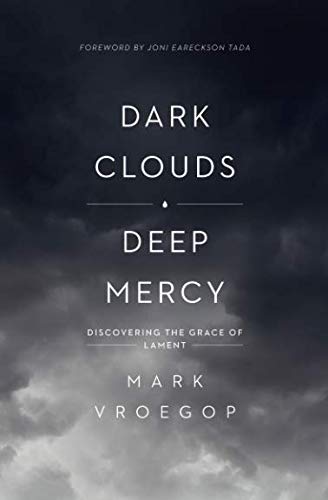
When tragedy strikes our lives, our churches, and our communities, we need a competent guide through the laments in the Bible, which are less familiar to most Christians than they should be. Take our diet of modern worship songs as an example. The book of Psalms is one-third lament, while the overwhelming majority of our modern worship songs are “positive and encouraging,” as one radio station boasts. Focusing on the upbeat in music and calling funeral services “a celebration of life,” are not necessarily wrong, but it does leave us impoverished. We also need to know how to grieve.
Dark Clouds, Deep Mercy has three sections: the first engages with four psalms of lament, the second with the book of Lamentations, and the final explores applications to individual and corporate life. The book has also discussion questions at the end of each chapter. Not only would it be a good book for preaching and worship pastors to read individually, but it’s also a good book for them to read together. Last fall at our church, we preached a 10-week series through the book of Job, and though Dark Clouds, Deep Mercy wasn’t published yet, I wish it had been so it could have better shaped not only our preaching but the whole worship service.
Learning the Meaning of Lament
There’s a famous joke from the show Seinfeld where George’s father creates the holiday Festivus, a foil to Christmas. Each year Festivus beings with the “airing of grievances.” Mr. Costanza bellows, “I got a lot of problems with you people! And now you’re gonna hear about it!” To the uninitiated, it can seem like biblical laments are like that, the mere ranting to God our pent-up anger and disappointment throughout the last year, a vomiting of emotions and a verbal shake of our fists. As Vroegop engages with four Psalms of lament in the first section of the book (Psalm 77, 10, 22, and 13, respectively), I gained a better understanding of what lament, biblically speaking, is and what it is not. And more importantly, the detailed discussion through each modeled how to make use of lament as an individual Christian and in the life of the church. Big surprise: it’s not the way of Festivus.
Biblical laments have, according to Vroegop, three key features. First, there is an address to the Lord. In this way laments are for believers, not those shouting to the void or an impersonal universe. Second, laments complain. The complaint might be overtly because of some sin, or it may be less clear why the tragedy struck, but regardless something has gone very wrong and the people of God aren’t going to pretend it’s okay. Finally, laments have an expression of trust or praise, sometimes both. When all the sawdust of a lament finally settles to the ground, a believer is still a believer because God is God. Often this expression of trust marks a turning point in the psalm. Appendix 4, entitled, “But, Yet, And,” traces a number of examples of this “turn” in various psalms. “In some cases,” Vroegop writes, “the specific word [but, yet, or and] is not present, but the tone of the sentence fits the purpose [of asking boldly or choosing to trust]” (209).
Like the book of Lamentations, Dark Clouds, Deep Mercy was also born out of tragedy. The Vroegops first experienced lament in the wake of a stillborn daughter and they later had other significant troubles during pregnancies. “Pain and fear mingled together in a jumbled torrent of emotion. . . . I wrestled with sadness that bored a hole in my chest,” he writes (17). My wife and I—and I’m sure many in your churches—know a little bit about this. You don’t forget that pale look on an ultrasound technician’s face when she says, “I’m going to grab the doctor,” on her way out the door. But it was in this season of sorrow that the Vroegop’s found solace in the Scripture. “The Bible gave voice to my pain. . . . I discovered a minor-key language for my suffering: lament” (17).
A Book for Those in Pain
Whenever I read a book about suffering, I find myself wondering about the author’s intended audience. Russ Ramsey, the author of Struck, another edifying book on suffering, has said there are two kinds of books on suffering. “There are books that you give to people who are interested in the subject, but not necessarily afflicted or suffering in the moment. And then there are books for people who are in the middle of suffering.”
Dark Clouds, Deep Mercy is more in the latter category, but it’s not the book you hand them on the way home from the funeral. The wounds are probably still too raw for this book. It seems to me that Dark Clouds, Deep Mercy is best given to someone when the steady delivery of meals from the church has stopped, when friends forget to check in, and when acute grief has dissipated but long-term grief still lingers. It is a good book for every pastor to read, but at some time or another, it will also be a book for most people in the pews.
* This book review originally appeared at 9Marks.
** Photo by Alex Plesovskich on Unsplash
We Are the Perpetual Resistance Movement: A Review of COMPETING SPECTACLES by Tony Reinke
A great book by one of my favorite authors.

As we discussed purity and parenting during a seminary class, Rob raised his hand from the back of the room. Our professor called on him. Rob said, “More than I want my daughter to not wear clothing that draws attention to her body, I want my daughter to want to not wear clothing that draws attention to her body. I want her to want the right things, not just do them.”
It was a formative moment in not only my seminary education but in my Christian maturation. Rob was on to something, and I wanted to be on to it too.
Tony Reinke’s new book Competing Spectacles: Treasuring Christ in a Media Age is a book to help us not only look at our smartphones less, but a book to help us want to look at them less by giving us something better to behold.
Competing Spectacles is a solid sequel to his book 12 Ways Your Phone Is Changing You (2017). In a culture of “viral moments competing for our attention,” Reinke explores how we can not only survive spiritually but even thrive (p. 13). “Few of us,” he writes, “have reckoned with the consequences of this tele-visual culture on our attention, our volition, our empathy, and our self-identity” (p. 33). But Reinke has reckoned with the consequences, and he relays them well—not in an alarmist, fear-mongering way but as a concerned friend and father.
Competing Spectacles has an uncommon structure. It’s one long essay broken into 33 mini-sections, which are separated into two parts, “The Age of the Spectacle” and “The Spectacle.” This structure might catch a few readers off guard, but he’s such a gifted writer that a 34,000-word essay isn’t as imposing as it might sound. Reinke is senior writer for Desiring God and author of several other books, The Joy Project (2018), John Newton on the Christian Life (2015), and Lit! A Christian Guide to Reading Books (2011). I’ve only done this for a few authors, but I make it a point to read (and in Reinke’s case, write reviews of) all his books.

“Spectacle” can mean different things. Spectacles are something we wear to help us see. But spectacles can also be what we see. This is the way Reinke uses spectacles throughout the book, spectacles as events. So, for example, each year the Super Bowl is a spectacle. The recent box-office hit Avengers: Endgame is a spectacle. The 2016 presidential election is a spectacle—actually the 2016 election had lots and lots of spectacles to it, something Reinke explores extensively in several sections of the book (especially “§9. Politics as Spectacle,” pp. 39–44).
But a local church worship service is also, by this definition, a spectacle. It’s a different spectacle, a smaller, less sexy spectacle than the latest Hollywood blockbuster or Adam Levine half-naked at half-time, but the gathering of the people of God is a spectacle nonetheless.
Competing Spectacles has tons of crispy writing, the kind of writing prevalent in Reinke’s other books. Just to give you a taste, he writes of the way “we never stop hungering for the Turkish delight-sized bites of digital scandal” (p. 56) and how the spectacle industry is a “gatling gun firing at us new media modules nonstop” (p. 150). That’s good writing! My favorite quote comes during his discussion of the spectacle of the local church. It’s a long quote, but read it slowly, perhaps even out loud.
Matched to the multi-million dollar CGI spectacles of Hollywood, the church’s interior spectacles seem dull. But they are beautiful and profound. Each week the local church reenacts the same things—Bible preaching, the Lord’s Table, water baptism—all of them faith-based, repeated, microspectacles (unlike the sight-based and unrepeated, expiring spectacles of the world). These church ordinances are weighted with cosmic influence. In Colossians and Ephesians, Paul is careful to show how the gospel-driven love and unity of local churches is a spectacle of the victory of Christ to the powers and principalities who seek to destroy God’s created order. The church is the perpetual resistance movement. And from generation to generation, she displays a spectacle of God’s victory to his cosmic foes, repeatedly striking those enemies with déjà vu of their defeat at the cross. (p. 101)
A few weeks ago, with as much passion as I could muster, I read this quote to our church. I might as well have been William Wallace on horseback with blue warpaint. “They may take our lives, but we are the perpetual resistance movement!”
For the first time in our 20-year church’s history, we enjoyed preaching, baptism, and the Lord’s Supper in the same worship service. We preach each week and have regular communion services, but we’ve always done our baptisms offsite in special services. We did this, in part, to mark baptisms off as special—they got their own service. But performing baptisms at another time than Sunday morning and in another location than our church building also meant we disconnected baptisms from the spectacle of a regular Sunday. Yet there is nothing, Reinke implies, regular about it at all. “From generation to generation, [local churches display] the spectacle of God’s victory to his cosmic foes.”
I want Christians to not only come to church each week but to want to come to church. And a big part of wanting to come to church regularly involves coming alive to the extraordinary reality of what happens on every ordinary Sunday in every ordinary local church.
If the local church is to become precious to us, another spectacle—the greatest spectacle—must first become precious to us: the spectacle of the cross of Jesus Christ. The cross is the heartbeat of Reinke’s book; it’s the central spectacle, both the theological center of the book and the geographic center of the book (e.g., the special attention the cross receives in section 17). He writes,
Into the spectacle-loving world, with all of its spectacle makers and spectacle-making industries, came the grandest Spectacle ever devised in the mind of God and brought about in world history—the cross of Christ. It is the hinge of history, the point of contact between BC and AD, where all time collides, where all human spectacles meet one unsurpassed, cosmic, divine spectacle. (p. 79)
Reinke’s book is not a book to get you to simply look at your phone less or watch media with a more critical eye. Competing Spectacles is a book to stoke your desire to want to behold something more than your screens; it’s a book, as the subtitle says, to help us treasure Christ in our media age. Channeling the famous quote by puritan Thomas Chalmers, Reinke writes, “The Christian’s battle in this media age can be won only by the expulsive power of a superior Spectacle” (p. 145).
* Photo by Barbara Provenzano on Unsplash
Related Posts

Dozens of Free Copies of My Audiobook: Don’t Just Send a Resume
Love to give away some of these!

I had no idea how difficult it would be to produce an audiobook. But then I tried.
It’s really, really difficult to read with excellence, even if you’re super familiar with the words because you wrote them!
I tried to narrate the audiobook for my “struggle” book that was recently published. After wasting a dozen hours of work and a thousand bucks, I abandoned the project and hired a pro. I hired David K. Martin to narrate the book for me. I hired David because he did such a great job on Don’t Just Send a Resume, my book to help pastors find the right job in a local church. Throughout the audiobook production process he’s been a consummate professional. For example, when I listened to an early, completed draft of the audiobook, I only found one error—one error in over six hours of audio! (By the way, David’s narration of my Struggle Against Porn book should be out later this summer.)
Just last week the audiobook of Don’t Just Send a Resume hit Amazon, Audible, and iTunes. But if you want a copy, you don’t have to buy one. I have a few dozen to give away. The only thing you have to do is send me a message (Facebook, Twitter, Instagram, or email: benjamin@fanandflame.com) so I can give you the code to download it.
The portion of the book we used for the audiobook’s sample comes from a section that I draw the title from. I’ve included that section below if you want to listen and read.
Again, if you’d like a copy, please send me a message. And if you know a pastor or someone in full-time ministry who might like a free copy, please send him or her this way!
* * *
Always Include a Short, Custom Cover Letter
It’s common to hear people talk of sending their resume to an employer. Never do this. Or I should say, never just send a resume.
Why? Because the cover letter, not the resume, is the leading edge of your job search. Merely sending a resume (at least in ministry) accomplishes little more than spamming a search committee. It’s lazy and rarely stands out from the stack. Sending a custom cover letter, however, shows you care. And pastors should care.

Many job search guides in the business world will tell you the primary focus is on the resume. I’ve been told that for many huge companies (think: Procter & Gamble and IBM), resumes are usually read before cover letters. Additionally, a resume might remain in large resume “banks” for recall. In these situations, some of the standard advice about resumes (like including key word optimization for enhanced searchability) makes sense.
But in ministry, things are different. The vast majority of churches will open a hiring process, complete a hiring process, and then throw everything away or save it for a year, then throw it away. This makes the process far more personal. Furthermore, churches don’t have a full-time HR person who spends his or her day scanning resumes. So when a church conducts a search, it will likely read or at least skim your cover letter first. So make it count.
Having said that, much of your cover letter can be boilerplate, meaning you can use most (but not all) of the verbiage with little to no modification. It should include the following descriptions:
this (briefly) is who I am;
this (briefly) is where I worked;
this is where I went to school;
this is where you can listen to my sermons (or watch videos of me leading worship);
this is what I’m passionate about and why you should hire me.
I won’t tell you exactly what to write, but stuff like this is expected and appropriate.
More than anything else, don’t make it generic. If everything in your cover letter could be sent to every church in America, then your cover letter will be underwhelming and most likely overlooked. Like a good sermon, letters have a particular audience in mind. Therefore, tailor at least one paragraph to demonstrate the following three things to the church.
First, demonstrate you actually read the job description. No job is exactly the same, even if they both share the title “youth pastor.” Someone, or likely several people, spent significant time wording the job description, and it will serve you well to show them you cared enough to read it closely. . .

Jumpstart Your Struggle Against Porn
Get a 10-day video series to help you struggle against porn.

Over the last 12 years of Christian ministry, I’ve had an abiding frustration—but perhaps the frustration will surprise you. Whether in college ministry or in a local church, I’ve often found myself meeting with guys who struggle with lust and pornography. And I go into these meetings wanting to be helpful, but I leave frustrated. But probably not for the reasons you think. My main frustration was me.
I’d want to share truth and hope and encouragement and strategies to win the war, but I’d flounder. I’m not sure I’d use the phrase “pastoral malpractice,” but that’s what it was starting to feel like.
Eventually this frustration gave rise to a few years of reading and writing and thinking about how to help men struggle against pornography. And out of the research came a short book. And out of the book has come this very short video series.
I call it “jumpstart,” because it’s not designed to fix everything about everything. But the ten, short videos are designed to reignite your pursuit of joy in God and purity. I’d love for you to check them out.
Also included with the videos is a free ebook called 50 Questions for Accountability Meetings, which gives you tons of questions to consider as you struggle against lust and pornography. [UPDATE: signup link has been removed; videos no longer available.]
* The video series is based off the book Struggle Against Porn: 29 Diagnostic Tests for Your Head and Heart (Amazon).

“Struggle...” Book Launches Today
Endorsements from Tim Challies, Drew Dyck, and Tim Chester.
Launching today—after three years of work—you can buy my book Struggle Against Porn: 29 Diagnostic Tests for Your Head and Heart (Amazon).
I wrote the book because many men struggle with porn but only a few struggle against it. And there’s a huge difference between the two. Through biblical reflection and more than one hundred questions for personal and group discussion, my goal in writing this book is to help men battle against sexual sin—to slay lust and cultivate love.
Below are the endorsements for the book. I’d love for you to consider buying a copy. Also, I put together a free video series and ebook to go with the book, which you can get here: jumpstart your struggle. [UPDATE: Jumpstart link has been removed; videos no longer available.]
* * *

“When I first began writing about pornography, many Christians were shocked to learn about not just the scope of the problem, but that the problem existed at all. Today, a decade later, the situation has changed radically and Christians may be so accustomed to hearing about pornography that we’ve almost come to accept it as normal. Yet pornography remains as dangerous and devastating as ever. For that reason I’m thankful for resources like this one that continue to combat this terrible plague.”
Tim Challies,
popular blogger at www.challies.com, co-founder of Cruciform Press, and author of several books including Sexual Detox: A Guide for Guys Who Are Sick of Porn
“Struggle Against Porn is a great blend of practical wisdom and gospel promises. The result is a book that will help you fight against porn while also giving you hope.”
Tim Chester,
pastor of Grace Church Boroughbridge, UK, a faculty member of Crosslands Training, and the author of over 40 books including Closing the Window: Steps to Living Porn Free
“The great Puritan theologian John Owen warned, ‘Be killing sin or it will be killing you.’ Struggling Against Porn is a serious, sin-killing book. Benjamin Vrbicek doesn’t tolerate the lackadaisical attitude so prevalent among Christian men who merely ‘struggle with’ porn. He wants to help them conquer it. By drawing our attention to core truths and practical instructions, Vrbicek has given us a battle plan for victory.”
Drew Dyck,
acquisitions editor at Moody Publishers, a senior editor at CTPastors.com, and author of several books
“Our enemy would have us do anything but look at Jesus. His seductive temptations are sinister, and we must be ready to combat them. Struggle Against Porn provides men with a raw, accessible, and insightful resource to help consider Gospel truths and how they apply to the daily battle for sexual purity.”
Garrett Kell,
lead pastor of Del Ray Baptist Church in Alexandria, Virginia and associate council member of The Gospel Coalition
“I’m thankful for this new resource from Benjamin—one of my favorite new Christian writers. Read deeply as you invest your life in pushing back the darkness of pornography, this great epidemic of our generation.”
Jeremy Linneman,
pastor of Trinity Community Church in Columbia, Missouri and the author of Life-Giving Groups

Next Week My Book “Struggle Against Porn” Launches
A book to help men struggle against—not with.
After a ton of research, writing, and re-writing (and then a lot more re-writing!), my book to help men struggle against pornography is finally ready to launch next week. The title is Struggle Against Porn: 29 Diagnostic Tests for Your Head and Heart.
I wrote the book because many men struggle with porn but only a few struggle against it. And there’s a huge difference between the two.
Look at it like this. If something were wrong with your car, you’d bring it into an auto shop for inspection. The first thing the mechanic would do is hook your car up to a computer for a diagnostic checkup. In a similar way, Struggle Against Porn is designed to be a diagnostic checkup for your head and your heart. Through biblical reflection and more than one hundred questions for personal and group discussion, my goal in writing this book is to help men battle against sexual sin—to slay lust and cultivate love.
Below is the table of contents. I’d love for you to consider buying a copy when it launches.
* * *
FOREWORD by Greg Strand
INTRODUCTION: AGAINST NOT WITH
PART I: FOUNDATIONS
1. “Verily, Verily, I Say unto Thee, Ye Must Be Born Again”
2. Believe Sexual Sin Is Wrong and Cultivate a Hatred of It
3. Fight for Superior Joys
4. Recognize the Grave Danger
5. Run like the Wind
6. Make It Personal: The Women Are Real Image Bearers
PART II: CROSS-TRAINING
7. Cultivate Humility
8. Plant the Bible in the Soil of Your Heart
9. Don’t Avoid Conflict; Engage It
10. Run from and Become Indifferent to Flattery
11. Be Intoxicated with Your Wife
12. Avoid “Dude Talk”
13. Cultivate the Fear of the Lord
PART III: THE NITTY-GRITTY
14. Stop (S-T-O-P!) Masturbating
15. Don’t Be Alone with Sexual Temptation
16. Pursue Deep, Gospel Friendships
17. Only Have Computers (Including Tablets and Smartphones) in Public Areas
18. Install Accountability Software on All Devices
19. Cut Off All Access to Sexually Stimulating Media
20. Know Your Situational and Emotional Triggers; Take Precautions Accordingly
21. Use Visual Smelling Salts to Resist Sexual Sin
22. Share the Existence of the Struggle with Your Wife
23. Go to Bed When Your Wife Goes to Bed
24. Communicate Your Sexual Needs to Your Wife
25. Treat the Sexual Needs of Your Wife as More Important Than Your Own
26. As Needed, Seek Professional Help
PART IV: A BRIGHT FUTURE
27. Become a Passionate Teacher and a Spiritual Father
28. Understand the Lord’s Discipline as His Training of the Sons He Dearly Loves
29. Whatever You Do, Don’t Stop Serving Jesus
CONCLUSION: ONE MAN, TWO STORIES
NOTES
* Photo by Tim Mossholder on Unsplash

Making the Faith Your Own Is not the Same as Making Up Your Own Faith
There’s a big difference.
A pastor told me how encouraging it is when, years later, former students return to tell him how they’ve made the “faith their own.” It’s a phrase he used to encourage students with, especially those near graduation.
But he also told me how discouraging it was when one particular student returned to tell how he had made the faith his own. As the former student described this thing he considered “the faith,” it became clear he had not made the faith his own but rather made up his own faith. There’s a big difference.
Over the Easter weekend, the New York Times ran an interview with Serene Jones, the president of Union Theological Seminary. In the first few paragraphs you realize she’s done the same thing. In the short interview, she uses the phrase “for me” five times, as well as several other similar statements, such as “I don’t believe” and “seems to me,” as in the sentence, “For Christians for whom the physical resurrection becomes a sort of obsession, that seems to me to be a pretty wobbly faith” (emphasis added).
In addition to rejecting the bodily resurrection of Christ, Jones also dismisses the reliability of the Bible, human depravity, the virgin birth, the substitutionary atonement of Jesus on the cross, and eternal bliss in the new heavens and new earth and eternal torment in hell.
When my friend retweeted the article, he said, “I have more in common with Islam than I do with the religion described as ‘Christianity’ in this interview.” That’s probably not hyperbole. Readers get the sense that if the interview kept going, no remaining doctrine of historic Christianity would have been left un-denounced.
At one point, Nicholas Kristof, who conducted the interview, asks, “For someone like myself who is drawn to Jesus’ teaching but doesn’t believe in the virgin birth or the physical resurrection, what am I? Am I a Christian?” Jones responds, “Well, you sound an awful lot like me, and I’m a Christian minister.”
That’s a fascinating response, to say the least. In what sense can people call themselves Christian ministers—or Christians for that matter—while holding no beliefs of the historic Christian faith?
In the New Testament, Jude wrote, “Beloved, although I was very eager to write to you about our common salvation, I found it necessary to write appealing to you to contend for the faith that was once for all delivered to the saints” (v. 3). Did you catch that? He speaks of “common salvation” and contending “for the faith that was once for all delivered to the saints.” Jude’s statement becomes meaningless if Christianity is infinitely malleable.
Words have meaning, and authors have intent. And Jones knows this. In one sentence she says, “At the heart of faith is mystery. God is beyond our knowing . . .” But she ends the paragraph saying, “I don’t worship an all-powerful, all-controlling omnipotent, omniscient being . . . That’s not the God of Easter.” So does the faith mean something or is it too mysterious to mean anything? Which is it?
When asked about what happens when we die, Jones responds, “I don’t know! There may be something, there may be nothing. My faith is not tied to some divine promise about the afterlife.” Did you notice another one of those “my faith” phrases? It all sounds so humble.

In his book Taking God at His Word, Kevin DeYoung writes about the infamous elephant metaphor for faith, the one where each person holds one part of the elephant, but because each is blindfolded, they don’t realize each holds the same thing. People often trot out the metaphor to explain how all religions are basically the same: some touch the elephant’s tail, others the side, and some the trunk. But if they all could only see, then they’d know that all religions are the same.
DeYoung disarms the faux-humility of religious pluralism that so often retreats to claims of mystery when there is no mystery. It isn’t actually humble, he notes, to profess agnosticism about what one is holding if the object you’re holding is shouting, “I’m an elephant.” That type of humility is better known as disobedience.
To be sure, there are aspects of mystery in the Christian faith, but the Christian faith cannot be all mystery or else there would be nothing to call “the Christian faith.” Moses wrote that “The secret things belong to the Lord our God, but the things that are revealed belong to us and to our children forever, that we may do all the words of this law” (Deuteronomy 29:29). There are secret things, and there are revealed things, but the faith once for all delivered is not a secret thing.
It was Eugene Peterson who described Christian faithfulness as a long obedience in the same direction. Serene Jones and Union Theological Seminary’s departure from the faith, however, are the result of a long disobedience in the same direction.
* Photo by Sutirta Budiman on Unsplash

Jesus Was Crucified at 9 am: Reflections on Good Friday
Reflections on the timeline and meaning of Good Friday.

The following are my notes for our church’s Good Friday Service. I hope these reflections bless you as we prepare our hearts for Easter.
* * *
Welcome
My name is Benjamin; I’m one of the teaching pastors here at Community Church. Welcome to our Good Friday Service. In just a moment we’ll formally begin our service. To prepare our hearts, please listen to our music team play a rendition of Psalm 88, which is a well-known Psalm of Lament. It’s an appropriate way to begin our Good Friday Service.
Song: “Can the Dead Rise Up to Praise?” (here)
Would you join me in prayer? “Dear Heavenly Father...”
In the early church, there was a young pastor named Timothy, who was called by the Lord to pastor a church in the ancient city of Ephesus. The Apostle Paul wrote two letters to Timothy that we have in our Bibles. In one of those letters, Paul told Timothy to “devote [himself] to the public reading of Scripture, to exhortation, to teaching” (1 Timothy 4:13). Each Sunday we do all three of these: we read Scripture, we exhort, we teach. But we often have more of the latter two (exhortation and teaching) than we do the reading of Scripture. So tonight we are going to major on the reading of Scripture, and I’m praying that the plain reading of Scripture would have its own way of exhorting and teaching us with the goal that our hearts might be strengthened by grace.
All ten of our Scripture readings tonight come from the gospel of Luke. The readings encompass the events that took place on Good Friday so many years ago. We are going to intersperse the readings of Scripture with songs, a few we’ll ask you to sing along with if you know them and a few the band will play over us as we listen and reflect. Before each cluster of readings, I’ll come forward to give a brief introduction to the readings. I’ll also venture a guess as to the “time stamp” of when each event took place throughout the Thursday night when Jesus was arrested and to Friday afternoon when Jesus died. Some of the times are exact because they are stated in the Gospels; other times are approximations based on what seems plausible. (I was helped by this article by Russ Ramsey.)
I’ll lead us in the first reading, which comes from Luke 22:47–53. This reading covers the betrayal and arrest of Jesus, which took place sometime in the late hours of Thursday night, so, perhaps something like 11:00 pm. Jesus, as you’ll see in the passage, refers to the following events as the beginning of an evil hour and “the power of darkness” (Luke 22:53)
Reading 1: Luke 22:47–53, Betrayal and Arrest of Jesus
Song: “How Deep the Father’s Love for Us”
After Jesus is arrested, he is beaten and mocked by soldiers. As well, religious leaders convene a council where Jesus is tried. All this takes place in the early morning hours of Good Friday, perhaps somewhere between 2:00 am and 6:00 am. Meanwhile, we’re also told that just as the sun is coming up, Peter denies knowing Jesus.
Reading 2: Luke 22:54–62, Peter Denies Jesus
Reading 3: Luke 22:63–65, Jesus Is Mocked
Reading 4: Luke 22:66–71, Jesus Before the Council
Song: “Oh God” by the Citizens
Now that the sun is up, the pace of the story quickens. Between 6:00 am and 8:00 am, Jesus appears before the Roman governor Pilate, and then the Judean ruler Herod Antipas, and then he goes back to Pilate where Jesus is sentenced to crucifixion. Between 8:00 am and 8:30 am, Jesus begins his march to Golgotha, which is an Aramaic word. Luke calls Golgotha by its translation: “The Place of the Skull,” likely so called because the rock formation looked like a skull and also because it was a place of execution and burial.
Weakened from his sleepless night, his beatings, and his flogging, Jesus is unable to carry his own cross, so a man name Simon is conscripted to carry the cross for him. We can’t be certain, but when you piece together what is said in Mark’s gospel with something that’s said in the book of Romans, it would seem that at least one of Simon’s sons and Simon’s wife became followers of Christ and even leaders in the early church (Mark 15:21 and Romans 16:13). We can’t know, but I’d love to think Simon became a believer in Jesus as well.
The crucifixion begins around 9:00 am. Over the next three hours, Jesus has a conversation with the criminals on the cross, and we do know for sure that one of those men becomes a believer, because Luke tells us so.
Reading 5: Luke 23:1–5, Jesus Before Pilate
Reading 6: Luke 23:6–17, Jesus Before Herod
Reading 7: Luke 23:18–25, Pilate Delivers Jesus to Be Crucified
Reading 8: Luke 23:26–43, The Crucifixion
Song: “Man of Sorrows”
After Jesus was on the cross for three hours, from 9:00 am until 12:00 noon, a strange darkness was over the land. Then, at 3:00 pm, in a loud voice, Jesus cries out to his father and gives up his spirit.
Sometime later that afternoon, as the sun sets—so perhaps around 5:00 pm—Luke tells us of a rebel, a wealthy religious leader named Joseph. Joseph did not consent to the condemnation of Jesus, as the other religious leaders did. Very bravely, Joseph requests permission to bury Jesus in a tomb.
In the Jewish reckoning of things, one day ends and a new day begins at nightfall, which means Good Friday comes to a close at sundown. But just before the sun goes down, Luke tells us a few women followed to see where Jesus is buried. Then they return home to prepare spices, which they intend to bring to the tomb in two days, after the Sabbath rest day and the celebration of Passover.
Reading 9: Luke 23:44–49, The Death of Jesus
Reading 10: Luke 23:50–56, Jesus Is Buried
Songs: “The Power of the Cross,” “There Is a Fountain,” and “Nothing but the Blood”
Closing Thoughts & Prayer
I don’t think it’s stealing the punchline from Sunday’s Easter sermon to tell you what happens. We know the story. The women never get to use the spices they prepared to place on his body. His body is gone.
Tonight we’ve been reading from Luke’s gospel, but it’s fair to say that the rest of the New Testament, in a way, is doing two main things: first, the New Testament gives us the interpretation of the events that took place on Good Friday and Easter. Through the life, death, and resurrection of Jesus, God was reconciling us to himself (2 Corinthians 5:18). Jesus bore the punishment we deserved and now—wonderfully—the perfect life of Christ is given to us. Through faith in Jesus, God now sees us as having the perfection of his Son.
The second thing the New Testament authors do is explain the implications of Good Friday for our lives, the life of the Church, and the future of the world. We certainly don’t have time to tease out all of the implications of the death and resurrection of Jesus. That will take our whole lives, indeed even our eternities.
But we should mention one implication. One implication of Good Friday and Easter is that believers in God do not grieve as those who have no hope, as Paul writes in 1 Thessalonians 4:13. We certainly grieve when a Christian who we love dies, and we certainly do the same on Good Friday.
Yes, we grieve the weight of our sin and the gravity of the cross of Christ. But Christians do not grieve on Good Friday as those who have no hope. We have great hope because the spices prepared for his burial were never used. And even so, when we die one day, our own tombs will not be our final place of rest. We will be with Jesus in paradise, just as Jesus promised the thief on the cross.
Join me in prayer, and then we’ll be dismissed. “Dear Heavenly Father...”
* Photo by Aaron Burdon on Unsplash

Did God Make the iPhone?
God aims to get all of the glory for all that he does.
The Evangelical Free Church of America (my church denomination) recently posted an excerpt from my book Don’t Just Send a Resume. The excerpt offers advice to pastors as they navigate the dicey conversation about compensation when interviewing with a church. In the post (and book), I make the statement:
The private nature and the potential misuse of money doesn’t negate its proper use. God made money, and though we tend to abuse it (just like sex, food, and exercise), God is not uncomfortable with the material world. He made it and called it good. So don’t shy away from talking about money in the final stages of a job search. Godly people can talk about money in godly ways.
In the comment section under the blog post, a man named Jay wrote:
Thanks for writing, Benjamin, and for publishing your work here for our benefit. I was surprised at your statement that “God made money.” Would you also ascribe cars, light bulbs, credit cards and other examples of human technology to God’s creative power?
My response to Jay was probably too long for a comment under a blog, but by itself it was a smidge too short to use as a blog post. So, I took my reply to Jay and expanded it here for us. I’d love to hear your thoughts on what I wrote. Have you ever thought about whether God made money and technology? Here’s what I think . . .
Great question, Jay. Thanks for asking it. I’m actually pondering my own sentence in deeper ways now that you’ve asked about it. I tend to think the answer to the question, Did God make technology? is both yes and no.
If there is a way to positively affirm that God “makes” technology, then I’m sure we’d both agree that God doesn’t make technology the same way he made Adam (and trees and stars and so on). The Bible has no “Let us make an iPhone.” And neither does God work at a Ford plant or in a cubical at Visa’s headquarters. Cars and credit cards—and I guess everything else—are made by people.
But in another sense, I do think the Scriptures teach that God is behind all human ingenuity. Every good and perfect gift, writes James, comes down from God (1:17). How many lives are saved through advances in medical technology? I know that every time I use Neosporin or get an MRI, I’m thankful to God for these good gifts. I recently went on a field trip with my daughter to the Civil War Museum here in Harrisburg, Pennsylvania, and I’m certainly thankful God has caused medical practices to improve from those days of ghastly limb amputation.
A verse that has also been helpful to me is Deuteronomy 8:18. Moses instructs God’s people, “You shall remember the Lord your God, for it is he who gives you power to get wealth...” Moses wants us to see God as the one behind our ability to make money. Another way to say this would be to say that God wants us to remember he is behind all “human” ingenuity and all “human” industry.
Here’s one other idea that I think is helpful. When Adam and Eve were in the garden before the fall, they were charged with caring for it. Have dominion over paradise and subdue it, God told them. Adam and Eve were to cultivate the raw, unformed aspects of Eden, in a comparable way to how God created and cultivated his creation in Genesis 1. But as soon as Adam and Eve used any tool other than their hands and fingernails to plant crops, or as soon as they made a knife to cut their food, couldn’t we call these tools, crude as they were, technologies?
I’m not saying that everything people make is good or that when good things are made, they are always made in ways that honor God. They are not. When certain people attempted to build a skyscraper to heaven so that they could make a name for themselves, God confused their languages as a judgment against them (Genesis 11). They “weaponized” their God-giving ingenuity and used it against their Creator.
We should look up at the night sky and say, “Look how awesome God is” because the heavens are his handiwork (Psalm 19). But we can also stand on the roof of the Empire State Building overlooking the sea of skyscrapers and say, “Look how awesome God is.” This is precisely what King Nebuchadnezzar did not do when he scanned the majesty of his kingdom. While his boastful words were still in his mouth, God judged Nebuchadnezzar for his refusal to see God’s sovereign hand behind the pomp of the kingdom (Daniel 4:28ff).
God aims to get all of his glory for all that he has done, which is why it’s important for us to see God’s role in “making” things he doesn’t directly make. “For from him and through him and to him,” the Apostle Paul writes, “are all things. To him be glory forever” (Romans 11:36).
* Photo by Edgar Chaparro on Unsplash

My Heart Is Full: A Miniature Memoir after Five Years of Ministry
A few reflections on pastoring at our church for five years.

John Piper has said that “God will hide from you much of your fruit [from your ministry efforts]. You will see enough to be assured of his blessing, but not so much as to think you could live without it” (The Supremacy of God in Preaching, 25).
I’ve found this to be true. I hear enough encouragement in ministry that I don’t want to quit—most of the time. But I don’t tend to hear so much encouragement as to become proud—at least I hope I haven’t become proud.
But the receiving of encouragement is not always so balanced of a thing in the short run. It’s a lot like gaining and losing weight. When you are, on the whole, losing weight, you still gain weight each time you eat, even if the total calories you burn create a weekly deficit. And when, on the whole, you’re gaining weight, each time you exercise or do any movement, or make no movement as you sleep, your body burns calories. Encouragement and discouragement in ministry are like that, something in constant flux.
It’s fair to say that encouragement didn’t come my way often when I first arrived at my current church five years ago. Early on, I never really wanted to leave, nor did I feel like anyone especially wanted me to leave. But I sort of had this sense that if I did leave, no one would miss me too much. People didn’t love or hate my pastoring; they seemed indifferent. That might be overstating things, but it’s how I felt.
I’m not sure of all the reasons I perceived these feelings of indifference. In hindsight, I believe the largest contributing factor was my change in role. At my former church, encouragement dripped into my inbox like it was hooked up to an IV bag, and the encouragement was broad and steady.
But at my last church, I was an associate teaching pastor not a senior teaching pastor. Church members seem to like rooting for an associate pastor, especially if he’s trying hard and improving. I’d preach an okay-ish sermon one week, but then a few months later I might preach a sermon that was a little better than just okay. People would let me know ways I had improved. They’d show me notes they took during the sermon. Then, eventually, I’d preach a few sermons that could almost be considered good, at least by associate pastor standards. A few times near the end I might have even preached well. That was fun. Again, the congregation rooted for me. Who doesn’t want an underdog to win?
When five years ago I came to Community Evangelical Free Church no longer an associate teaching pastor but a senior teaching pastor, someone also pulled the IV out of my inbox. It’s not that anyone ever said this outright, but it almost felt like people were thinking, Hey, you’re a senior teaching pastor now; we sort of expect your sermons to be good, and the same goes for your counseling, discipleship, Bible knowledge, administration, and everything else you do.
For whatever deficit of encouragement there was in the first few years—whether it was an actual deficit or it was just perception, only the Lord knows—I certainly know now that my church is rooting for me. Last weekend my church gave me a big dose of encouragement as we celebrated my five-year anniversary. A few members of the original search team, staff, elders, my small group, and a few other friends, gave up an evening to share ways that my wife and I have blessed them through our ministry here. They even prayed over us. My heart is full.
In one note, a dear friend wrote,
I see you in the trenches week in and week out wrestling with the Scriptures, honing your preaching craft, writing for the edification of God’s people, centering (and re-centering) your work, ministry, and family on the gospel. . . . Over the last five years you’ve made gospel-centeredness tangible.
That note and the other notes hold more life-giving encouragement than I feel comfortable sharing here. I don’t want my reflections to be considered self-serving. But one thing stood out as people around the room shared: the wide cross-section of life that pastoral ministry occupies. For one couple, I had officiated the weddings of two of their daughters. For another couple, I had visited them in the hospital while they sat beside the bed of a dying parent, once for a father and once for a mother. I had also prayed with new mothers and fathers in hospitals when their children were born. With others, we’d shared tears and prayers and pans of brownies in homes during countless small group meetings. And all of them had endured my preaching. Speaking of preaching . . .
My best friend, Mike, had a raffle of sorts to see who could guess how many sermons I had preached in the last five years. My co-pastor and I alternate preaching, so it wasn’t difficult to do a little math and make a decent guess. My guess didn’t count, but I thought it might have been around 110, which turned out to be a little high. In a few seasons, like last year when we renovated a building, my preaching frequency slowed a bit. The answer was 104 sermons in the last five years, which amounts to something like 400,000 words. That’s a lot of words.
Do you remember those arcade games with a mechanical bar that slides back and forth, continually nudging a huge stack of coins resting on a shelf? You play the game by dropping in coins and hoping the mechanical bar will nudge the stack in such a way that some eventually fall off the ledge. That’s often how I think about preaching and pastoral ministry. Preaching is a series of tiny nudges. There are the granular nudges in 400,000 individual words and the aggregate nudges in 104 completed sermons. With most nudges, nothing seems to happen. So in faith you reload again. And again. And again.
But then sometimes the nudges connect. Change happens. People are helped and healed. I’m thankful my church cared enough about me to show me the fruit from a few of my ministry nudges.
My heart is full.
* Photo by Amanda Herrold Photography

HUMBLE CALVINISM by J. A. Medders (FAN AND FLAME Book Reviews)
An accessible and punchy book about how knowing God’s initiative in salvation should keep his children humble.
Nine years ago I was searching for my first job in pastoral ministry. During the interview process with one local church—the church that would eventually hire me—they asked that I fill out an in-depth questionnaire. It had questions about my family, education, and hobbies. There was also a meaty theological section that began by asking, “How do you associate with Calvinism or Arminianism?”
My full answer was a bit longer, but here’s some of what I wrote:
I think the first thing I’d say to a random Christian asking me about Calvinism or Arminianism, would go something like, “I think I know what I mean by those terms, but what do you mean when you use them?” In my experience people often have a very unsavory connotation of whichever side they do not espouse to the extent that the other position becomes a caricature that proponents do not hold themselves. However, if what you describe in your Teaching Doctrinal Statement is what you believe Calvinism to be, I’m totally on board. . .

One of the things that caused me to appreciate this church was not just their theological precision but their humility. Members who joined the church did not have to embrace, or even understand, this thing called Calvinism. It was only the Bible teachers, staff, and elders who needed to agree to teach in concert with the doctrinal statement. And yet, they cared enough to take the time to write everything out so that prospective members (and prospective staff pastors) could know what they were getting into when they joined.
Well, I’m rambling a bit, but this combination of theological precision and humble posture do not go together as often as they should. This is one reason I liked J.A. Medder’s new book, Humble Calvinism: If I Know the Five Points, but Have Not Love . . . Medders is a pastor in Texas at Redeemer Church. He’s also the author of Gospel Formed and co-author of Rooted. If his name sounds familiar to readers of this blog, perhaps it’s because I’ve written about him a few times. He’s one of the twelve contributors to my recent book Don’t Just Send a Resume, and he hosts Home Row, one of my favorite podcasts about writing.
“We don’t need less Calvinism,” Medder’s writes early in the book, “we need more real Calvinism” (p. 27). I agree. Calvinism, which holds to a high view of God’s sovereignty, especially in salvation, ought to produce the most humble of Christians. You can’t rightly claim you were a wretch when God did everything necessary to save you while simultaneously having a boastful smirk and a cocky swagger. It sometimes does happen, but it shouldn’t happen. In fact, I’m sure several people reading this post have been hurt by Christians who espoused Calvinism but did so with such arrogance that you’ve been turned off the topic ever since. “Many of us who claim to love the ‘doctrines of grace,’” Medders writes, “have not grown in showing grace. We have not become more gracious, kind, tender, and compassionate. And that can only mean one thing: we actually don’t know the doctrines of grace” (p. 17).
But others reading this review might be thinking, “Wait—I don’t really know what Calvinism is. Neither do I know the ‘five points’ mentioned in the subtitle.” To this, I’ll say that Medders does of faithful job of bringing readers up to speed. After the introduction there is a short section that covers historical background and definition of terms. In the rest of the book, Medders unpacks each of the five points of Calvinism (often identified by the acronym TULIP) and how each point should produce meek not malicious Christians.
As someone who has read a number of books on this topic, let me also say how enjoyable Medders made his book, which is not easy to do when explaining theology; his sentences snap, crackle, and pop. For example, he writes of those who wield their Calvinism like a lead pipe; getting his first whiff of TULIP; making theological taxidermy a hobby; and predestination as the prequel of our faith in Christ (pp. 19, 43, 45, and 77).
Humble Calvinism is a helpful book for those trying for the first time to understand the Calvinistic view of God’s sovereignty in salvation. And it’s also a convicting book for pastors like me who need to be reminded that if our understanding of Calvinism—or any other doctrine—produces in us arrogance, then we haven’t learned the doctrine as we ought.
Related Posts


To Spank or not to Spank? We Do
If you’re going to spank your children, make sure you do these 13 things—or don’t spank at all.
I’ll say at the start of this that my wife and I spank our children.
But in this post I’m not going to begin with 10 minutes of throat clearing—you know, all that introductory stuff to make sure we are all starting on the same page. I’m just going to assume that the reader knows that when I say spank, I don’t mean beat. And I’m going to assume that the reader knows when I say spank, I don’t mean it’s the only way to discipline or even the best in every circumstance. I have never beat my children, and we have used many other methods of discipline in addition to spanking.
My wife and I have six children, so we’ve been thinking about this for a long time. But I’ve especially been thinking about it over the last few weeks. This year I’m officiating the weddings of five young couples, and during premarital counseling when we discuss the disciplining of children, it’s fair to say that most, if not all, seem moderately or strongly opposed to it. This trend has proved true for most of the last dozen engaged couples who have sat in our living room to talk about raising children (and budgeting and intimacy and for richer and for poorer).
The other thing that got me thinking about it was a humorous and somewhat odd sermon intro by pastor Matt Chandler (“That Which Satisfies” on John 6:22–71, preached March 3, 2019). While he tells a story of disciplining his own children, you can almost feel how the congregation seems both humored and uncomfortable. At one point, Chandler momentarily breaks from his story to say something like, “I know you don’t spank your kids, but we do.” Apparently, I’m not the only one hanging onto a method of discipline that’s going out of style—or one that has already long gone out of style.
Yet this post isn’t part of my crusade to get you to spank your children. I’ve never written about this before and don’t plan to do it again. I certainly don’t want to be another polemical voice in the already overly opinionated milieu of Christian child-rearing. Instead, I’d like to talk about how parents can spank their children rightly. In other words, if you’re already open to the idea of spanking—or perhaps already doing it—then I’d love to offer some thoughts about how to and how not to proceed.
The Bible doesn’t say much about spanking. The modern Proverb about spoiling a child by sparing the rod isn’t actually in the Bible. Although Proverbs does say these things:
Whoever spares the rod hates his son,
but he who loves him is diligent to discipline him (13:24)Folly is bound up in the heart of a child,
but the rod of discipline drives it far from him. (22:15)
I don’t want to quibble with anyone about whether “rod” should be understood literally or if it’s a metaphor for discipline of another kind. Again, I’m simply trying to help those already walking a certain path to stay on that path in a way that honors God.
So, here are 13 thoughts about what would and would not help to make spanking most effective and honoring to the Lord.
1. A Calm Mom or Dad
Don’t spank in anger. If the child’s disobedience is causing you to react poorly, you probably should have spanked (or disciplined in some other way) long before you did.
2. A Spoon is Better than a Hand
My suggestion is that you use a wooden spoon or plastic spatula rather than your hand. This suggestion has little to do with how it feels to be spanked with either item. I think using a spoon is better than using your hand because, over time, it seems wise to have something else do the spanking that isn’t so closely tied to you. You can put a spoon away in a drawer or diaper bag, but your hand is always with you.
3. Spank Only for Willful Disobedience
Don’t spank a little kid for making the sorts of mistakes little kids tend to make. If a kid spills a drink at dinner, that doesn’t call for a spanking. But if a kid looks at Mom and yells, “NOOO!!” when asked to pick up toys, that does call for a spanking. Related to this point of “little kids being little kids,” if your child throws a temper tantrum because you went on vacation and kept the little guy up way past his bedtime for days on end, that’s not something to spank about either. That tantrum is on us, the parents.
4. Spank Away from the Presence of Others
Don’t spank a child in front of her siblings, friends, or other company. The point is not to humiliate.
5. Spank on the Child’s Bottom
If the child is very young, say 18 months, you can do it lightly on the hand. Otherwise only spank on the bottom. You don’t want a child fearful about what part of his body will receive the spanking. The punishment should be a procedure known to the child not something fearfully erratic.
6. Explain Why You Are Spanking
If a police officer gave me a traffic ticket, which has happened a few times, the officer has always made it clear what law (or laws) I violated. The same should be true of spanking. Children need to know what they did wrong. This is true with all methods of discipline.
7. Seek to Draw out an Apology
Related to making sure a child knows what he did wrong, explain the need to repent verbally and apologize to those sinned against.
8. Tailor Discipline to the Child’s Temperament and Age
A child might go through a season of disobedience where she needs a few spankings every week. But that should be very rare. And some children, because of their tender disposition, shouldn’t get but a few spankings the entire time they grow up. Know your child. When it comes to age, I’d say 18-months old to 6-years old is a decent window, though you might go a bit longer. But don’t spank a 12-year old, or a 12-month old for that matter. A friend mentioned something helpful to me about this. He encouraged me that if the child is violently resisting the spanking, then it’s not the time to do it. Wait for things to calm down. Traumatization is not the effect we’re aiming for.
9. Make Spanking Consistent
Children should not be surprised that a certain action resulted in a spanking, and when you do spank, they should be consistently done. Avoid being random and erratic. Don’t ratchet up the physical force for a greater offense. Also, spanking shouldn’t be the thing that only Dad does (or only Mom does). This pits children against certain parents and each parent against each other. In a blended family, more thought might be needed here, as sometimes it can be best for the biological parent of the child to do the more difficult disciplining, at least at first.
10. Give Only One Warning
Don’t threaten with a spanking if you don’t intend to follow through. If you warn a child sixteen times before a spanking, you’ll certainly be teaching but not what you should be teaching. And whether you spank or not, please don’t ever “count to three” slowly to get a child to obey. ONNNNEEE... pick up that toy... I mean it... TWOOOO... just bend over and pick it up... TWOOOO AND A HALFFFFF... Don’t make me have to spank you because here comes number three... This just teaches delayed obedience, which is also known as prolonged disobedience.
11. Reaffirm Love and Show Affection
When the spanking is over, it’s over—all of it. Hug your child and remind her how deeply you love her.
12. Apologize to Your Child When You Get it Wrong
A Dad who never repents is a terrible lesson to teach. No parent is perfect. It’s not if but when you’ll need to apologize to a child. The apology should be done privately, as with the spankings, but your apology should also be done publicly because likely others in the house heard the commotion. Public sin should have a public repentance.
13. Take the Long View
Big problems are not typically fixed in one afternoon. Consistent love and discipline (of whatever method) over the life of the child is what shapes the child’s heart and character.
Let me know in the comments what I’m missing.
* Photo by Xavier Mouton Photographie on Unsplash
A reminder that Christian ministry must always be about Christ.