
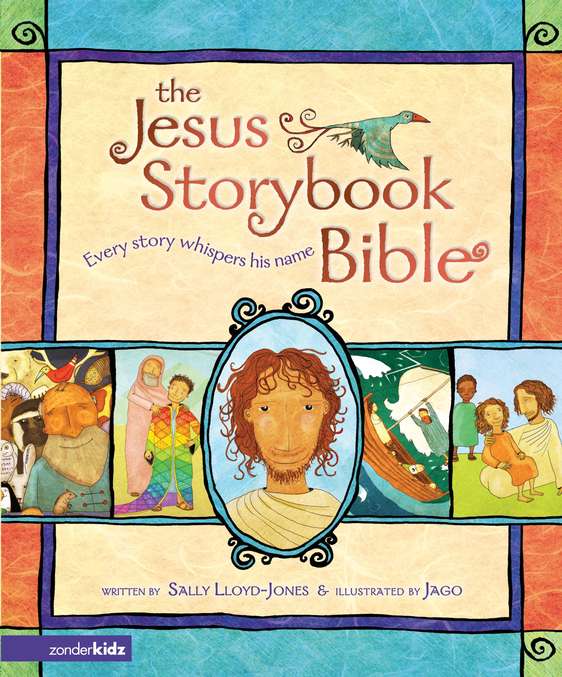
THE JESUS STORYBOOK BIBLE by Sally Lloyd-Jones (FAN AND FLAME Book Reviews)
A book review of The Jesus Storybook Bible by Sally Lloyd-Jones . . . well, it’s not really a book review; it’s probably better, but you’ll see that as you read.
Sally Lloyd-Jones (Author), Jago (Illustrator). The Jesus Storybook Bible: Every Story Whispers His Name. Grand Rapids, Michigan: Zondervan, 2007. 352 pp. $17.99.
My children and I love Disney-Pixar movies. We’re not alone. Probably half a billion people across the world feel the same.

The brilliance of the these movies—movies such as Toy Story (which I know is now 20 years old) or more recently Up (2009), or even more recently, Big Hero 6 (2014)—is the way the producers craft the story to engage both children and adults without alienating one or the other.
The Jesus Storybook Bible by Sally Lloyd-Jones has this same brilliance. Whether you have been a Christian for many years or you are just being acquainted with the faith, it would be a great resource for you. Oh, the children you know will love it, too.
The rest of this “book review” is not really a review at all. It’s a modified version of an email I recently wrote to a friend. Let’s call her Sarah.
Backstory: My wife and I met Sarah a few months ago. We had a great conversation with her about the Bible. As the conversation went on, we realized that Sarah didn’t really know much about Christianity, and what she did know—as is true of so many people I meet—was all wrong.
Sarah had assumed the Bible was, as Lloyd-Jones writes, “a book of rules, telling you what you should and shouldn’t do.” So, I asked Sarah if we could send her a book to help her get a better sense of what the Bible is really about.
She said, “Sure.”
But before the book arrived, I sent Sarah the below email to explain why I would send a children’s Bible to an educated, non-Christian adult.
* * *
Sarah,
Thanks for emailing! Apparently, I’m slow at responding. Sorry.
Okay, so here’s the deal on the book we were talking about. I just ordered it, and it should get to you in a day or two. However, let me give you a heads up so that you are not confused when it arrives. I’m sending you a children’s Bible. Yes, you read that correctly. It even has tons of pictures!
I hope you chuckle at that and are not offended. I know you are very intelligent and educated. The children’s Bible I’m sending, though, is actually not your typical Bible for kiddos. It’s actually very, very good, and it’s very well written. In fact, I have used it many times with adults at my church and they have appreciated it each time. (It’s also, by the way, the Bible we read as a family, and even though I’m a pastor and very familiar with the Bible, I often get a lot out of it, too.)
Anyway, the main reason I’m sending this book is because it’s the best resource I know for capturing the overarching narrative of the actual Bible, namely, a story about a rescue mission to broken people, not mainly a collection of stories designed to teach morals. There is a huge difference.
One of the phrases that the author (Sally Lloyd-Jones) uses repeatedly to describe God’s love is, “Never Stopping, Never Giving Up, Unbreaking, Always and Forever Love.” I think that’s a pretty good description of one of the main themes of the real Bible.
As you and I discussed in person, the Bible is a BIG book, and it tends to overwhelm most people, at least at first. Reading this could be a helpful way to investigate Christianity in a few hours without having to slog through the whole Bible—of course, I’m a proponent of reading the Bible straight up, 100-proof style . . . but maybe not yet. Or maybe next? If so, I can help start you on that process, as well.
Again, I hope you chuckle and are not offended with my selection. Thanks for emailing. Now I’m back to work.
Thanks,
Benjamin
Benjamin Vrbicek | Teaching Pastor
Community Evangelical Free Church

My Inner Curmudgeon and The SpongeBob SquarePants Game of Life
I try not to gripe about anything and everything. But there’s an aspect of The Game of Life that drives me nuts.
I try to not to be a curmudgeon. Really, I do. Some authors fuel their blogs with nothing more than their “Inner Curmudgeon.” Like cars without gas, their blogs would cease to run without him.
I, however, show restraint—most of the time.
Last spring, my annoyance with the television show The Bachelor oozed out here. Today, I’m afraid my Curmudgeon spills out again. This time it’s directed at The Game of Life.
Over Christmas, my daughter was given the game. Don’t get me wrong; I’m not at all mad at the person who gave it. In fact, we enjoyed playing it together as a family. And besides being fun, the game teaches many helpful life skills.

PICTURE OF MY WIFE’S CAR. Apparently, after 4 kids, one has to ride on the roof.
There’s an aspect of the game, however, that drives me nuts. You’ll have to read my letter to the Consumer Affairs Department of Hasbro Games to find out what bothers me.
It’s not the best example of evangelism and, I’m not sure I’d send it again, but with only a little updating, I attached (below) the letter I wrote to them in the summer of 2006 after my Inner Curmudgeon was poked by The SpongeBob SquarePants Edition of The Game of Life.
(By the way, Hasbro Games did write back. They sent a form letter thanking me for the feedback.)
* * *
Hasbro Games, Consumer Affairs Department
PO Box 200
Pawtucket, RI 02862
Re: THE GAME OF LIFE in Bikini Bottom, SpongeBob SquarePants Edition
Dear Consumer Affairs Department:
Over Memorial Day weekend, my wife and I went to visit my family in Chicago. My little sister Katelyn (nine years old), asked me to join her in some board games. One of the games we played was The SpongeBob SquarePants Game of Life.
Because I noticed in the instruction booklet that it states that you would be “happy to hear any comments about the game,” I thought I would send a few.
I can appreciate some of the life skills that your board game teaches children, such as budgeting, making mortgage payments, dealing with unexpected expenses, and the importance of a college education. However, I did not appreciate the outlook promoted by the game, specifically what constitutes a “successful life.”
In explaining how a player wins the game, the back page of the instruction booklet reads,
After all players have reached the Shady Shoals Rest Home, cash out . . . . The player with the highest net worth wins! [Online here]
The question I want to ask is whether this the right worldview to portray how the real game of life is “won”? Are the biggest winners in life those who store up as much wealth and property and possessions and net worth before they “kick back and relax at the Shady Shoals Rest Home”?
I don’t think it is. Some of the richest people in the world are miserable. The person with the biggest house, most toys, and largest bank account can still miss the whole point of existence, thus not win the real game of life, but lose.
While I don’t expect this letter to represent a majority, I simply urge the one or two people who will read this letter to not throw it out without reflection. Real life is no game. We are only given one chance and we must decide whether or not life consists in the abundance of our possessions. I believe that life is more than amassing a large net worth.
Consider the weighty implications of the question that Jesus once posed: “What good will it be for a man if he gains the whole world, yet forfeits his soul?” (Matthew 16:26). In other words, if a person arrives at Shady Shoals Rest Home with the highest net worth, yet missed the whole point of existence, what does he or she gain?
The answer to the rhetorical question is, “Nothing.” It is no advantage to gain as much stuff as possible only to have death rip it from one’s hands.
As an alternative way to go about things, Jesus taught,
Do not store up for yourselves treasures on earth, where moth and rust destroy, and where thieves break in and steal. Store up for yourselves treasures in heaven, where moth and rust do not destroy, and where thieves do not break in and steal. (Matthew 6:19-20)
We store up “treasures in heaven” not by climbing the corporate ladder or keeping up with the Joneses but by receiving Jesus Christ as our treasure. And for those who do this, their treasure will never be taken away.
Again, I understand that every board game must have a way for people to “win.” My encouragement is that you broaden your understanding of how winning is measured.
Sincerely,
Benjamin Vrbicek

Reading List 2015
I’m not sure if readers love them, but I read enough blogs to know that bloggers love to create them: End-of-the-Year Lists. This is my contribution: The list of books I read in 2015.
For the last three years, I have tracked every book that I’ve read. My goal has been to read 52 a year—about 1 a week. If for no other reason than accountability, I publish the list at the end of the year on my blog. Often, I need this kind of pressure to perform.
So, in 2013, I read 34 books. In 2014, I read 50 (list here). This year, 51!
To be sure, this makes it look like things are trending in the right direction (34 -> 50 -> 51). And in some ways, they are. If you measure 2015 by the total number of pages, however, I’m actually down a bit. Last year I averaged 251 pages a week, whereas this year I only averaged 218, which amounts to approximately 2,000 missing pages.
This leads me to the first of 5 (brief) comments before I share my list.
First, reading a total of 51 books, which is just 1 short of the goal of 52, on the one hand, is not at all a big deal. On the other hand, it actually stings quite a bit. Here’s the reason: if you look at my list, the book that I want to re-read every year didn’t make it—the Bible is missing.
I did, of course, read a lot of the Bible, but on my list I only count “completed” books. As of this morning (12/31/15), I’m in John 20. Thus, I feel as though presenting my list is like displaying a huge puzzle that’s missing the most important piece—a piece that’s exactly 2,000 pages. Next year, by the grace of God, I hope to fix this. Please hold me accountable.
Second, this year I read more novels than ever before in my life. There were 8 that came from our church book club, which I helped lead. Another 3 came from The Chronicles of Narnia series by C.S. Lewis. These I read aloud to my family. Both the book club and the family reading time were rich additions to life.
Third, there’s lots of Timothy Keller on the list: 6 books and 12.5% of the total pages, to be exact. He’s such a helpful writer. If you’re not familiar with Keller, his prose is very simple but the ideas are profound.

Fig. 1. 5-week Rolling average of my reading in 2015.
Fourth, as you can see from the chart (above), it looks as though I read the most books in the fall and the least in the late spring. I’m not sure what that tells me, except this: (Next year) after Easter, don’t slow down!
Finally, because people ask (and because it seems this like what bloggers often talk about), my 2 favorite books of the year were What Does the Bible Really Teach about Homosexuality? by Kevin DeYoung (which I talk about here), and The Sense of Style: The Thinking Person’s Guide to Writing in the 21st Century by Steven Pinker. They were very different books, but each is excellent in its own way.
Without further ado, here’s my book list in the order I completed them…
* * *
Reading List 2015
Is God anti-gay? (Questions Christians Ask) by Sam Allberry (88 pages) [READ MY REVIEW]
Washed and Waiting: Reflections on Christian Faithfulness and Homosexuality by Wesley Hill (160 pages) [READ MY REVIEW]
Burning Hearts: Preaching to the Affections by Josh Moody, Robin Weekes (144 pages) [READ MY REVIEW]
The Lion, the Witch and the Wardrobe by C.S. Lewis (200 pages)
Evangelical Convictions: A Theological Exposition of the Statement of Faith of the EFCA by EFCA Spiritual Heritage Committee (321 pages)
The Christian Atheist: Believing in God but Living As If He Doesn’t Exist by Craig Groeschel (256 pages)
A Man After God’s Own Heart: Devoting Your Life to What Really Matters by Jim George (272 pages)
The Great Gatsby by F. Scott Fitzgerald (180 pages)
The Life You’ve Always Wanted by John Ortberg (288 pages)
The Freedom of Self Forgetfulness: The Path to True Christian Joy by Timothy Keller (48 pages)
Affirming the Apostles’ Creed by J.I. Packer (160 pages)
Of Mice and Men by John Steinbeck (112 pages)
Prince Caspian by C.S. Lewis (200 pages)
Who is Jesus? by Greg Gilbert (144 pages) [READ MY REVIEW]
The End of the Affair by Graham Greene (192 pages)
What Does the Bible Really Teach about Homosexuality? by Kevin DeYoung (160 pages) [READ MY REVIEW]
Porn-Again Christian: A Frank Discussion on Pornography and Masturbation by Mark Driscoll (56 pages)
The Word Became Fresh: How to Preach from Old Testament Narrative Texts by Dale Ralph Davis (160 pages) [READ MY REVIEW]
Taking God At His Word: Why the Bible Is Knowable, Necessary, and Enough, and What That Means for You and Me by Kevin DeYoung (144 pages) [READ MY REVIEW]
Just Do Something: A Liberating Approach to Finding God’s Will by Kevin DeYoung (144 pages)
The Hole in Our Holiness: Filling the Gap between Gospel Passion and the Pursuit of Godliness by Kevin DeYoung (160 pages)
Heart of Darkness by Joseph Conrad (72 pages)
Themelios, An International Journal for Students and Religious Studies (Vol. 40, issue 1; April 2015) by Carson, D.A., and Others (Editors) (196 pages)
A Time to Embrace: Same-Sex Relationships in Religion, Law, and Politics, 2nd edition by William Stacy Johnson (390 pages)
God and the Gay Christian: The Biblical Case in Support of Same-Sex Relationships by Matthew Vines (224 pages)
God and the Gay Christian? A Response to Matthew Vines by Albert Mohler, Jr. (Editor) (96 pages)
Misreading Scripture with Western Eyes: Removing Cultural Blinders to Better Understand the Bible by E. Randolph Richards, Brandon J. O’Brien (240 pages)
As I Lay Dying by William Faulkner (267 pages)
The Reason for God: Belief in an Age of Skepticism by Timothy Keller (310 pages)
The Old Songs by Fred Burton (220 pages)
Counterfeit Gods: The Empty Promises of Money, Sex, and Power, and the Only Hope that Matters by Timothy Keller (256 pages)
Judges For You: For Reading, For Feeding, For Leading (God’s Word for You) by Timothy Keller (224 pages)
Judges: Such a Great Salvation by Dale Ralph Davis (240 pages)
Book Launch: How to Write, Market & Publish Your First Bestseller in Three Months or Less AND Use it to Start and Grow a Six Figure Business by Chandler Bolt (172 pages)
4 (short) eBooks by various authors (100 pages)
The Joy Project: A True Story of Inescapable Happiness by Tony Reinke (148 pages) [READ MY REVIEW]
The Sense of Style: The Thinking Person’s Guide to Writing in the 21st Century by Steven Pinker (368 pages)
Newton on the Christian Life: To Live Is Christ by Tony Reinke (288 pages) [READ MY REVIEW]
Peace Like a River by Leif Enger (320 pages)
Moving On, Moving Forward: A Guide for Pastors in Transition by Michael J. Anthony, Mick Boersma (304 pages)
What Color Is Your Parachute? 2016: A Practical Manual for Job-Hunters and Career-Changers by Richard N. Bolles (368 pages)
Jayber Crow by Wendell Berry (384 pages)
How to Read a Book: The Classic Guide to Intelligent Reading by Mortimer J. Adler, Charles Van Doren (426 pages)
Galatians for You: For Reading, for Feeding, for Leading by Timothy Keller (208 pages)
Crucial Conversations Tools for Talking When Stakes Are High, Second Edition by Kerry Patterson, Joseph Grenny, Ron McMillan, Al Switzler (272 pages)
Pride and Prejudice by Jane Austen (278 pages)
The Meaning of Marriage: Facing the Complexities of Commitment with the Wisdom of God by Timothy Keller (352 pages)
Best Wedding Meditations: An Anthology by various authors (71 pages)
The Voyage of the Dawn Treader by C.S. Lewis (200 pages)
Duel in the Sun: Alberto Salazar, Dick Beardsley, and America’s Greatest Marathon by John Brant (256 pages)
Sacred Marriage: What If God Designed Marriage to Make Us Holy More Than to Make Us Happy by Gary Thomas (304 pages)
RELATED






Don’t Be Shy About or Afraid to Talk About Money
Recently, I’ve been posting some tips to help pastors find the right job in a local church. This post is a continuation of the series. It’s about why you shouldn’t be shy or afraid to talk about money during the hiring process.
Recently, I’ve been posting some tips to help pastors find the right job in a local church. This post is a continuation of the series. It’s about why you shouldn’t be shy or afraid to talk about money during the hiring process.
* * *
The Bible is replete with stories of those ensnared by the power of money.
Consider the famous Levite in Judges 17-18. “Young man, do you want a better preaching gig?” he is asked. “Well, come on up. Don’t be a priest to a family; be one to a whole tribe.” When the Levite heard this, “[his] heart was glad” (Judges 18:20).
Or consider Ananias and his wife Sapphira in Acts 5, Gehazi in 2 Kings 5, and Zacchaeus in Luke 19.
We don’t know the specifics of why they were so captivated with money. Was it status or security? Power or pleasure? We just don’t know.
What we do know, however, is that money ensnared them.
Greed can be a slippery and hidden thing. Tim Keller writes in Counterfeit Gods about the way it sneaks up on people.
Notice that in Luke 12 Jesus says, “Watch out! Be on your guard against all kinds of greed.” That is a remarkable statement. Think of another traditional sin that the Bible warns against—adultery. Jesus doesn’t say “Be careful you aren’t committing adultery! He doesn’t have to. When you are in bed with someone else’s spouse—you know it. Halfway through you don’t say, “Oh, wait a minute! I think this is adultery!” You know it is. Yet, even though it is clear that the world is filled with greed and materialism, almost no one thinks it is true of them. They are in denial. (pp. 57-58)
This is a good observation. Maybe the last line, however, should not read, “They are in denial,” but “We are in denial.” I know I often am.
The potential for money to become an idol makes it difficult for pastors to talk about compensation during the hiring process, especially when you add to the equation how taboo discussing one’s income is in our culture. (Consider this: Of your friends, how many know your annual salary? Or how many of your friends’ salaries do you know? Probably not many.)
But the private nature and the potential misuse of money, should not negate its proper use. God’s not uncomfortable with the material world. Again, he made it. Thus, our aim is proper use not misuse or avoidance, with the latter (avoidance) being only a specific type of misuse.
Therefore, in the final stages of a job search, don’t shy away from talking about money. If you are unable or unwilling to talk about money, it’s not because you are godly. Godly people can talk about money in godly ways.
Think about this for moment. The church you are interviewing with has been talking about money for many months. Likely, they locked in a salary range for this position well before you even heard about the opening, which means they had to get comfortable talking about money. And it means they shouldn’t be surprised when a candidate wants to talk with them about it, too.
Early in the hiring process, it will probably suffice to talk in generalities, but at some point, you’ll want to talk in more detail, even asking the church to put the entire compensation package into writing. When you ask for the church to do this (which they should be glad to do), here are some of the benefits (besides the salary) that you’ll want to ask about:
health, life, and disability insurance
a health savings account
continuing education and conference money
money for ministry “tools” such as books and computer software
cell phone
moving expenses
vacation
retirement
contribution to FICA
a parsonage, if one exists
sabbatical policy, if one exists
performance reviews and associated yearly pay increases
cost of living differences if moving from one region to another
Not all of these will be provided, of course. And some that aren’t, might be provided in the future. I’d encourage you to ask about all of them, however, because you are not simply negotiating for higher pay. What you are doing by asking—or what you should be doing—is seeking to arrive at clarity regarding compensation. Few things will cause more bitterness to you and your family (and the church!) than misunderstandings about compensation.
If you need resources to help you determine what is a reasonable compensation package, there are several places to turn. First off, if you know any senior or executive pastors, talk to them. Often, they can give you good advice on what they might pay someone with similar experience and education.
Also, you can Google “pastor pay” (or “youth pastor pay” or “worship pastor pay,” etc.) and you’ll get lots of leads. Of course, these will have to be vetted for reliability; nonetheless, it will give you some reference points.
Finally, if you want a resource based on more data (lots and lots of data!), you might try the Compensation Handbook for Church Staff by Richard R. Hammar. It’s the definitive book on the topic, and has been for years. The most current edition is the 2016-2017 one. It’s only sold on his website, although previous editions can be found elsewhere.
But whatever you do, don’t ignore discussing money simply because it’s awkward.
During pre-marital counseling with engaged couples, when we discuss delicate subjects, I repeatedly say, “It’s only awkward if we make it that way.” The same will be true for you as you talk about money with a church.

Timber! A Favorite Christmas Memory
I have many favorite Christmas memories, so it’s hard to pick the favorite. But here is one of them.
The Christmas season is full of magic. As long as I can remember, it’s been this way for me.
A few years ago, for our church’s Christmas newsletter, the staff was asked to share our favorite Christmas memories. I have many favorites, so it was difficult to choose a favorite. But here is one of them.
* * *

Picture of me with my sister when I was in high school.
“Almost there… just a few more… Timber!”
With great fondness I remember the yearly family adventure of cutting down a Christmas tree—hot chocolate in styrofoam on an overcast day; biting wind and thick mittens; throwing a nerf football with Dad and brothers; riding the tractor through forests of naked deciduous trees; the hunt for the perfect blue spruce or douglas fir; and, of course, taking my turn with the saw.
When I moved out for college this tradition, and the memories of it, started to fade. But the winter of my final year in school, Brooke and I became engaged and the desire to plant these memories in my own family began to grow.
At the time, I lived in a house with a vaulted living room ceiling, so naturally I theorized the only limiting factor on the size of the tree to buy was the price. With joy we conquered the perfect tree, returning to my car like victorious hunters with a trophy elk. But there was one big problem, a twelve foot problem: the tree didn’t fit in the trunk of my 4-door Altima.
In the end, it only “fit” across the back seats with the base out one window and the top two feet out the other. On the thirty minute drive home, passing cars looked at us with a mixture of annoyance and amusement.
It was a good tree, and a favorite Christmas memory.


WHAT DOES THE BIBLE REALLY TEACH ABOUT HOMOSEXUALITY? by Kevin DeYoung (FAN AND FLAME Book Reviews)
Last week, my review of What Does the Bible Really Teach about Homosexuality? by Kevin DeYoung was published in the theological journal Themelios. DeYoung’s book is not only my favorite book on the topic, it’s also my favorite book of 2015.

Last week, my review of What Does the Bible Really Teach about Homosexuality? by Kevin DeYoung was published in Themelios: An International Journal for Students of Theological and Religious Studies (40.3, December 2015).
I was honored that it was published. DeYoung’s book is not only my favorite book on the topic, it’s also my favorite book of 2015.
Whether you agree with the traditional Christian understanding of sexuality or whether you disagree . . . whether you think you understand all of the issues or whether you are confused . . . you should read DeYoung’s book. I highly recommend it.
You can read the full review below, or you can find it on the Themelios website here and download the PDF here (my review is on pp. 180-181).
* * *
Kevin DeYoung. What Does the Bible Really Teach about Homosexuality? Wheaton, IL: Crossway, 2015. 160 pp. £7.99/$12.99.
My grandmother is theologically conservative, but she’s stayed in a denomination that has drifted. She wants to know. The barista at Starbucks who found out I’m a pastor wants to know. The young family who visited our church and talked to me in the foyer afterward wants to know. They all want to know what the Bible really teaches about homosexuality. Kevin DeYoung has written the book to answer their questions.
DeYoung is the senior pastor at University Reformed Church in East Lansing, MI and the author of several books, including Just Do Something, The Hole in Our Holiness, Taking God at His Word. In all of these books, DeYoung presents rich, complex doctrines—whether the will of God, sanctification, Scripture, or now sexuality—to a popular audience, and he does so in ways that are clear and compelling without being simplistic. In this current book, DeYoung affirms the traditional Christian understanding of sexuality and engages the most common objections to this view. The book is structured in two central parts, with an introduction at the start, and a conclusion and several appendices at the end.
In the introduction, DeYoung notes that questions related to homosexuality abound. “How can I minister to my friend now that he’s told me he’s attracted to men? Should I attend a same-sex wedding?” (p. 16). But his book is only about one question, at least directly. It’s the one question that Christians must answer before all of the others: According to the Bible, is homosexual practice a sin that needs to be forgiven and forsaken, or is it, under the right circumstances, a blessing that we should celebrate and solemnize? Readers familiar with DeYoung, or Crossway, won’t be surprised at his answer. He writes, “I believe same-sex sexual intimacy is a sin.” And then he adds, “Why I believe this is the subject of the rest of the book” (p. 17).
[To read the rest of the review, please visit Themelios (40.3, December 2015).]

No Longer Slaves
“No Longer Slaves” is a popular Christian worship song. I often hear it on the radio, and we occasionally sing it at our church. Here are five reasons I love this song.
In the spring, we introduced our church to the song “No Longer Slaves” by Bethel Music. If you haven’t heard the song before, you need to. You can watch the video here, see the lyrics at Bethelmusic.com, and you can buy the song (and album) on iTunes.
But before I leap into this post, let me acknowledge one thing. Apparently, there are some theological issues worthy of discussion around Bethel Church and their understanding of apostleship and authority, as well as their practice of spiritual gifts.* While these are important topics, they won’t take us in the direction I want to pursue in this post.
Here, I only want to share five reasons why I love this song.
1. I love when ‘singing themes’ overlap with ‘preaching themes.’
In our church, we try to sing songs that share themes with the sermon. In other words, we try to sing what we preach and preach what we sing. This tends to help us, I believe, live what we preach.
Coordination between music and preaching doesn’t always work out, nor should it have to, but it is the ideal. And this spring, as we were teaching through Galatians, it was the perfect time to introduce “No Longer Slaves” since the song comes primarily from Galatians 4:4-7, 31 (and also Romans 8:12-16).
2. I love the powerful, gospel imagery.
Slavery. Bondage. Deliverance. These are explosive themes in our culture, like firecrackers dipped in gasoline and rolled in magnesium.
Consider the acclaim of a movie like “12 Years a Slave.” As a friend pointed out to me, the movie was nominated for 323 movie awards and won 164 of them, including three Academy Awards, a Golden Globe, and a Screen Actors Guild. Additionally, the movie has a 96% “fresh” score on Rotten Tomatoes despite being a very difficult movie to watch. It’s tough to find any movie with such a high score on RT.
It’s not just a cultural issue, either. Themes of slavery, bondage, and deliverance are supercharged biblical motifs, as well, motifs which reach their apex in the gospel message of Jesus Christ.
The gospel is the announcement that Messiah has come, and through his costly death and victorious resurrection, he’s delivered his people from slavery to sin, bringing them into the freedom of relationship with God.
Or, in short, the gospel is the announcement of how orphans become children and slaves become heirs.
And that’s something to sing about.
3. I love the line “All my fears were drowned in perfect love.”
I had missed it so many times, but on one morning as we sang it in church, I finally noticed it. The first two lines from the bridge go like this:
You split the sea, so I could walk right through it
All my fears were drowned in perfect love
Obviously, the imagery in the first line is from Exodus (“you split the sea…”), but finally, after listening to the song maybe 20 times, I noticed the same Exodus imagery in the second line as well: “All my fears were drowned in perfect love.”
In the Exodus, God splits the Red Sea; the Israelites walk through it; and then, the perfect and protecting love of God that parted the Sea for his people, then un-parts the Sea—drowning all the enemies of God’s people (“All my fears were drowned in perfect love”).
4. I love the warmth.
I love the line, “You surround me, with songs of deliverance, until all my fears are gone.” It reminds me that God, in all of his terrifying power, is my salvation.
We see similar reflection on God’s power and love in Psalm 136:10-17. In this passage, the “steadfast love” of God is repeatedly juxtaposed with God’s crushing power on display in Exodus. Just think, the mighty arms that drowned Pharaoh’s chariots are the same arms that embrace us in Jesus Christ.
5. I love the raw emotion.
Finally, I just love the raw emotion. Have you listened to the whole song? Have you heard the ending?
One of the volunteer music leaders at our church pointed this out to me. He told me that singing as Jonathan David Helser does near the end of the song, is not good for your vocal cords—not good at all. Apparently, it puts them under duress. (You can jump to this part in the song here.)
I’m certainly not musically trained, but I’m sure that’s probably true.
But he sure sounds passionate, doesn’t he?
_______________
[I want to say a special “thank you” to Ben Bechtel and David Barreca for reviewing this post and their musical leadership at our church. And thanks to everyone at Community Evangelical Free Church who serves in our music ministry. You help us encounter and live the gospel.]
* For an interesting podcast that discusses these issues, listen to the first hour of Greg Koukl’s interview with Doug Geivett on Stand to Reason. Bethel Church is named around 46:30, but you’ll need to listen earlier if you want to understand the context.

Lost in December: A Short Story
Recently, I wrote a short story called "Lost in December." It's a story about having a busy schedule, experiencing a miscarriage, and discovering what's really important in life.

For the last several months, I've been working hard on a short story called "Lost in December."
It's a story about having a busy schedule, experiencing a miscarriage, and discovering what's really important in life.
I'm giving it away to anyone who subscribes to my weekly updates. You can read an excerpt below.
Thank you to all those who helped polish this story: Kelby Adams, Carolyn Aiken, Eunice and Keith Davis, Marc DeSantis, Scott and Stacey Ervin, Mike Grenier, Ally Hall, Meghan Jenkins, Brian Neese, Remington Moll, Tom Reidy, Stephen Smith, Megan Spinney, Linda Vargo, Molly Vrbicek, Robb and Diane Vrbicek, Amanda Waddell, Andy Walker, and Mary Wells.
And, of course, thank you to the one for whom this story isn’t just a story; I love you.
* * *
Excerpt from "Lost in December: A Short Story"
It had been a cold day in December, and not just for Tucson. It was made worse by the way it forced itself on us. No one had the right coats with them; it had been warm when we woke up.
Allison and I hadn’t talked all day, and we had driven to the Christmas party separately. She had errands, and I had work to finish. But now we made the brief walk from our separate cars to the restaurant together. “I’m glad you could come, sweetie. Did the babysitter show up?” I asked Allison.
“It’s cold. Let’s just get inside.”
That day, even the foothills, which never have snow, were white. My wife had goose bumps.
As I held the door open for her, I commented that I didn’t remember coming to this restaurant before. She said they were all the same.
* * *
If you'd like to get a copy of the whole story, click here.

Godless vs. Godward Gratitude
In two days, millions of people will celebrate Thanksgiving. We’ll sit around a table, we’ll eat a hearty meal, and we’ll (hopefully) express our gratitude. This is a good thing. It’s healthy to remind ourselves of the many blessings that we have received. But this Thanksgiving, don’t make the mistake of not knowing who to thank.
This fall, I wrote a short response to an essay by Laura Hillenbrand, which she wrote on the topic of gratitude called “Two-Minute Ode to Chocolate.” Actually, it’s probably the other way around; it was Hillenbrand who wrote the short essay, and I who wrote a long response.
Regardless, my central critique was that real gratitude must terminate somewhere (or better, not somewhere but on Someone). Hillenbrand’s gratitude, however, while abundant in her essay, doesn't terminate anywhere or on anyone. Instead, her thanksgiving just wafts away, as though it will be reabsorbed back into the impersonal universe that gave her such marvelous gifts in the first place.
This, however, is not how gratitude should work. This is god-less gratitude. It’s not godless because it is the sum of all evil; it’s godless because it is gratitude devoid God.
At one place in my response I wrote,
I love Hillenbrand’s prose, but she simply stops short; she traces [the source of her many blessings] around the globe to farmers and seeds and donkeys and red soil and even to the heavens for rain. But while she traces them “in every direction,” her gratitude arrives nowhere, like a perpetual road trip without a destination. Hillenbrand explores the rivers but never to their source.
True gratitude traces blessings back to their source, their ultimate source. True gratitude is Godward.
We see this kind of Godward gratitude very clearly in Psalm 136, which serves as a stark contrast to Hillenbrand’s essay. Psalm 136 has 26 verses, each with a unique statement that expresses thanksgiving to God followed by the repetition of, “for his steadfast love endures forever.”
The psalm starts with God,
1 Give thanks to the Lord, for he is good,
for his steadfast love endures forever.
2 Give thanks to the God of gods,
for his steadfast love endures forever.
3 Give thanks to the Lord of lords,
for his steadfast love endures forever;
And it ends with God,
26 Give thanks to the God of heaven,
for his steadfast love endures forever.
And in the middle, the psalm thanks God for general things, such as
25 [It is] he who gives food to all flesh,
for his steadfast love endures forever.
As well, the psalm thanks God for specifics things, such as
15 [he] overthrew Pharaoh and his host in the Red Sea,
for his steadfast love endures forever;
This is Godward gratitude.
It’s gratitude that starts with God and ends with God. It’s gratitude that sees every blessing, the specific and the general, as gifts from a personal God—not an impersonal universe.
In two days, millions of people will celebrate Thanksgiving. We’ll sit around a table, we’ll eat a hearty meal, and we’ll (hopefully) express our gratitude. This is a good thing. It’s healthy to remind ourselves of the many blessings that we have received.
But this Thanksgiving, don’t make Hillenbrand’s mistake. Don’t make the mistake of failing to direct your gratitude towards God. Instead, trace your thanksgiving to it’s source.
As you go around the table to express your thanks, rather than simply saying, “This year, I’m so thankful for ___________,” instead say, “This year, I’m so thankful to God for ___________.”
It’s a subtle but huge difference. If you say this from your heart, not as a Christian cliché, it’s the difference between godless and Godward gratitude.

Finish like a Champ
Recently, I’ve been posting some tips to help pastors find the right job in a local church. This post is a continuation of the series. It’s about what to do before you leave your current role, namely, finish like a champ.
Recently, I’ve been posting some tips to help pastors find the right job in a local church. This post is a continuation of the series. It’s about what to do before you leave your current role, namely, finish like a champ.
* * *
When I was thirteen years old, I ran a local 5k. At the start of the race, some kid ran full-speed for the first 100 yards. I passed him at 200 yards. And so did everyone else.
The next day, however, he got his picture on the front page of the paper. I remember being really mad about it.
See, he started well but didn’t finish well.
Anybody can start a race well. But they don’t give you medals at the starting line. It’s finishing well that counts—in a race and especially in life. Marriages can start well, pastorates can start well, and so can the Christian life. But consider Solomon in the Old Testament (1 Kings 3; 11:1-8) or Demas in the New Testament (Colossians 4:14; Philemon 1:4; 2 Timothy 4:10). They seem to have started well, only to fail at what really counts: finishing well.
At the point in the job process in which you have put all the previous tips into practice (1, 2, 3, 4, 5, and 6), you are likely in the process of a transition. Maybe you even have your house on the market and looking at new homes in another city. That’s great, right?
But planning for and making the transition are hard work, and, in the midst of it, you may find it easy to neglect your current role. You may find it easy to forget to finish well.
I remember what a busy season this was for me when I found my first job in a local church. After I accepted the offer, I still had to finish my final exams at school, complete projects at work, and make updates on my home. This was hard work. There was a lot to do. But whether it’s difficult or not, is irrelevant. God calls you to finish like a champ.
I’ve worked in several places, and it’s always memorable and telling when someone finishes well or doesn’t. Those are the memories that last. Did he simply coast to the finish line, collecting paychecks but not really working? Or was he actually fired for misconduct? Or, on the other hand, did he finish all of his responsibilities, tie up loose ends, and go above and beyond to make sure no one would be left with unfinished projects—to make sure he finished well?
How you finish is what people remember.
I know of a pastor who oversaw the small group ministry at his church. As he prepared to transition to a new church, he continued to help launch small groups, even launching one a mere two days before he left. It was confusing to people—in a good way. Why would he keep working like this?
It says a lot about us, and our God, when we finish strong, especially when we have a “better” job starting in a matter of days. Regardless of who the employer is, we ultimately work for the Lord, and therefore we should work “heartily” unto him (Colossians 3:23).
Many times people don’t finish strong. But Jesus did. And he calls us to do the same.

How to Leave a Church Well
We spend lots of time talking about how to start church membership well, but we should also be discussing how to leave a church well. Here’s an excerpt from the Epilogue to the church membership book I wrote called, EACH PART WORKING PROPERLY.
An excerpt from the Epilogue to the church membership book I wrote called, Each Part Working Properly.
* * *
We’ve just spent three weeks talking about what it means to join a church generally and specifically to join our church. We’ve talked about what we believe about all sorts of theological doctrines, from the Gospel, to the EFCA statement of faith, and we even touched on premillennialism, Reformed theology and complementarianism. We’ve talked about where our denomination has been, how our church was planted, and how, in the future, we’d also like to plant churches. We’ve talked about the importance of being practically connected to God’s body, the local church, and we have talked about the story God has given you to share. As I said at the start, this was our attempt to love you well. You need to know what you are getting into when you join a church. It’s not a small decision.

But we’re not done yet; there is one more thing to cover.
We live in transient times. People can so quickly change cell phone numbers, email addresses, and even houses, jobs, and careers. In today’s culture, there are simply not many things that have permanence, even from a human perspective, and this includes loyalty to a local church.
All of this is not necessarily a bad thing, but it does create the need for a conversation about how to leave a church well. In this short epilogue, our purpose is not to delve into all the potential reasons for leaving a church—the good, the bad, and the ugly. But given the fact that, unless you and I die while at Community, at some point in our lives we will all move on to another church for one reason or another.
What we ask is this: when the time does arrive, that you make the necessary effort to leave Community well. What “well” looks like will vary from situation to situation. Perhaps it involves a simple phone call to the church office to let us know. Or perhaps it involves a longer conversation with members of the pastoral staff.
Because we really do care about you, we don’t simply want you to fade away, or worse yet, to leave with feelings of resentment and hurt, or unresolved conflict. Leaving a church poorly is not good for anybody—the person, the particular church from which you leave, and even the next church that you join. In fact, if you didn’t leave well from your previous church, it’s not too late. God wants you to do so, because when we talk about the church, we’re talking about Jesus’s bride.
And as God loves you, we love you. So, if you should decide to become connected to our fellowship, great. But please love us enough in return to leave well, if and when the time comes.

NEWTON ON THE CHRISTIAN LIFE by Tony Reinke (FAN AND FLAME Book Reviews)
John Newton’s life is a spiritual, gourmet grocery store, and author Tony Reinke spent several years selecting and preparing for us a splendid meal. It’s called Newton on the Christian Life: To Live Is Christ.
Tony Reinke. Newton on the Christian Life: To Live Is Christ (Theologians on the Christian Life). Wheaton, Illinois: Crossway, 2015. 288 pp. $19.99.
I’m not a John Newton scholar.
But likely, neither are you. Likely, you only know the things most of us know: Newton wrote the classic hymn Amazing Grace, and that he was a former slave trader in the British Empire, who, upon conversion, became an influential pastor and author.
That’s about all.
However, if we only know this, then we have only sampled the appetizers about Newton. There’s more. Newton’s life is a spiritual, gourmet grocery store, and author Tony Reinke spent several years selecting and preparing for us a splendid meal. It’s called Newton on the Christian Life: To Live Is Christ.
The book is part of a series by Crossway called “Theologians on the Christian Life”; it’s a series designed to expand our palates. Stephen J. Nichols and Justin Taylor, the series editors, explain in their preface that modern Christians need perspective from the past to correct our overemphasis on the present, on the NOW.
A Focus on Newton’s Letters
Perspective from the past doesn’t necessarily mean biography, however; and this is certainly the case with Reinke’s contribution. There are occasional details about Newton’s sailing career (especially a few treacherous moments), and a few passing references to his marriage (which was evidently quite exemplary), but the focus is not his life—but his letters. Newton wrote volumes of them, a thousand of which have been collected and published. Reinke writes,
I have read and reread every letter with the goal of condensing his core message and collecting his most distinct contributions on the Christian life. (p. 31)
That’s no small task. On every page, the extensive footnotes remind readers of the enormity of Reinke’s endeavor.
And by the way, when you hear “personal letters,” don’t think personal e-mails, or even “thank you” or “birthday” cards. Instead, think blog post: think thoughtful words intended for a wider reading. In fact, letter writing was the social media of the 18th century, Reinke writes (p. 22).
The book is structured in 14 chapters, with fitting bookends that focus on the all-sufficiency of Jesus Christ and the insufficiency of self. Other chapters cover topics such as “Indwelling Sin” (Chapter 5), “The Goal of Bible Reading” (Chapter 10), and “Victory over Spiritual Weariness” (Chapter 12).
Some Things I Love
First, I love the writing.
Reinke and Newton are gifted with words, especially fresh metaphors and similes.
Consider these examples from Reinke: he describes the human protections one makes for his or her soul as “castles of cardboard” (p. 53); a Christian who walks in God’s grace as one who will “rub the world’s fur in the wrong direction” (p. 100); and our longings for God as “dehydrated affections” (p. 114). Cardboard, fur, and dehydration—all fresh.
And Newton, for example, describes the remaining sinful desires in a Christian as trying to write with perfect handwriting while sin and Satan keep smacking your elbow (p. 112); of faith surviving inside a Christian like “a spark burning in the water” (p. 116); and preaching his Calvinism as “sugar [in tea]. I do not give it alone, and whole; but mixed and diluted” (p. 26). Scribbles, spark, and sugar—all fresh.
Second, I love the solid theology.
Junk food can taste good, but it’s not good for you. And poison might taste good, but it’s certainly not good for you. In contrast, what I love about Newton on the Christian Life, is that the writing tastes good and works for our health, not against it.
Both Newton and Reinke are evangelical and reformed, which means they love the Bible, cherish the gospel of free grace from a big God, and believe the “substitutionary atonement of Jesus Christ is the epicenter of ministry” (p. 56). These are the meat and potatoes, plus the kale, wheat germ, and chia seeds of the Christians life; yet it’s all prepared by authors who make nutrition tasty.
I think it’s for these two reasons—skill in writing and large overlap in theological emphasis—that John Piper says what he says in the foreword about Reinke and Newton. He writes,
One of the most remarkable things about this book is that the voice of Tony Reinke and the voice of John Newton have become almost indistinguishable. (p. 15)
When I first read that, I wasn’t sure exactly what Piper meant, or if it would even be a good thing to have such a blending of voices, but now I see what he means, and I agree—it is a good thing.
Finally, I love the devotional warmth.
I won’t belabor examples, but consider two. On page 158, Reinke encourages pastors in their struggle over the “imperceptible growth” they so often see (or don’t see!) in their flock. And on page 215, he challenges “Christian communicators, songwriters, authors, and pastors” to “display the magnificent beauty of Christ” in all that they do. Both of these spoke to me. You, perhaps, are not a pastor or communicator, but as you read the book, I’m sure you’ll find sections that speak to you with equal devotional warmth; I’m sure of it.
One “Word to the Wise” & One Pushback
First, one quick heads up to readers. The nature of the book, and I suspect the series, lends itself to lots of block quotes. Readers accustomed to skipping these will have some re-training to do, especially when Newton’s poetry and hymns are quoted, as these require even closer reading. But don’t let this scare you. Just be ready to chew this delightful meal slower than normal.
Second is my one critique. Reinke saves his one pushback on Newton for the end of the book, as I have in this review (pp. 260-3). His pushback is related to, what Reinke detects, as an imbalance in Newton’s theology.
Newton, in an effort to be faithful to the Bible’s emphasis on the sinfulness of man—including the remaining sin in a believer’s life which rightly brings God’s displeasure—tended to undervalue something else that the Bible does teach, namely, that in the doctrine of definite atonement, there is “an unbreakable and particular love” that God has for his children, regardless of their moment-by-moment obedience. Or in short, Reinke sees in Newton an overemphasis on God’s displeasure with sin that kept him (and others) from resting in God’s abiding gospel-given favor, the favor purchased on the cross.
Okay, now we’re getting somewhere, right?
A lot of learning happens at the points of contention: learning about Newton, learning about Reinke, learning about Christian thought, learning about joy, learning about the God who made us and his Word that sustains us.
I tend to think more frequent “pushbacks” might have helped us learn these lessons. They might have worked like rumble strips on a highway, that is, kept us alert, whereas smooth sailing, albeit through beautiful scenery, was less engaging—you can zone out. I’m not advocating driving on the rumble strips indefinitely (who wants that book?!), just a tap here and there to keep us attentive.
Despite this pushback, I love the book and highly recommend it.
Reinke writes that he hopes we will think of his book as “a field guide meant to get dirty, dog-eared, and faded in the clenched hands of a Christian pilgrim” (32).
Mine did. And if you read it, yours should too.
* Tony Reinke also wrote Lit! and The Joy Project, and edited Mom Enough (which I reviewed here, here, and here).


Introduction from EACH PART WORKING PROPERLY
An excerpt from the Introduction to the church membership book I wrote called, EACH PART WORKING PROPERLY.
An excerpt from the Introduction to the church membership book I wrote called, Each Part Working Properly.
* * *
Our membership class used to be on a Sunday after church. It was just an hour or two, but it made for a long day.
In the class, a few pastors would share about our church, and we’d do our best to teach the material and answer some questions. Often, however, the whole thing felt rushed. Often I could tell that someone wanted to ask follow-up questions, but at the same time, he didn’t want to be “that guy”—you know, the one who keeps people at a meeting even longer, a meeting that’s already too long.
And it wasn’t just getting through all of our information that made the class rushed. We, as pastors, also wanted to get to know the people in the class, just as they wanted to get to know us. Yet there just wasn’t much time for this either.
Let me put it like this. It was as though we were all at a restaurant to enjoy a good meal with good company, but then we looked at our watches, realized we were out of time, and we had to go. So together, we scarfed down our food and left—a little unsatisfied.
Now, we have slowed things down.
Now, the membership class lasts four weeks. During the first three weeks, we cover topics that we think would be helpful to you as you consider what it might mean to join our church. We cover topics such as the meaning of the Gospel, our church’s history and structure, and our denomination’s core theological beliefs.
This may not seem very important—but trust me, it is.
Let me tell you why with a little story. I have a brother who started attending a church in the Midwest with his family. At first, things seemed great. They liked the pastor, the worship was engaging, and the people were friendly. And so they stayed. But as time went on, they began to have questions about the theology of the church. After a year and a half at the church, my brother told me, “You know, Benjamin, I don’t think we would have stayed here if we had known upfront what this church was about.” The church wasn’t teaching anything heretical, just off center a bit, at least from my brother’s perspective.
This put them in a place where they had to make a hard decision: stay, continuing to invest with people they now considered family, or leave, following their theological consciences only to start over somewhere else.
We don’t want this to happen to you. We care about you. This membership class, and this book, are expressions of that care. Of course, we believe this is a good church, a good place to worship God; that’s why we’re here. But you’ll need to decide that for yourself, and the best way for you to make that choice, we believe, besides participating in our weekly worship services, is by going through this class.
In addition to your learning about us, throughout the class, we hope to learn about you as well. That’s especially what the last week is about. On Week 4, there is no “material” per se; we dedicate all of the time in class for you to take turns sharing some of what God has done in your life. This will take place among the people that you’ve sat at the same tables with throughout the class. For some, perhaps even you, this sharing about what God has done in your life sounds like a scary thing. But it shouldn’t be; we’ll do our best to prepare you for it.
Finally, in this class we hope that you’ll find a ministry, or several ministries, for you to serve in; that is, we want you to find a place to use the gifts that God has given you. Growing churches can be misleading. Newcomers see all of the activity and think, “There’s no place here for me to serve.”
Wrong.
We may have a lot going on, but we want you—in fact, we need you—just as a healthy family needs all of its members. Because through the power of the Gospel, “when each part is working properly” (Ephesians 4:15), God builds his church in love.

THE WORD BECAME FRESH by Dale Ralph Davis (FAN AND FLAME Book Reviews)
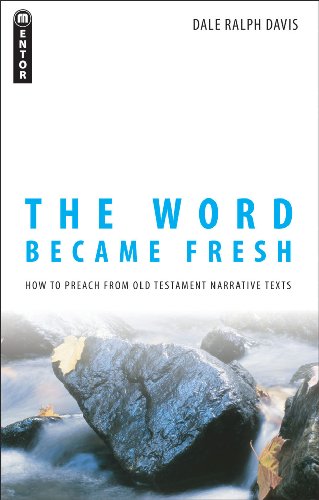
Dale Ralph Davis. The Word Became Fresh: How to Preach Old Testament Narrative Texts. United Kingdom: Christian Focus, 2006. 160 pp. $16.99.
As the full title suggests, The Word Became Fresh: How to Preach Old Testament Narrative Texts is a book about preaching. However, in the first sentence, author Dale Ralph Davis tells his readers,
This book was not my idea. I’m leery of saying too much about preaching.
Well then, I’m sure glad someone else had the idea for the book, because—reluctant to speak about preaching or not—Davis certainly has much wisdom to offer.
He’s eminently qualified for the task, having steeped in these passages for dozens of years and publishing commentaries on Joshua through 2 Kings. Moreover, he’s spent time as both professor (Reformed Theological Seminary) and pastor (most recently at Woodland Presbyterian Church in Hattiesburg, Mississippi).
Warm, Devotional, and Spunky
Early in the book, Davis writes, “If what I study won’t preach, there is something wrong with the way I study what I study” (p. 7). In other words, the upshot of observation done properly is devotional warmth and personal application. If you read enough books on theology, however, you’ll know this often does not prove true. Yet as Davis mined the biblical text, his observations certainly are.
Davis’s comments are also filled with spunk. For example, when describing the fire that Elijah called down from Heaven in 2 Kings 1, he writes that “servants of the state” were reduced to “puddles of carbon” (p. 62). That’s a poetically tenacious way to put it.
Additionally, he offers many contemporary illustrations that serve as bridges between our world and the world of the ancient text. In one place, Davis tells of a Chicago Cubs baseball player who insisted that his wife mock him whenever he was up to bat by crying, “You big bum! You can’t hit!” (p. 6-7). Davis follows with this comment:
Now biblical preaching is a bit like that. We need to hear some loving mockery behind us, crying, “So what? What difference does all this study make for anyone?” If we are constantly “berated” that way, it will make us far better interpreters.
Finally, throughout the book, Davis refreshed my belief that it is the rigorous exegesis of a passage—that is, the careful attention to how an author describes who God is and what he is doing among his people—that fuels the engaging sermon. The affections are not stirred by the light and casual skimming of Bible passages so that the preacher can find a place here and a place there from which to leap into other comments. No, good preaching is expository; it explains the text. Or said differently, Davis reminds us that in good preaching, the Bible functions not as the diving board (what you use to leap into other things), but rather the deep end of the pool (what you swim in).
A Book of Best Practices, Not “Hot” Tips
We live in a world that promises quick fixes and easy solutions. That’s not what Davis does in this book; he offers what people call in other industries “best practices,” those tried and true methods that have proven to be the most effective—not easy, but effective.
For example, on page 123 Davis demonstrates two ways to outline a passage: one that smothers preaching and another that fuels it. He uses 1 Samuel 16:1-13 as the case study. First, he writes that you could outline the passage in this way:
I. Samuel comes to Bethlehem, vv. 1-5
II. Samuel’s wrong move, vv. 6-7
III. An embarrassing moment, vv. 8-11
IV. David arrives, vv. 12-13
It’s an outline that’s faithful to the passage, sure, but, in the end, doesn’t generate much of a sermon: “some guy did this, and then some guy did that.” This outline won’t preach because “it’s not telling us what Yahweh is doing.”
Davis encourages us, rather, to consider centering our outlines on what God is doing. Imagine, instead, that our breakdown of 1 Samuel 16 goes like this:
I. The God who provides for his kingdom, v. 1
II. The God who stoops to our fears, vv. 2-5a
III. The God who prevents our folly, vv. 5b-7
IV. The God who reverses our conventions, vv. 8-13
Now we’re getting somewhere. Now we do not simply have “some guy” on the move but some God. That’ll preach.
Two Places That “More” Would Have Been More
As much as I loved the book, let me offer two improvements, which, in a way, I hope will only be received as backhanded compliments—like a man who enjoyed the meal so much that he complained he couldn’t get seconds because the food was all gone.
The first improvement is that the book needs a Scripture Index for future referencing. Throughout, I found the exegesis so rich and instructive that I could imagine myself returning to the book each time I preached an OT narrative just to see if Davis touched on my passage. Without an index, however, all his exegetical trees disappear in the forest. Sure, many of his comments are likely in his specific commentaries, but in the Preface he tells readers directly that he tried to use OT passages not covered in his commentaries in order to not double up (p. ii). I’m sure I’ll re-read this book again in the future to have my preaching juices stirred, but the periodic use as a reference book won’t happen, and that’s a shame.
The second improvement would be if Davis gave readers a fuller discussion of, and justification for, what he calls a “theocentric” approach to preaching. By theocentric approach, he means, I gather, that he doesn’t believe every preached OT passage needs to become explicitly Christocentric, that is, each sermon does not need to explicitly culminate its focus on Jesus Christ. Davis is not opposed to being Christocentric, of course; he just doesn’t believe every passage or sermon requires it.
His discussion of this topic comes at the very end of the book in a short section titled “Addendum (can be skipped).” But Davis’s theocentric approach shouldn’t surprise careful readers; by the time he addresses it directly, he’s already spent 100+ pages demonstrating it.
This review is not the place to outline all of the issues involved with a “theocentric vs. Christocentric” debate, but preachers, and even mature Christians, should already be aware that the extent to which one sees—and how one sees—Jesus Christ in the OT is a huge and sometimes thorny topic.
In fact, I have a book on my shelf that’s devoted exclusively to this topic—the topic of knowing Jesus through the OT—and in the Preface, the author, who is a seasoned and accomplished scholar, likens the experience of writing about Jesus in the OT to a soldier doing an army-crawl on his belly while live rounds fly overhead. In other words, it’s a precarious endeavor.
But let me be clear: I’m not desiring more from Davis on this topic because it’s the polemics that excite me. Not at all. I’m a practitioner, a vocational gospel preacher. Thus, several times a week I find myself telling others, “This is what this verse means, and this is how we come to know the grace of God in this passage.” And very often, “this verse” is in the OT, and very often, I wish I had more confidence in the correct “move” from the OT to the Gospel. If Davis had offered us more on this topic, I certainly would have been helped.
Despite these criticisms, perhaps the highest compliment I could pay Davis would be to say that, as I read The Word Became Fresh, I felt both instructed as a preacher, and refreshed as a reader of the Word.
* * *
A Few Favorite Quotes
“We are guilty of arrogance, not merely neglect, when we fail to beg for the Spirit’s help in the study of Scripture… We may have a high view of the Bible… Yet in our own Scripture work we easily ignore its chief Interpreter. Professionalism rather than piety drives us. We needn’t be surprised at our sterility and poverty if we refuse to be beggars for the Spirit’s help.” (Dale Ralph Davis, The Word Became Fresh, 1-2)
“We tend to get irritated if God doesn’t fit our notions of what he ought to be. We don’t, truth be told, want some God we have to fear. Which is to say, we don’t want the real God.” (Dale Ralph Davis, The Word Became Fresh, 65, emphasis original)
“Don’t be afraid to wade into the nasty narratives of the Old Testament, for it’s in the nasty stuff you’ll find the God of scary holiness and incredible grace waiting to reveal himself.” (Dale Ralph Davis, The Word Became Fresh, 74)

More Tips for Getting the Right Job in Ministry, Part III of V
I’ve been writing a series of posts designed to help those looking for a job in Christian ministry. This is a continuation of the series, as well as background on why it’s important.
I’ve been writing a series of posts designed to help those looking for a job in Christian ministry (1, 2, 3, 4, and 5). But before I share more, let me back up and explain why I’m doing this.
Here’s the deal: it took me five years to get my seminary degree. It was exhausting. It cost thousands of dollars and took thousands of hours to learn the things I needed to help lead in a local church. But eventually, that training was complete. It was time for my classmates and me to look for jobs. But this didn’t go so well for many of us. In fact, there were some—guys I respected and thought would make great pastors—that struggled to find the right church or any church at all. I don’t know all of the reasons for this, but I suspect, in a few cases, it was because they didn’t know the right things to do to find a job.
In the end, I did find a great church to work for, but it didn’t come easy for me either. Struggles were many. This series of blog posts is designed to prevent pastors from floundering while trying to connect with the right church.
To use an analogy, consider an Emergency Medical Technician (EMT). An EMT, though trained, eventually needs an ambulance to get him to the location of an accident. After all, he’s been trained to help those who are hurt. But if he can’t get to the accident, he can’t help.
Consequently, I’m writing these tips in order to get those who are trained connected to those who need them. I’m not so interested in helping pastors earn lots of money or find the sexiest job; that’s not what ministry is about. What I really hope to do is connect pastors to local churches.
With that background in mind, here are three more tips for candidates in order to accomplish this.
* * *
7. Build and leverage your personal network.
For whatever reason, I hate the word networking. It feels greasy. When I hear it, I think cheap suits, slick hair, gaudy gold chains, and a guy who points with his finger as he talks.
Even if this is a cliché, at one point or another, we’ve all had the miserable experience of being used, that is, we’ve all experienced networking after Genesis 3.
But what if networking didn’t have to look this way? What might networking have looked like before the fall?
Imagine gathering some friends and family to celebrate what God is doing in your life and asking them to pray for you as you consider future opportunities to serve God? Imagine reaching out to people that you don’t currently know, but who might be able and happy to genuinely help?
In other words, what if networking was more like buying a friend a cup of coffee than trying to sell a used car?
Networking, at its best, should just be purposeful communication with people you care about and people that care about you. Moreover, if this is what networking is, isn’t it something we could do without selling our souls or trampling on someone else’s. I think I can create a list of friends and acquaintances that would love to see me find a job where I’ll thrive. I bet you can too.
So make the list. Make a list of everyone you think would be excited to see you in a the right job in Christian ministry. Some of the people in your network are your close friends and family, people you know pretty well.
Others, perhaps, will be those you don’t know all that well, though they are people who might be “in the know” about potential jobs. For example, you might be able to ask that pastor of a large church in the large city that you want to move to if he’d be on the list. And perhaps you can add someone in the placement department of a seminary, or someone in an administrative role of a denomination who might know about job openings.
Now, I keep talking about a “list,” but let me be clearer because there are really two lists. At first, you’re just brainstorming a list of people who you think could help you in this process. That’s the first list.
The next step is to actually speak with these people and ask if they would mind being on an email list of people that you want to send periodic updates to regarding the progress of your job search. This is your actually networking list.
As you speak to people, be sure you always give a length of time for how long you expect to send emails. For example, you might say something like this:
For the next 9 months, I’m going to email some friends updates about my job search progress. Would it be okay if I emailed you an update about once a month during that time?
Also, would you be open to sending me any ideas or leads you might have for me, and praying for me as you think about my situation?
That’s something most people will say yes to because they know what they are getting into. Moreover, it’s been made clear to them that you know you’ll be doing the bulk of the work; in other words, you’re not expecting them to find the job for you.
Before moving on, let me mention two more things about networking. First, in your preliminary phone call and in every subsequent email, remember to emphasize the level of confidentiality that is needed. Are they sworn to secrecy? Or are they able to, in fact encouraged to, forward your email around to their friends? The answer will depend on your situation, of course, but make sure it’s abundantly clear.
Second, when you email people, consider using the “Blind Copy” (BC) function. This way everyone isn’t able to see all of the other recipients of the email. This might not seem like a big deal, but here’s what you don’t want: you don’t want your dear aunt Jessica (bless her heart) to keep hitting “reply to all,” to tell you how excited she is for you. Not professional. (But the fault will be yours.)
And if your email list gets really large, you might even want to use a mass email service such as MailChimp (which should be free for the size we’re talking about). The upside of a mass email service is that your email will look professional, but the downside is that it will look too professional, and then you’re back to networking after Genesis 3. It’s a hard thing to balance, but if your motives for networking are pure, people will sense this and be glad to lend a hand.
8. Have a mock interview.
Having a mock interview proved to be one of the most helpful things I did during the job search—yet, as I’ll explain, also one of the least enjoyable.
When I was looking for my first pastoral job, I had participated in interviews many times before but never in the context of a local church. All my experience had been in the business world. There is some helpful overlap, but I can tell you, with certainty, that when I interviewed with engineering firms no one ever asked me to articulate the gospel or explain the Trinity. No one ever asked my opinion on whether all of the small groups in a local church should use the same curriculum or if each group should choose their own. And they didn’t want to know what spiritual gifts my wife had. They didn’t ask these kinds of questions. I needed practice at answering them—lots of practice.
This is why I’m so thankful one of the elders at my local church offered to create a mock interview for me. He recruited several other mature Christians at our church, and for about two hours on a Tuesday night in a classroom in the basement of our church, they grilled me. Then for another hour they gave me feedback.
It was miserable, absolutely miserable.
But why? Were they mean? Not at all. Were they unfair? Nope.
It was miserable because I thought I was good at interviewing but wasn’t. In other words, by miserable, I mean deeply humbling.
Invariably, my answers were too long, and at times, unrelated to the actual question at hand. I had a lot to learn. Likely, so do you. As humbling as the process was, I am so thankful for it. I’m thankful I had friends who cared about me enough to help prepare me for ministry, even if that meant giving some honest feedback.
Before you begin the interview phases of a job search, I highly encourage you to have a mock interview. The best people to conduct it are those in your church who’ve sat on search committees before and, perhaps, even have hiring responsibilities in their job. If you don’t have this, recruit some friends to do this for you. With a quick internet search you can find good interview questions so that those conducting the interview don’t have to do too much legwork. Regardless of how you get this done, I could not recommend it more.
9. Send the best samples of your work.
I recently had coffee cups made with our church logo on them. We give them to newcomers. But before I bought 300 coffee mugs, I asked the company that made them to send me a sample. This was helpful. It helped me make an informed decision.
However, the company keeps sending me stuff: pens, water bottles, tote bags, and brochures—lots and lots of brochures. This has not been helpful.
Candidates can learn something from this. At the right time, and in the right amount, sending samples is helpful. But sending too many samples, or sending them at the wrong time is not helpful—in fact, it’s harmful.
Early in the hiring process, your cover letter is probably enough, but as the process continues, you’ll likely want to send a few of the best samples of things you have worked on. This does not mean you should send a complete series of handcrafted small group curriculum from the last five years. Don’t do that. But it might mean that you send your favorite lesson or two. That’s helpful.
If you are a worship leader, it might mean you send a sample of a devotional you lead your worship team through, or a few favorite worship sets with an explanation of why you enjoyed them so much. If you are in youth ministry, perhaps you have videos from events or mission trips or material from a favorite Wednesday night teaching series. If so, send them over.
Again, sending high-quality samples of your work, at the right time and in the right amount, is helpful. It’ll help you stand out from the crowd.
Stay tuned in the coming weeks for three more tips. They’re important. Churches are full of hurting people, and God means to help them. These tips are an ambulance designed to get EMTs to the place where they can do what they’ve been trained to do.

More Tips for Getting the Right Job in Ministry, Part II of V
I’ve been doing a blog series designed to help pastors find the right job in a local church. Here is the next installment of that series.
Recently, I’ve posted several articles designed to help pastoral candidates get the right job in a local church (1, 2, 3, and 4).
Over the next month or two, I will continue to unroll my remaining 12 tips (three tips at a time). Here are next three.
* * *
4. Get and send a recommendation letter.
My wife and I read books differently. Let’s just say that she has been known to skip a preface or two, and maybe even a few other pages along the way. I, on the other hand, won’t ever skip a page. I’m anal like that.
But there is, however, even for me, an exception to this rule. I never read the pages at the very front of a book titled “In praise of _________.” If you ask me, these pages aren’t even meant to be read, not closely. They are just there to make a point, namely, several well-known people think this book (or author) is hot stuff.
To me, a recommendation letter is sort of like that. They are nice to have because, at a glance, they give legitimacy to a candidate but, in my opinion, that’s about all. If you do decide to send one, however, and I’m not against it, here are a few ways to make the most of it.
First, realize that a reference letter doesn’t have to be from a Christian celebrity for it to be helpful. If John Piper or Rick Warren or Bill Hybels want to write you a recommendation letter, sweet. But don’t worry if they don’t. The other people applying for the job don’t have one either—probably.
It will likely be more helpful if you get a letter from a former supervisor or someone you oversaw (such as a small group leader you trained or a musician on your music team).
The most helpful letter, however, would be from someone who is already known by and has the respect of the church at which you are applying.
Recently, we hired a full-time youth and music director. He didn’t have a recommendation letter, but he did have on his reference list two men whom we already knew very well and greatly respected. Again, he just had these men as references, but each of them would have been great candidates for recommendation letters.
Second, if you don’t have someone famous to endorse you or someone who knows both you and the church, find someone interesting to write one for you.
When I was transitioning from a career in engineering to one in pastoring, I asked one of my former pastors to write a recommendation letter. That’s not very interesting. But I also asked my Muslim engineering co-worker to write a recommendation letter. That is.
Obviously, my Muslim co-worker couldn’t speak to my preaching abilities or how well I could lead a small group; but, since we had worked closely on projects for several years, he was able to comment on my character and teamwork, and even how we had engaged each other in conversations about religion. Churches seemed to find his letter helpful. Not everyone has a Muslim co-worker, but if you do, or if you have someone like this, consider asking them to write a recommendation for you. They might do it.
Finally, don’t lead with your recommendation letter. Remember, you’re not hot stuff simply because you have one. When you send your information to a church put everything in this order: cover letter, resume, family bio, references, and, finally, the recommendation letter.
5. Keep track of everything.
The level of complexity of your job search will depend upon your context. If you are currently established in a ministry role, and only casually looking for a job, your search will likely not be too complex and you’ll manage it without much effort.
If, however, you are in a transition stage, say, about to graduate from seminary, then at some point in the job search, you’ll start to get overwhelmed. The job search may start simple but become complex quickly, and you’ll want to track everything before it gets there. At some point, you’ll forget which church you sent which piece of information, which church has a deadline coming up, and which church has a senior pastor that prefers to be called Steve, not Steven.
Let me give you an analogy. During the last year, I developed a food allergy that caused a lot of discomfort when I ate certain foods, and some days it even left me unable to work. I don’t know why this happened and I’m not happy about it, but it did happened. And to figure out what I’m allergic to, I had to track everything I ate for several months.
At first, I would convince myself that I could wait until the end of the day, or even wait several days, to record everything I had eaten. I thought this would be more efficient.
Big surprise: this doesn’t work. I always forgot the details.
It’s the same in the job search. You think you can keep track of it, but you can’t. Make a folder for every job, electronic or otherwise, and keep track of every interaction. Don’t wait a day or two. You’ll forget.
I recently went back and looked over the computer folder entitled “placement” from when I was preparing to graduate from seminary, and there were 17 different folders in it! Granted, some were threadbare because I only had one or two interactions with a church, but other folders were chalked full of details.
Additionally, along with folders, create a calendar (again, electronic or otherwise), to remind you of important deadlines and when you need to follow up with a church.
6. Know where to find job openings.
Having a professional resume, cover letter, family bio, references, and a recommendation letter makes for a good start. Yet, if you don’t know where to send them, you’re not going to get a job. Somehow you have to connect your information with the right employment opportunity.
But where do you find these opportunities?
Lots of places. Broadly speaking, here are a few of them.
Job Search Websites: As I’ve mentioned before, ChurchStaffing.com tends to be a good place to look, as it seems to be the most populated. (Note, their tagline is “The Site for Church Employment,” not “A Site for…”.) But there are others, for example, Church Staff Search or ChurchJobsOnline.com, but the quality goes down pretty quick after these. Something to keep in mind, though, is that the strength of these websites, at least ChurchStaffing.com, is also the challenge: lots of traffic. If you find a job you’re interested in, you’ll likely have to be aggressive. Additionally, The Slingshot Group and Vanderbloemen Search Group, which are primarily recruitment firms (i.e. headhunting firms), have job postings (here and here), and even The Gospel Coalition, a favorite organization of mine, has an online job board (here). You’ll have to look pretty hard to find it, but when you do, you’ll see it’s stuffed with opportunities.
Denominations: Often church denominations have resources for connecting candidates and churches. They have a vested interest in doing so. And when I say denominations, I have in mind official denominations such as the Presbyterian Church in America or the Southern Baptist Convention (see their respective job postings here and here). Yet, I also have in mind movements such as Harvest Bible Fellowship which now has over 100 churches and also posts jobs openings (see those here). I can’t speak with authority on every denomination or movement, but I can speak to my own, The Evangelical Free Church of America (EFCA). In our denomination, the country is broken up into 17 districts, each district with its own staff who, on average, resource just under 100 churches each. When, fresh out of seminary, I was looking for a job, I sent cover letters and resumes to someone in each district, and followed that up with a phone call. For me, this didn’t generate all that many leads, but I think if I had already been serving fulltime in an EFCA church, especially if had I already been ordained (and not fresh out of seminary), it would have opened up more doors.
Church Planting Networks: If you are interested in church planting, then you probably already know about organizations such as Acts 29, Converge Worldwide (formerly the Baptist General Conference), and Sovereign Grace. However, if not, you can read more about planting within in these organizations here, here, and here. And there are others. You’ll find them if you look.
Bible Colleges and Seminaries: Some of the best places to find jobs are through Bible colleges and seminaries. The upside to these is twofold. First, by virtue of each institution’s theological DNA, to some extent the theology of the churches posting has already been vetted. This is helpful to both you and the churches. Second, a church will often have one or more of the current staff who are positively biased to hiring candidates from their alma mater. There’s nothing wrong with this. For both candidate and church, the hiring process is a risk, and anything one can do to mitigate that risk, including connecting people who shared theology professors, is a good thing. The downside of finding jobs through Bible Colleges and Seminaries, however, is that often access is only granted to current students and alumni. Under certain circumstances, perhaps the gatekeeper would give you access, if, say for example, you graduated from another likeminded seminary and are currently looking to relocate to the city that the particular seminary is in. It’s hard to say, but you won’t know until you ask. To find this person, just call the seminary and ask to speak with the person overseeing placement.
Other Ministry Organizations: I won’t list any specifics here, but likely every major mission agency, camp, and parachurch organization has their own job postings. I know that’s true for places like Fellowship of Christian Athletes, Cru (formerly Campus Crusade for Christ), and Gospel for Asia (see those here, here, and here).
Direct Marketing: And finally there is direct marketing. This is the most targeted approach, which means you are reaching out to a specific organization or church within a certain region. Yet, don’t get your hopes up since this is unlikely to be successful. If you have constraints, however, on the region, or even city, where you need to live then it might be worth a try.

9 Quotes from THE JOY PROJECT by Tony Reinke
The Joy Project by Tony Reinke was released earlier this week. You can download the book free of charge at Desiring God. Here are nine of my favorite passages in the book.
Yesterday I rode my bike past a church sign that said,
Happiness is not
the absence of difficulties
but the presence of God.
Typically, church signs are nothing more than clichés and sentimentality. Blah. But this one is pretty good. Yet we must ask, “If happiness comes from God’s presence, how do we get God’s presence?”
Tony Reinke wrote The Joy Project: A True Story of Inescapable Happiness to answer this question. The book was released earlier this week, and you can download the book free of charge, in three digital formats, at desiringGod.org/thejoyproject.

The book explores—no, celebrates!—God’s mission to bring his children infinite joy. And it does so through the theological framework called Calvinism or the doctrines of grace or the acronym TULIP (total depravity, unconditional election, limited atonement, irresistible grace, and perseverance of the saints). In fact, these five points serve as the scaffolding for the five central chapters of the book.
The Joy Project, however, is not a polemical fight. Rather, as I said above, it’s a celebration, and in this way it’s more in keeping with the Bible’s treatment of the subject—behold the beauty before bemoaning the controversies.
In the spring I read Five Points: Towards a Deeper Experience of God’s Grace by John Piper. It was a good book (and Reinke quotes from it a few times and Piper more than a few times), but I think The Joy Project is the book that I’d be more likely to give to the people in our church. I’m not saying it’s necessarily better, just perhaps more suited.
Reinke wrote on his blog, “The Joy Project…fulfills of a dream of mine to write and publish a full book free of charge to the world.”
Thanks, Tony, for livin’ the dream. And thanks, Desiring God, for making it happen. And now may God use this book as a means to completing his joy project.
* * *
Below are a few of my favorite passages.
We conclude that the barriers to abiding joy are the unhealthy choices that clog our lives. The root problem, we think, is that we’re stuck in a rut of predictability and laziness, so we must unstick ourselves. We turn to self-improvement... We buy productivity apps for our phones. We resolve to become more “chill” parents, sexier spouses, better friend-winners, and more purposeful people-influencers. We need to sit less and walk more. We need to sleep more and eat less… We drink more water, less coffee, less soda. We buy organic, fair trade, rBGH-free, gluten-free, free-range. We pay off credit card debt and build our savings… We commit to staying on top of our e-mails, checking our phones less often, watching less television, visiting the library more, and reading our neglected stacks of books. (p. 2*)
Simply put, the driving motive in history is the desire for happiness. All sin, from slavery to prostitution to racism to terrorism to extortion to the sparks that ignite world wars—all are driven by a desire for happiness apart from God. (p. 13)
The greatest hazard we face is not intellectual atheism—denying that God exists. Our most desperate problem is affectional atheism—refusing to believe God is the object of our greatest and most enduring joy. This is the heart of our foolishness. The fool speaks from the depths of his affections and longings and declares: God is irrelevant (Ps. 14:1). (p. 13)
Even if we don’t feel them, the consequences are real. Our idols misshape our souls like drugs alter the facial features of a meth addict. Unlike a drug-ravaged face, whose degeneration can be captured by time-lapsed photos, we don’t see the drastic changes to our souls quite so readily, but this soul-distortion afflicts everyone who follows after the pleasures of sin. (p. 22)
We are dying sinners in desperate need of a spiritual double bypass surgery, but we spend our pocket change on double cheeseburgers. We get happy again with a momentary food buzz, but the temporary buzz is slowly killing us. (p. 25)
Left to ourselves, we are stuck in our total depravity. The centripetal force of our affections keeps us gazing at ourselves. We turn away from God for our joy, and turn toward all we have left: money, sex, power, personal affirmation, Facebook friends, Twitter followers, and Instagram “likes.” We use these old technologies (and we will use new technologies in the future) to tabulate our approval and then to use those metrics of approval to compare our popularity with others. When we do, we trade authentic glory for residual sludge. It’s like drinking mud. And we choke. (p. 33)
The cross did not merely make salvation possible. The cross is not like a single who secures a wedding date and reserves an elegant church years before finding a mate, hoping they will find someone in the meantime. No, Christ’s death secured salvation for the elect individually, by name. In his death, Christ effectually pursues a bride by entering the brothel of idolatry to grab hold of the elect, one by one, by name, and pulling them out from the bondage of sin. (pp. 55-56)
Anticipating unending joy in the presence of Christ changes everything. It means we can relinquish control over our lives. It means we have no fear of the future. It means all our pressing toward personal holiness is not in vain. God elects so that we will be conformed to the image of Christ, in his holiness and in his happiness. It will be done, and we strive and obey in this inescapable hope. (p. 99)
But of course you and I know better than to say we found joy. Rather, joy found us—sometimes slowly, sometimes at warp speed. That is the story of TULIP. Calvinism is the story of a long-planned, sovereign joy that finds you before you even see it coming. (p. 121)
* All pages numbers from the PDF version.

Chipotle’s Super Short Book Report Sweepstakes
I love Chipotle. I love chocolate. And I love authors who use words well. This week I read something that helped me appreciate all of these, and I think you should read it too.
Ode to Chipotle
Just over 13 years ago (4,869 days to be exact), I fell in love—with Chipotle burritos. Their size, their shape, their spice: all of it.
Our first date was on May 25, 2002 in Fort Collins, CO, and I think every month since then, on average, I have enjoyed a chicken fajita burrito with corn salsa and some other garnishes. That’s around 160 burritos or $1,100 worth. If you prefer to measure in calories, that’s around 175,000 … but who’s counting?
The Competition
If you’ve been to Chipotle in the last week, you might have noticed that they are holding a competition. It’s related to the “cultivating thoughts” series which is displayed on the side of soda cups and to-go bags. If you don’t know what I’m talking about, imagine a short story or thoughtful reflection, say 300 words or so, by a popular author. These words stare at you while you eat just begging to be discussed.
Now, back to this competition. It’s called the “Super Short Book Report Sweepstakes.” To enter, you must write—you guessed it—a super short book report for one of the entries in the series. And when they say “super short,” they mean it: just 103 characters. Maybe you’d like to contribute your own report. You can do so here, but you’ll have to hurry. The competition ends tomorrow (9/23/2015).
Laura Hillenbrand’s Ode to Chocolate

I chose to respond to Laura Hillenbrand’s entry. She’s the author of Unbroken (which I reviewed here) and Seabiscuit … and now, as well, the short essay “Two-Minute Ode to Chocolate.”
In her Ode, Hillenbrand traces the global web of activity that must take place for her to enjoy a single square of chocolate. The Ode, in its entirety, goes like this:
It is the simplest ritual of my noondays: A square of dark chocolate, little larger than a postage stamp. For its minuteness, I savor it all the more, closing my eyes as it melts gently, generously, in my mouth, as softly exquisite as a kiss.
Always, I think, I am grateful. In my mind, I follow my chocolate to its beginnings. I see a drop of rain touching red soil, and beneath, a seed waking. Leaves reaching for sifted sunlight. Careful, sure hands unclasping fruit from limbs. A kind donkey pulling a laden wagon. Wise faces bent over an ocean of seeds, summoning sweet from bitter. Roads and rivers and cunning machines that bear the chocolate to me. Someone built that wagon; someone cut that road; someone labored under a beaded brow; someone heeded an inspiration; someone offered love. How wondrous is a world that brings such gifts.
In my little ritual I am connected to that sunshine, those hands, that river, the beautiful alchemy that unites so much in a square of chocolate. A drop of rain that falls on the other side of the world, in a place whose language I may never hear, becomes sweetness on my tongue, thankfulness in my heart, words spilling from my pen, and perhaps a thought, however fleeting, in the mind of whoever reads them.
We are none of us bereft, ever. We slumber in seas of gifts. To wake up to them, to follow their tributaries, is to traverse in every direction, yet always arrive at the same place: Gratitude. Awakening from my chocolate, I look about and wonder: Whose hands made this? To whom do I owe thanks for the song of a wren? For the warmth of a sweater, cool grass under bare feet, the joy of dogs playing, laughter, a whispered I love you, the scent of bread?
I am grateful. I am grateful. I am grateful.
What I Love about It
There is a lot that I love about these 319 words.
I love the concreteness: a square (not a piece) of dark chocolate (not just chocolate); a drop of rain (singular) touching red soil (not the earth or ground); leaves reaching (they are not passive, they reach) for sifted sunlight (sifted implies a forest above); and so on.
And I love the idea of ritual, a word she uses twice. The ancients would climb high mountains to worship, and some of us still do; Hillenbrand eats a postage stamp of dark chocolate.
And I love the way she invites us to view this universe of beneficent activity that is required for mass produced chocolate: seeds, rain, sun, a kind donkey pulling a laden wagon, and oh, speaking of the wagon, “someone built that wagon; someone cut that road; someone labored under a beaded brow.” Indeed they did.
And I love the frequent, but not overdone, alliterations (e.g. melts gently, generously… sifted sunlight… seeds, summoning sweet... Roads and rivers…).
So What’s Missing?
There are other things I love, but the essay is missing something, something important. Did you notice it? I tried to bring this out in the “super short book report” which I submitted to Chipotle for the competition.
Here’s what I wrote:
LH’s ODE TO CHOC explores the many tributaries that bring us gifts but misses Who is at the headwaters.
I capitalized the “w” intentionally. I love Hillenbrand’s prose, but she simply stops short; she traces these tributaries eloquently around the globe to farmers and seeds and donkeys and red soil and even to the heavens for rain. But while she traces them “in every direction,” her gratitude arrives nowhere, like a perpetual road trip without a destination. Hillenbrand explores the rivers but never to their source—even while asking all the right questions:
I look about and wonder: Whose hands made this? To whom do I owe thanks for the song of a wren? For the warmth of a sweater, cool grass under bare feet, the joy of dogs playing, laughter, a whispered I love you, the scent of bread?
Yes, she concludes with the right response, a tri-fold statement of gratitude: “I am grateful. I am grateful. I am grateful.” But are we so wrong to ask, “Grateful to whom?”
Hillenbrand doesn’t answer her rhetorical questions, but the Bible does. James writes, “Do not be deceived, my beloved brothers. Every good gift and every perfect gift is from above, coming down from the Father of lights with whom there is no variation or shadow due to change” (James 1:16-17).
Perhaps her statement, “How wondrous is a world that brings such gifts,” would be better written, “How wondrous is the God who gives such gifts.”
The Gospel Heals our Misplaced Gratitude
Look, I love Chipotle, I love chocolate, and I love authors who use words well. I’m thankful for these gifts, and a billion others, but what happens when we don’t locate our gratitude where we ought to? What happens if, like Hillenbrand, we don’t thank the right person?
Consider a student who received a full scholarship to college from a generous donor. Sure, this student should be thankful towards the school and the professors, the authors of his textbooks, the factory workers that produced them, and the trees that became paper. Of course, the student should be grateful for these. But at some point, you ought to thank the person who paid for your scholarship, the one who made the whole experience possible.
But my analogy is not strong enough; what if the person who gave the scholarship was also responsible for the knowledge of the professors and the production of the textbooks and the forests of trees and the rain that waters them and the workers and machines that cultivate them?
Now we are back at the central issue: ultimate gratitude to the One ultimately responsible.
Hillenbrand speaks of how “we slumber in seas of gifts,” but we might press the metaphor further: we are dead, and need more than the smelling salts of gratitude to awake us; we need resurrection.
That’s why I also love the Gospel of Jesus Christ. I love the gospel because God provides a way for sinners who misplace their gratitude to be forgiven, and for forgiven sinners to know Who is at the headwaters drenching us in delight.

More Tips for Getting the Right Job in Ministry, Part I of V
Recently, I posted several articles designed to help pastors find the right job in a local church. Over the course of the next month or two, I have 15 more tips that I will share in subsequent blog posts (three tips at a time). Here are the first three.
Recently, I posted several articles designed to help pastors find the right job in a local church (1, 2, and 3). I hope you’re not tired of them yet because there’s still more to be said.
Over the next month or two, I have 15 more tips that I plan to share in subsequent blog posts (three tips at a time). Here are the first three. Stay tuned for the rest.
* * *
1. Pray without ceasing.
Many people know that the shortest verse in the Bible is John 11:35, “Jesus wept.” But this is only the shortest in English Bibles; this verse is actually three words in Greek, edakrusen o iēsous.
The shortest verse in the Bible, in the original languages, comes from 1 Thessalonians 5:17. Paul instructs us to “pray without ceasing.” That’s three words in English, but in Greek it’s only two, adialeiptōs proseuchesthe.
Now this is mostly just silly Bible trivial, but the point I’m leading up to isn’t; Paul’s point isn’t trivial in the least. As Paul ends this letter to the church in Thessalonica, he does so by reminding the church of the gospel. He writes, “For God has not destined [Christians] for wrath, but to obtain salvation through our Lord Jesus Christ…” (5:9).
And after this gospel reminder, he then gives a host of short, but important commands related to how Christians should live in light of the gospel message. One of these commands is to “pray without ceasing.”
As you look for a job, because you are a Christian who has not been “destined for wrath,” but to obtain salvation through our Lord Jesus Christ, you ought to be someone who prays—someone who prays without ceasing to the God who saved you. This doesn’t mean that Christians don’t do other things besides pray. Of course we do. But it does means in and around, before and after, and throughout everything we do, we pray.
In the job search, it will be easy to overlook this kind of persistent prayer, even neglect it. There will be plenty of other things to do: make cover letters and resumes; collect references and recommendations; research websites, both church websites and job boards; build a network of people who will help you along the way; prepare for interviews; and so on. In the midst of all these tasks, there will always be pressure to do “just one more thing.” Consequently, prayer can easily fall by the wayside. Don’t let it.
We are always dependent and desperate people—dependent upon God and his grace, and thus desperate for him to move on our behalf. Sometimes we feel our dependence more acutely than at other times, but it’s always there. Prayer acknowledges this dependence, and it is the God-appointed outlet, or channel, for our desperate need.
And when you feel the most overwhelmed and the job search looks anything but promising, you don’t have to pray alone. Get some friends to join you. Just make sure you do it. And besides, if you don’t depend upon God when finding a job in ministry you’ll likely not depend upon him once you’re in ministry, and that begs the question whether or not you should be in ministry at all.
You see, prayer doesn’t “work” because God is a giant piñata and prayer is the stick that whacks him until he gives us goodies. Prayer works because God is gracious and good, and because he is sovereign.
This leads to my next tip.
2. Trust in the goodness and sovereignty of God.
When looking for a job, it’s imperative that you keep a vibrant trust in the goodness and sovereignty of God.
But perhaps you’re thinking,
The “goodness and sovereignty of God”? Benjamin, I thought you were going to give me lots of juicy tips for finding a job in Christian ministry. Now you’re going all Mr. Systematic Theologian on me. Where’s the practical stuff?
Here’s the deal: there will likely be low moments during the job search and hiring process, very low moments. There were for me. To make it through these moments, you’re going to have to commit yourself now, before the low moments, to the belief that God is good and he is in control.
Consider what you’ll do if a church you really like, maybe even the one that you think could be the perfect fit, says, “No thanks.”
What are you going to do?
And consider what you will do if this same church does something worse; what if they say nothing at all—silence. No returned calls, emails, letters—either because they lost your resume or because they were not considerate enough to close the loop.
Or maybe, at some point, you’ll realize that you have to take “that list”—you know, the list you made of the details about your dream job in your dream city with your dream church—and you’ll find yourself throwing it in the trash. You’ll throw it away because the job search has become so difficult and the rejections so frequent that you no longer care about finding your dream job; you just want a job.
Or maybe this will happen. Maybe you do get a job, even a good job, but when you move to the new city, your old house doesn’t sell—for another 18 months. Now all of your savings are gone and you’re not sure if you should sell your car. Then, to make things more difficult, the role you were promised at the new church doesn’t turn out to be exactly what you expected, or even what they expected.
I’m not making this list up. These things can happen. (They all happened to me!)
Yet God has his purposes for these times as well, even though it may feel like he’s trying to shake you, or even break you. As Tim Keller writes in his book Counterfeit Gods, “Sometimes God seems to be killing us when he’s actually saving us” (p. 20).
I think when we as Christians sing about the faithfulness of God (e.g. the classic hymn “Great is Thy Faithfulness” or a host of contemporary songs that major on this theme), what we are singing about are primarily two things: the goodness and sovereignty of God.
God is good in that he never does evil or ultimate harm to his children. This is a wonderful thing, but if he were not also sovereign, his goodness wouldn’t be much help to us because he couldn’t act upon it; in other words, without sovereignty, God’s goodness would just be a platitude. But he is sovereign.
Sovereignty is having absolute control over everything that has happened, is happening, and will happen in the future. God has this type of sovereignty. Scripture tells and shows us this.
We can see it in the overall narrative of the Bible, namely, the overarching story of a sovereign God acting in history—across all nations and generations—through the smallest of details that he governs (such as a fish swallowing a coin) as well as the largest of details (such as the geopolitics at work in the book of Jeremiah).
And we can see God’s sovereignty explicitly affirmed in Scripture in many verses. For example, consider just this one verse from 2 Chronicles: “O Lord, God of our fathers… you rule over all the kingdoms of the nations. In your hand are power and might, so that none is able to withstand you” (20:6).
It’s true that for some people, the goodness and sovereignty of God is primarily a thing of controversy. But I hope that before these doctrines are controversial to you, they are beautiful to you. Because it’s only a vibrant, gospel-empowered trust in the goodness and sovereignty of God that will sustain you in the low moments… and it’s also what will fill you with humble gratitude in high moments.
3. Speak to former employees.
Okay, after all this deep stuff on prayer and God’s sovereignty, let me end with something a little lighter.
You won’t always be able to, nor will you always want to, but it won’t hurt to ask the church (or organization) if you can speak to former employees.
And when you do speak to them, you might ask questions like these:
What were your favorite things about working at the church? Least favorite?
If you feel comfortable saying, what were the circumstances for your departure?
Would you work there again? Why or why not?
Also, if you know former employees are still in the area, you might want to know if they plan to still attend the church or not. This is especially helpful to ask of a former senior pastor. You’ll want to know if the guy who planted the church and pastored it for 25 years is still living down the street and showing up on Sundays in the front row. The shadow of this pastor’s leadership will be strong enough as is, and to have him still among the church could potentially be divisive.
And as you speak with a former employee, be as discerning as you can. Remember, he or she is likely a former employee—not a current employee—for a whole matrix of reasons including the good, the bad, and the ugly.
If at any point the person is hesitant to answer specific questions, and you are unsure why, perhaps you could just say something like this: “If you were me, what questions should I be asking the church before I committed to them?” This allows the former employee to offer suggestions of things you can pursue together without the former employee having to spell out all the issues.
Okay, that’s it for this post. Stay tuned for 12 more tips. Oh, and be sure to leave me a comment below if you have a tip that you think should be included.

More Than Amnesty
A poem to celebrate that, in the gospel, we have far more than amnesty.
Neither every moment nor every aspect of pastoral ministry enthralls. However, I am convinced—through the study of the Word and pastoral life within the local church—that every endeavor to promote connection between God and his people is nothing short of participation in God’s intention for the universe.
Said another way: laboring towards genuine, God-besotted, gospel-community is laboring with the grain of the universe, not against it. And because this is true, our labors to cultivate this type of community are always deeply meaningful, whether we palatably perceive it in every moment or not.
Furthermore, in my experience, as summertime ends and the school year begins, people tend to be more inclined to involve themselves in this type of genuine, God-besotted, gospel-community in a local church. They sign up to serve in the nursery; they join the worship team; they commit to a small group Bible study.
This year, in order to celebrate the beauty of these commitments and the reconciliation which was hard-won for us by Jesus Christ, I reworked a poem I wrote a few years ago. It’s called, “More Than Amnesty.”
Amnesty means one group has pardoned another group of wrongdoing. But amnesty doesn’t necessarily mean the two groups are now reconciled, and it certainly does not imply that they are friends; it merely means they are neutral.
In the gospel, we have far more than amnesty. Yes, God has pardoned, but the sacrificial death of the Son of God does not bring us into a neutral relationship with God, a merely pardoned relationship.
Rather, through the gospel, we are reconciled with God; we are made his friends; we become beloved sons and beloved daughters of God. That is more than amnesty. And this is what we were made for.
May God stir deeper longings in our hearts for this type of genuinely God-besotted, gospel-community. And may God enable our churches to make greater progress towards it.
* * *
More Than Amnesty
In God’s likeness with no shame
Eve and Adam rule and reign
Stretching glory ‘cross the earth
‘til they doubted God’s great worth
Now scorched and frayed and fractured
Father’s connection shattered
Like concrete cracked with hammer
Change Garden’s bliss to clamor
A willful grab for power
Caused Paradise to sour
Now a fire guarded gate
None will circumnavigate
So flounder, flop, flail—long years
Try to fix, yet smudge and smears
To sin’s shackles bondage bound
With no way by man yet found
But wait, but wait, oh—but wait
upon us no crushing weight
Now the curse of sin undone
By the beauty of the Son
More than our forgiven debt
We have deepest longings met
More, more, more than amnesty
A blood adhered family
Restored, redeemed, reconciled
Children no longer exiled
Now, the Father holds us dear
“I will be your God,” we hear