
A few of my daughters have become so good at watercolor that I’ve taken it up myself. Wanting to be better than they are at art is probably not the best reason to start a hobby.
Actually, I’m sure it’s not the best reason. In fact, it’s a lousy one. But it’s funny how much of my life is driven by envy. Well, maybe not full-blown, ugly envy, the kind that makes a person go mad with discontent, but more low-grade envy, the kind that makes you annoyed by how easily some skill seems to come to someone else.
This has happened with my running, too. My oldest son is now three inches taller than me, and he has been an all-state cross-country runner for the last three seasons. But before he was so ridiculously, obviously better than me, he and I would jaw at each other about what distance I could still beat him. Anything that required endurance was his, but I still claimed I could beat him in short sprints. But then last track season, we somehow ended up next to each other in a race during practice. These things tend to happen when I coach. Anyway, he beat me . . . in a sprint. I wasn’t happy. It wasn’t the kind of unhappiness that made me go mad with discontent, but it was a low-grade unhappiness.
This makes me think of a verse in Ecclesiastes where the preacher soberly observes how much of life is driven by envy. “Then I saw that all toil and all skill in work come from a man’s envy of his neighbor.” How much? All, he says. He then adds, “This also is vanity and a striving after wind” (Eccles. 4:4).
Why am I blabbing about all my striving after wind? As healthy as I want to be—both as a human and as a Christian—I still feel I have so many unhealthy tendencies when it comes to play (and probably work, for that matter). It’s hard for me to play simply because play is fun, play relieves stress, play creates something beautiful, play reflects the image of our creator. If I made sourdough bread, you better believe I’d score that bread like no one has ever scored bread before.
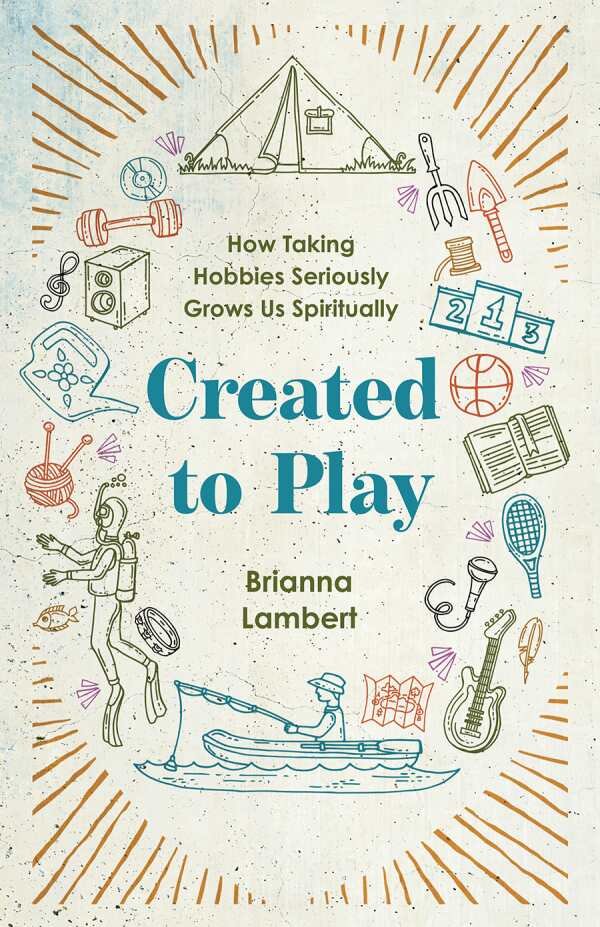
For the past week, I’ve been reading Brianna Lambert’s book, Created to Play. I’ve been chuckling at the subtitle, How Taking Hobbies Seriously Grows Us Spiritually. The practice of seriously training and lifting weights and working out is what sometimes tends to grow me unspiritually. But when I really slow down to think, it’s not that I’ve thought too much about sport and play and training and hobbies, but that I haven’t thought about them deeply enough, at least from a biblical framework.
This is one of the reasons I’m thankful for her book. Brianna occasionally gave me updates as she wrote and even let me read bits and pieces along the way, so I knew I’d like the whole book. But I didn’t realize I needed it too. In each chapter, she identifies clusters of hobbies (Makers, Beholders, Movers, etc.). She explains how these hobbies bring glory to God and blessings to others. She also highlights key temptations and how to work through them.
To encourage you to consider buying the book, I grabbed a dozen of my favorite passages and included them below.
* * *
Hobbies quietly remind us that life isn’t all about productivity or our curated identity. We exist in Yahweh’s world—recipients of his rule, his order, his tender mercies, his plan, and his beauty. This reality exists independent of our effort; we only need to step into it. (12)
Notice God didn’t materialize this dwelling [the tabernacle] into existence; instead, he invited his people to create it. He filled men like Bezalel and Oholiab with his Spirit and the ability, intelligence, and knowledge to craft (Exodus 31:2–6). (23)
We might be tempted to believe the impulse to share stems from our social-media-saturated environment. . . . However, our motivations to express and amplify beauty run deeper. I realized this after a social media fast a few years ago. While my compulsory reach for the phone diminished with time, I couldn’t shake my hunger to share good news. Part of me still longed to tell someone about the delicious recipe I made or the witty show my husband and I discovered. Instead of news feeds, I simply found an outlet in family members and friends who received my excited messages. (35)
Nothing is wrong with satisfying hunger or thirst with a frozen pizza or cheap cup of coffee. I’ve done both and more. Yet when Nourishers get the opportunity, we delight in using our free time to nourish to the brim. Could I make a brisket as tender and flavorful as the one at the restaurant? Could I perfect the foam on my latte and make it not only good but also beautiful? (51)
In every expertise and niche food sits the overflow of affection and joy that fills the earth with the glory of God. Nourishers prove within their play that food isn’t merely fuel but the opportunity for extravagant delight, even if it lasts only a moment. (62)
We don’t have the body of Usain Bolt, Serena Williams, or even the guy on the treadmill next to us—we tend our own body with all its thorns. Our arthritic wrist, sore legs, and history of injuries tag along with our every step, and if were honest, most of us would like to participate in an exchange policy. Even here, in places of real disappointment and struggle, our play as Movers reorients us toward worship. Our play becomes the vehicle of remembering God’s faithfulness inscribed onto our broken body. (67)
We can adopt a similar indulgent attitude in our play as Movers. The joy of challenging and pushing our body is addicting, after all. Movers can easily find themselves hungering for more. We might push even harder, add another workout day, and ignore our body’s cries to stop and rest. Instead of striving with our body, we beat it and damage it to fulfill our gluttonous desires for bragging rights or accomplishment. In doing so, we forsake the call to rightly tend to the body God gave us. Every good athlete must navigate the thin line between pushing their body and exasperating it. Gluttony entices us to ignore this line, caring only for the next hit of satisfaction, the next data point in our exercise app, or the next completed workout. (76)
Bees carefully buzzing in and out of their hives with pollen and goats who crinkle their noses and playfully butt their heads against each other in their stall worship in the same manner. Our pepper plants and chickens proclaim the excellences of their God with each bloom and every chirp. Bending low to creation through our hobbies quickens our heart to see the reality that we aren’t the only creatures to proclaim God’s glory. Though we express our worship and reflect God very differently, we still join, as Bauckham notes, “a continuous anthem of glory, happening all around us if we choose to notice it.” (84)
No, [our treasured collections] won’t last forever. They can’t hold the weight of our hopes; yet, at the same time, they are some of our Lord’s gifts amid the darkness. Their discovery preaches the heart of our searching Father and reminds us of the glories of collected beauty. For God has scattered beauty across this broken earth, and we get to gather it up. (104)
I felt this thrill the summer my husband and I spent a few weeks restoring my grandfather’s old telescope. For hours I suited up with a face shield and gloves to sandblast every piece of metal smooth. We resurfaced the mirror, spent time cleaning and painting, and eventually pieced it back together looking brand new. When we rolled it out the first night to catch a glimpse of the craters on the moon and the rings of Saturn, I thought of the way my grandpa once did the same in the mountains of California. Instead of losing one more object to decay, we rescued this one. We infused it with life and time to shore up even more memories. (108)
This ability emboldens us Restorers to skirt past the brand-new factory-made desk and choose the old-fashioned oak monstrosity at the thrift store. While the new one looks trendy and stylish, we know its cheap particle board won’t hold up for long, but the sturdy planks of oak will continue to weather through generations of use. We understand there is more than what we see on the surface. (112)
Decay never has the last say. Our clean baseboards and sanded floors give us glimpses of hope for the day renewal will spread across every piece of this world—to stay. In the meantime, we’ll pick up our sandpaper and wrench and tell the story of hope one more time. (119)
* Photo by Renee Hughes on Unsplash
