

When the Wrong Voices Offer Shortcuts to Writing Success
A long, personal exploration of how I became a writer and the temptations writers often face when they spend a decade trying to be a writer.
[Dear Reader: I typically write blog posts that can be read in five to ten minutes. This is not one of those. I’ve been tinkering with this collection of words for literally years, and it has grown into a mega-post, something akin to a chapter in a book and a twenty-five-minute meandering journey. I know the algorithm and the need for clicks should push me to do everything I can to make you read . . . but I’m doing the opposite: Please feel free to pass. Seriously. This essay won’t be for everyone, even most people. It’s a long, personal exploration of how I became a writer and the temptations writers often face when they spend a decade trying to be a writer. I also overlay the essay with a tender yet fragile moment in Abraham and Sarai’s marriage, a couple who have been dead for about four thousand years. So, there’s that too. Without further ado, here we go.]
* * *
“Now Sarai, Abram’s wife, had borne him no children. She had a female Egyptian servant whose name was Hagar. And Sarai said to Abram, ‘Behold now, the LORD has prevented me from bearing children. Go in to my servant; it may be that I shall obtain children by her.’ And Abram listened to the voice of Sarai. So, after Abram had lived ten years in the land of Canaan, Sarai, Abram’s wife, took Hagar the Egyptian, her servant, and gave her to Abram her husband as a wife.”
Genesis 16:1–3
Ordinarily a husband ought to listen to his wife. God makes a husband and wife one flesh that each might bless the other. The first man, Adam, however, got himself—and the rest of us—in a lot of trouble because, according to God, he “listened to the voice of his wife” (Gen. 3:17). When Eve invited Adam to sin, he should not have listened to her. He should have said, “No, God is good, and God did surely say that every tree is ours save the tree of the knowledge of good and evil.” But Adam did not speak up. He complied. Maybe he wanted to try the fruit too. Many years later, Abram fails as Adam failed: he listens to the voice of his wife when she invites him to sin (16:2).
After all the promises God speaks over Abram in the previous episode, a decade drags by, seemingly in silence. “So, after Abram had lived ten years in the land of Canaan . . .” (16:3a). In this decade of silence, Sarai devises a plan. “Sarai, Abram’s wife, took Hagar the Egyptian, her servant, and gave her to Abram her husband as a wife” (16:3b). What compels her to such action? And what compels him to listen to her plan?
Sometimes those with young children, those in the thick of child rearing, will say, “The days are long, but the years are short.” The energy required to raise children, volunteer at school, coach sports, attend to the home and meals and laundry, work one or two jobs, serve in a local church, write a blog post or two, maintain friendships, exercise, pay bills, and so on, becomes so time- and energy-consuming that the days never seem to end. You wake up and go go go until you go to sleep. Because the long days are filled so full, the years race by. One moment you’re holding a child in your arms after he’s stubbed his toe, and the next moment you’re a blubbering mess as you walk back to your car in the parking lot of a college campus without your son.
For Sarai, without a child to mark the days, the years were long. And that decade in the land of Canaan was especially long. With only the family business and her husband to occupy her attention, most of her days likely looked the same. So did the months. And the years.
Over these ten years in Canaan, if Sarai has a regular monthly menstrual cycle, she has one hundred and twenty experiences of not being pregnant. That’s one hundred and twenty times hope would rise and fall. We are not told, but perhaps during these years Sarai began to go through menopause. Indeed, this would put a thud in the phrase “Behold now” from verse 2. “And Sarai said to Abram, ‘Behold now, the LORD has prevented me from bearing children.’ ” Now any hope of having a child, at least humanly speaking, is gone. All her desires for a child, her desire to be “normal,” and all the insecurities about herself as a woman and wife who can’t find a way to become a mother—behold now, these desires and insecurities that she has carried and cultivated, shatter beyond repair. It is, she feels, the Lord’s fault: “The LORD has prevented me from bearing children.”
On the one hand, we wonder whether her plan to have a child through Hagar is her way of giving God a helping hand in fulfilling the call upon them to bless others. God had promised a child, so perhaps her plan is a means to that end. Her husband must have heard rightly that he would become the father of many children, but perhaps she wonders whether they were wrong to interpret the promises to mean that she would become the mother of many children, at least in the ordinary way. God, after all, had only said to Abram that “your very own son will be your heir” (15:4).
On the other hand, perhaps her plan is more about ending her pain. Sarai has probably hoped so much and hoped so hard and hoped for so long that she finally quits hoping because even her hope hurts, a cruel tease. Hagar will cauterize this hurting hope. Sarai doesn’t have it in her to keep fighting to believe that God is good and has a perfect plan. She doesn’t want to put another woman in her husband’s arms, except she might. He might just listen to her too.
Perhaps the shame she felt over her infertility led her to offer Hagar to Abram. Maybe she hoped the offer would be rejected—No, Sarai; we will do no such thing—but extending the offer still felt like the right move.
Regardless of which motives tempt the loudest, living in the land of Canaan plays a role in implanting the idea. If this is how other men of stature in Canaan, the patriarchs of the land, have more children, then why not them?[1] Perhaps the ways of Canaan are the ways God means to fulfill his promise. A decade is long enough to be established in the community. Long enough to make friends. Long enough, not only for the people of Canaan to be influenced by Abram and Sarai, but long enough for them to influence each other. There are other ways to have a family, they suggest. There’s Hagar, the village tells her.
* * *
In the summer of 2010, I had two jobs in different cities about a two-hour drive apart. That summer was also the time I became a writer. The change didn’t happen the way one might flick on a light switch. Becoming a writer was more like slowly scooting together four or five separate votive candles, closer and closer, until they became one big burning candle.
I couldn’t see it at the time, but one candle probably shouldn’t have been there.
After we got married, my wife and I moved to St. Louis, Missouri, where we found jobs and started a family. But that summer we split our time, spending three and a half days in St. Louis and the other three and a half days in Jefferson City. We lived in the parsonage of a church, and I worked as a pastoral intern.
During our weekly car drives, my wife and I would laugh as she read aloud from Jon Acuff’s book Stuff Christians Like. Acuff grew up as a pastor’s kid, and his book is a playful critique of Christian subculture. He makes fun of all the goofy things even godly Christians do: Sunday school teachers feeding kids their body weight in goldfish crackers, worship leaders sporting skinny jeans, and missionary dating. “Sometimes the mission field God calls you to is hot, single people,” he writes. “It’s rare, but it happens.”[2]
If his book does have any serious critique of Christians and the church, Acuff seems to rebuke without cynicism; he rebukes as someone who still wants to be on the inside, as someone who still loves Christ and the bride of Christ. I liked his approach. Listening to my wife read Acuff made all the driving we did that summer go a whole lot faster. It also, in ways I was not consciously aware of, shaped all the writing I did that summer. But I’ll have to explain a few things before that makes sense.
[I]
Back in St. Louis, I continued working the job I had after college, the one that put my engineering degree to use at a construction company. I designed fire protection systems for buildings, mostly hospitals and office spaces, and oversaw projects ranging from thousands to millions of dollars. Working there while also traveling for the internship, God again stretched my faith.
The church in Jefferson City had given their associate pastor a sabbatical and I attempted to fill in, leading youth group, preaching once a month, and doing whatever else needed to be done, including attending elder board meetings, helping with Vacation Bible School, and cleaning a toilet that had overflowed. You know, standard intern stuff.
That summer, the church continued its sermon series through the book of Genesis. We preached slowly and expositionally through the life of Jacob. Specialists in childhood development speak of certain years of a child’s life, typically the early years, as more formative than others. These early ministry years, in my pastoring generally and preaching specifically, proved more formative than others. But as much as I remember the sermons I preached that summer, I remember the devotionals I wrote even better.
My boss that summer was Pastor Mark Kiekhaefer. Mark is the sort of pastor who, some thirty years after seminary, can still sight-read a Hebrew text, in part because he is brilliant, but more so because he just stays at it, plodding through passage after passage, like the passages we plodded through together in Genesis.
On my first day as a summer intern, he told me that when he started in ministry, his boss had the practice of writing a short reflection about ministry every Monday morning in a journal. Mark had adopted that practice and wanted me to try it over the summer. So I did. At the time Mark was handwriting his reflections, but I decided to type them so I could fiddle with the words, though I didn’t know before the summer that fiddling with the words was something I’d enjoy.
I’ve written a few hundred articles since that summer, but these early reflections retain a vividness few other writing projects do.[3] In the tinkering with words that summer, words tinkered with me—who I was, who I was becoming, who I would be. I wrote the sorts of reflections I thought Pastor Mark, my boss and mentor, would enjoy. If he did enjoy them, as I remember it, he never told me. He didn’t need to tell me; I knew he enjoyed them because I knew who he was.
When I look back at them now, the devotionals I wrote that summer read like poor derivatives of Jon Acuff’s wit because they were. I hadn’t necessarily been trying to imitate his writing voice; the emulating just happened as I listened to my wife read his words. Writing the kinds of reflections I thought Pastor Mark might enjoy reading happened just as subconsciously. Again, it would be several more years until I could embrace the label, but writing these reflections to bless my boss and mimic Jon Acuff were two of the candles that slowly got scooched together to make me a writer.
Also, during that summer I taught an adult Sunday School class using material I had written. I titled the study “The Bible, Homosexuality, and Culture: Helping Christians Navigate the Issues.” In the class, I had thirty or forty people, including elderly women, reading Romans 1 and lyrics to Lady Gaga’s songs. It was something else.
I had written the study, all thirty thousand words, the previous winter and spring. Someone close to me was wrestling with whether the traditional view of same-sex relationships, for lack of a better phrase, was actually the biblical view. To be candid, though, this person wasn’t really wrestling with the issue anymore. They were already pretty convinced the traditional view of homosexuality was not the biblical view. When my friend first told me this, I didn’t have much to say, but I asked if he would let me think about it and send him an email with a few thoughts. He agreed, so I did.
That email to my friend about the Bible’s view of homosexuality grew into an independent study I conducted under the supervision of one of the New Testament professors at my seminary, a man careful with words, thoughtful about culture, and loyal to Jesus. When I finished the study, I had it printed at a local Kinkos and gave it to my friend. If my friend ever read it, he never told me.
The writing in that curriculum was rough, very rough. I have a copy on my bookshelf that I updated several more times. Through repetition, editing, and my maturation as a writer, each edition of the material improved. While that book remains nothing I’d ever show anyone today, that independent study produced a Sunday school curriculum—the work of researching the issues, writing the study, and teaching the class, all guided by the voice of a thoughtful professor—and became another historical relic from that summer that made me into a writer.
[II]
Not all the influences were as healthy. A year before that internship, in the summer of 2009, Pastor Mark invited me to preach at his church. At the time, they were in a series on the life of Abram. I preached Genesis 16, focusing on the story of Abram, Sarai, and Hagar. Looking back over old material, you always feel like you could have done better. For me, looking back over my Abram and Hagar sermon manuscript makes me cringe. I’m not sure I’d make it through listening to the audio unless someone paid me. The tone hits wrong, like I’m trying to be someone else, someone more brash. After my sermon, I remember a few people in the congregation coming up to tell me they liked the humor. I don’t remember Pastor Mark being one of them. Today, if I were in a congregation and heard a preacher deliver the same sermon I did, I’m not sure I’d approve either. It strikes me as too coarse, too shock-jock.
Of course, every preacher looks back on his early sermons and cringes, even as I assume the young Eliphaz in the book of Job eventually matured and regretted his bombastic zeal without knowledge. Every preacher and every writer wants to be better than we are when we begin, yet all of us can only begin the journey to the land God will show us from the land he already has us.
But the main reason I get a yuck feeling when I think of my early sermons, especially this one, is not just that I was a rookie but that a few of the strongest influences on my writing and preaching voice now make me feel, well, a little yuck. Another Pastor Mark also shaped my early preaching more than I probably realized. The brash, sometimes abrasive preaching voice of Mark Driscoll was the soundtrack to my construction work in St. Louis. A coworker in our engineering office, just a few cubicles down from me, listened all afternoon to conservative political commentator Rush Limbaugh. Because my coworker was hard of hearing, we all listened to Rush. Then I got to thinking about it; since I wanted to be a preacher someday, I should listen to more preachers. So I bought headphones and listened to John Piper, Bryan Chapell, and others, but mostly I devoured the online content from Mark Driscoll and Mars Hill Church.
Mark Kiekhaefer and Mark Driscoll were, and remain, two very different Marks.
I’m not sure whether Jared C. Wilson would use the same language to describe his early ministry influences, but he seemed to hint at it on social media when he shared a picture of four preachers with the caption, “My preaching journey,” and added the comment, “It’s been a wild ride, friends.”[4] The pictures moved from Bill Hybels to Andy Stanley to Mark Driscoll, and finally to Ray Ortlund. You might not be as enmeshed in the evangelical world of American preachers as Wilson and me, but trust me, those images, when compiled in that sequence, communicate a lot.
In Wilson’s thinking, his pictures depict a move from “pragmatic [preaching] to grace-driven,” a transition he has written about at length in books such as The Prodigal Church and The Gospel-Driven Church. But this sequence from the influence of one pastor to another communicates more than a shift from one philosophy of preaching to another. Two of the first three pastors were dismissed from their churches on moral grounds, with Driscoll being one of the two.
Our preaching journeys and writing journeys may be circuitous; indeed, they often are, even as Abram and Sarai’s journey led them from city to city, spending ten years here and ten years there. But when the greatest voices of influence over a Christian writer or preacher (or patriarch and matriarch) are not so Christian, it will eventually show.
The opening of the book of Isaiah comes to mind, with its list of kings: “The vision of Isaiah the son of Amoz, which he saw concerning Judah and Jerusalem in the days of Uzziah, Jotham, Ahaz, and Hezekiah, kings of Judah” (Isa. 1:1). These kings tell careful readers a story; they offer insights into the social and spiritual milieu Isaiah and the people inhabited. Mentioning these kings did for Isaiah’s audience what mentioning the names Washington and Lincoln, Nixon and Trump might do for us. They communicate the struggles Christians experience at particular moments in history, and the ways some Christians overcame those struggles and others did not.
William Zinsser, the author of several books, including the popular On Writing Well, testified to the power that our writing communities have over us in his book Writing about Your Life. The book is part memoir and part advice on how to write memoir. Zinsser includes essays and book excerpts from his writing career, then strategically inserts himself back into the prose to speak directly to readers about the decisions that arose while writing, why he made them the way he did, and how writers might approach similar decisions. In the chapter on writing about place, Zinsser includes a travel piece from early in his career. In it, he tells the story of landing in a faraway country and the troubles he had.
Commenting in hindsight on his early writing, he writes, “Today, I can’t imagine subjecting readers to such persiflage: the breezy language, the strenuous reaching for a gag, the racist patronizing of the Sudanese ‘boy.’ ”[5] His wife accompanied him on the trip, and she appears often in the piece, but even the two of them are “reduced to caricatures of irritable tourist, just as the customs inspector [in the story] has been reduced to a cartoon bureaucrat.” Indeed, Zinsser confesses that much of the dialogue was fabricated to conform to the expectations of readers. “It was the literary convention to treat indigenous people as comic props—quaint folk seemingly put on earth to torment Western writers and tourists with their ineptitude. The writers, in turn, deliberately put themselves in preposterous or dangerous situations at the hands of the ‘natives.’ ”
Modern readers would likely notice these flaws without a tour guide highlighting them. The original book containing his travel account, however, received “pleasant reviews” when it came out in the 1950s. “Nobody called it contrived or condescending; it was just another new arrival in a genre that Western readers had long enjoyed.”
And that was the problem. The community of travel writers and of travel readers had created a feedback loop in which xenophobia sold books. Looking back with what Christians would describe as contrition, even repentance, Zinsser concludes, “It had been much too easy for much too long.” Floating downstream through the land of Canaan always is.
[III]
If we read Genesis 16 merely as a passage about succumbing to temptation, we fail to see the culpability of Abram and Sarai not only in the moment when they doubted God’s promise and provision and devised a plan, but in becoming products of their world. Or, to use the language I’ve been using, Abram and Sarai were culpable for the voices of influence they curated and for the real consequences in their actions that resulted from listening to these voices.
If begetting an heir through a maidservant was a commonly accepted practice in Abram’s world for an affluent, powerful man, then Abram was not careful enough in how he curated his influences. He was not careful enough in who he sought to be like, not careful enough in whose voice he gave his ear and his heart to—his long discipleship and catechesis in the long wrong direction. The author of Hebrews states the principle in the positive: “Remember your leaders, those who spoke to you the word of God. Consider the outcome of their way of life, and imitate their faith” (Heb. 13:7). In short, first choose your leaders wisely, then listen to their voices carefully.
In a broad sense, the story of Genesis 16, my tale of votive candles becoming one larger candle, and all the ways you might be becoming a writer and being shaped as a writer raise the question of what kind of plausibility structure you build around yourself. We must be careful what sort of community we have around us, because that community, its leaders and followers, will tend to show us what we believe the good life should look like, how the good life can be attained, and what sacrifices are worth making to attain it.
For Abram, over time, what was merely a plausible idea became a reality to inhabit. If we choose the wrong version of the good life for a writer, we may make moral sacrifices to achieve that good life. In fact, as we make these moral sacrifices, they won’t appear to us as moral sacrifices at all, but simply the sort of acceptable behavior one does to get what one wants. The continued influence of Mark Driscoll might lead to following his path of using church funds to buy a spot on the best-seller list, gaming the system through well-orchestrated purchases. Such a move becomes plausible rather than unthinkable only if you surround yourself with people who think this way, people who believe that real authors do these sorts of things to obtain the writer’s good life. This example of Driscoll’s likely strikes you as egregious, and it should. But the publishing empire that was Driscoll & Co. became what it became via incremental justifications—ten years lived listening to the wrong voices. It’s likely Mark Driscoll was, at the outset anyway, called by God to write books, just as Abram was called to have children who had children who had children. But the legitimate calling of God upon a person to write books or preach sermons or start a family must be carried out in the ways of God, with his voice as the loudest. “Doing the Lord’s work in the Lord’s way is not some exotic thing,” writes Francis Schaeffer. “It is having and practicing the mentality which Christ commands.”[6]
The land of Canaan might be a decent way to describe where we all live. Any writer who lives “ten years in the land of Canaan,” as Abram and Sarai did, must be careful about the influences we curate. The words we tinker with will be tinkering with us. “Do not be deceived,” writes the apostle Paul. “Bad company ruins good morals” (1 Cor. 15:33). Social media can give a sense of belonging and purpose, which are critical ingredients in the writing life. Social media also allows writers to share their own work and promote the work of their friends. There’s nothing inherently wrong with this promotion. The infrastructure that connects good authors and good articles with interested readers isn’t inherently wrong. Yet we all know the pitfalls of writing that has been too influenced by social media culture and the pressure it produces. Social media pressures writers to write fast and be current, to give their take on every hot issue. This pressure cooker will shrivel the soul of most writers. Ten years spent writing predominantly in the land of social media will change us. Social media also tempts writers, for example, to spend exorbitant amounts of effort courting the attention of the biggest names on the biggest platforms as a shortcut to success. “This is the only way to get ahead as a writer,” you’re told. “There’s Hagar,” they say. “Just get her attention.”
Yet we need to consider how exhausting this effort is and how it siphons creativity from the work of actually writing words, shifting valuable energy toward the work of promoting words. This is not even to mention how fickle and fleeting the approval of those we consider big names can be. Paul Tripp’s book Dangerous Calling: Confronting the Unique Challenges of Pastoral Ministry has five endorsements on the back cover. Of the five people, three are no longer in ministry because of moral failure. This speaks to the dangers of pastoral ministry—a danger Tripp himself has wonderfully avoided—but it also speaks to the fickleness of writers and publishers who view endorsements from big authors as a shortcut to success. What shall it profit an author to gain the whole pantheon of evangelical endorsements if their voices turn out to be hollow?
You can see the influence of ten years in the land of social media when you see authors constantly running giveaways for those who follow, tag, retweet, and subscribe. A little is not wrong, but the frequency with which some authors run these types of posts might belie the desperation of Sarai. I’ve run these promotions myself because I felt I had to do them . . . or else.
I remember the afternoon I was on a Zoom call with a book marketing guru, and he told me I had to get a thousand more subscribers before I would get a book contract. Hearing that from such an expert sent me into a tailspin. I spent hours thinking about how to offer the perfect lead magnet on my website, how to craft the perfect call to action, and how to write the audience-driven, search-engine-optimized content that could—no matter the cost to me as a writer and, more importantly, as an image bearer—get those thousand subscribers. It was the pits. To please this guru, I made a series of five videos to give away some of my self-published books and get blog subscribers, but by the time I had shared the fourth video, I was so disgusted by the content I had made that I couldn’t bring myself to click publish on the fifth.
Self-publishing itself can—but does not necessarily have to—arise from unhealthy influences and impure motives. At its worst, self-publishing stems from an author’s refusal to wait upon the Lord, unwillingness to be professionally edited, and distaste for working on small, seemingly insignificant projects until the Lord brings the opportunity to work with a traditional publisher.
Influences from our writing community not only shape how we publish and how we promote writing that has already been published. Influences, especially unhealthy ones, can exert pre-publishing pressures as well, even down to how a writer cultivates her craft. We’ve all read wonderful writing on the internet that we could rightly classify as serious writing, in the best sense of the phrase. Still, the medium of the internet itself tends to encourage lazy thinking, short, staccato paragraphs, and clickbait list-articles, or listicles as they are often called (e.g., “7 Ways to Make Passive Income While Writing for a Christian Audience”). Additionally, writing that aims to appeal to search engine algorithms pressures writers to prioritize hot takes of an increasingly polarizing nature. Simply arguing for the talking points of your tribe, whatever you consider your tribe to be, won’t generate as many pageviews and shares as slandering those who are not in your tribe. Writing on the internet would seem to require you to craft prose that shouts louder and more belligerently than the next guy or you won’t be heard above the white noise. “I’m the good guy,” we shout. “They’re the bad guys. And I have the receipts to prove it.”
What then shall we say? Shall we then forsake serious, virtuous writing because it no longer “works”? The apostle Paul would likely say, “May it never be.”
[IV]
I became a writer under the influence of others, as all writers do, whether consciously or subconsciously. The influence of Pastor Mark Kiekhaefer nudged me toward becoming a self-reflective writer, a thoughtful pastor, a careful exegete of Scripture, a loving shepherd, and a preacher who cares about words and stories and the Word and the Story. The humor of Jon Acuff manifested itself in noticeable but mostly benign ways. My seminary professor encouraged me to write about difficult topics and taught me how to tailor my words to a small audience. Then there was Driscoll and his less positive, less benign influence toward bravado, the votive candle that didn’t belong.
We would be naïve to assume that we aren’t constantly shaped by a social and spiritual milieu. Since we are being shaped, we need to take care to choose the right voices. To use biblical language, we become what we behold, whether like idols or like Christ. The psalmist writes of idols, “Those who make them become like them” (Ps. 115:8). But when we behold Christ, we behold our future, not just in the sense of who we will be with in the future but who we will be like in the future. “And we all, with unveiled face, beholding the glory of the Lord, are being transformed into the same image from one degree of glory to another” (2 Cor. 3:18).
Ten years in the land of Canaan, or ten years spent becoming a writer, will change a person for better or worse, depending on which voices speak the loudest to our hearts.
Oh, be careful, little ears, what you hear.
* Photo by Justin Ackison on Unsplash
Endnotes
[1] Many Bible commentators mention how common was the practice of using a maidservant to have more children. For example, Victor P. Hamilton quotes from four ancient sources that mention this: a passage from Hammurabi’s Code, a Nuzi text, an old Assyrian marriage contract, and a neo-Assyrian text. Then Hamilton adds, “All four demonstrate a marriage practice spread over two millennia in which an infertile wife procures a surrogate wife, a maidservant.” The Book of Genesis, Chapter 1–17, The New International Commentary on the Old Testament (Eerdmans, 1990), 445.
[2] Jon Acuff, Stuff Christians Like (Zondervan, 2010), 71.
[3] I’ll just mention one example from that summer of writing. In the final, eleventh week of the internship, I wrote a reflection titled “Interpreting Passages When the Details Leave a Character’s Motive Morally Ambiguous.” If the title strikes you as a ridiculous mouthful, wait until you hear the title of the appendix generated by that reflection: “A Mock Interview with Jacob and Esau: Genesis 33 As a Case Study for Interpreting Passages When the Details Leave a Character’s Motive Morally Ambiguous.” In the appendix I positioned myself, with as much verisimilitude as I could produce, as a police detective, even writing a script in which I questioned each brother, trying to draw out where each brother’s words seemed to lack congruence with their actions. I’m sure the time I gave to this stretched the intentions of the standard internship. But the writing exercise taught me how to proceed when exegetical ambiguity portends homiletical ambiguity.
[4] Jared C. Wilson, @jaredcwilson, X, 6:28 PM, May 10, 2022, https://x.com/jaredcwilson/status/1524154323319791618.
[5] William Zinsser, Writing about Your Life: A Journey into the Past (Marlow & Company, 2004), 73. (The rest of the quotes used from this book are taken from pages 71–74.)
[6] Francis Schaeffer, The Complete Works of Francis Schaeffer: A Christian Worldview, Volume Three, A Christian View of Spirituality (Crossway, 1985), 47.
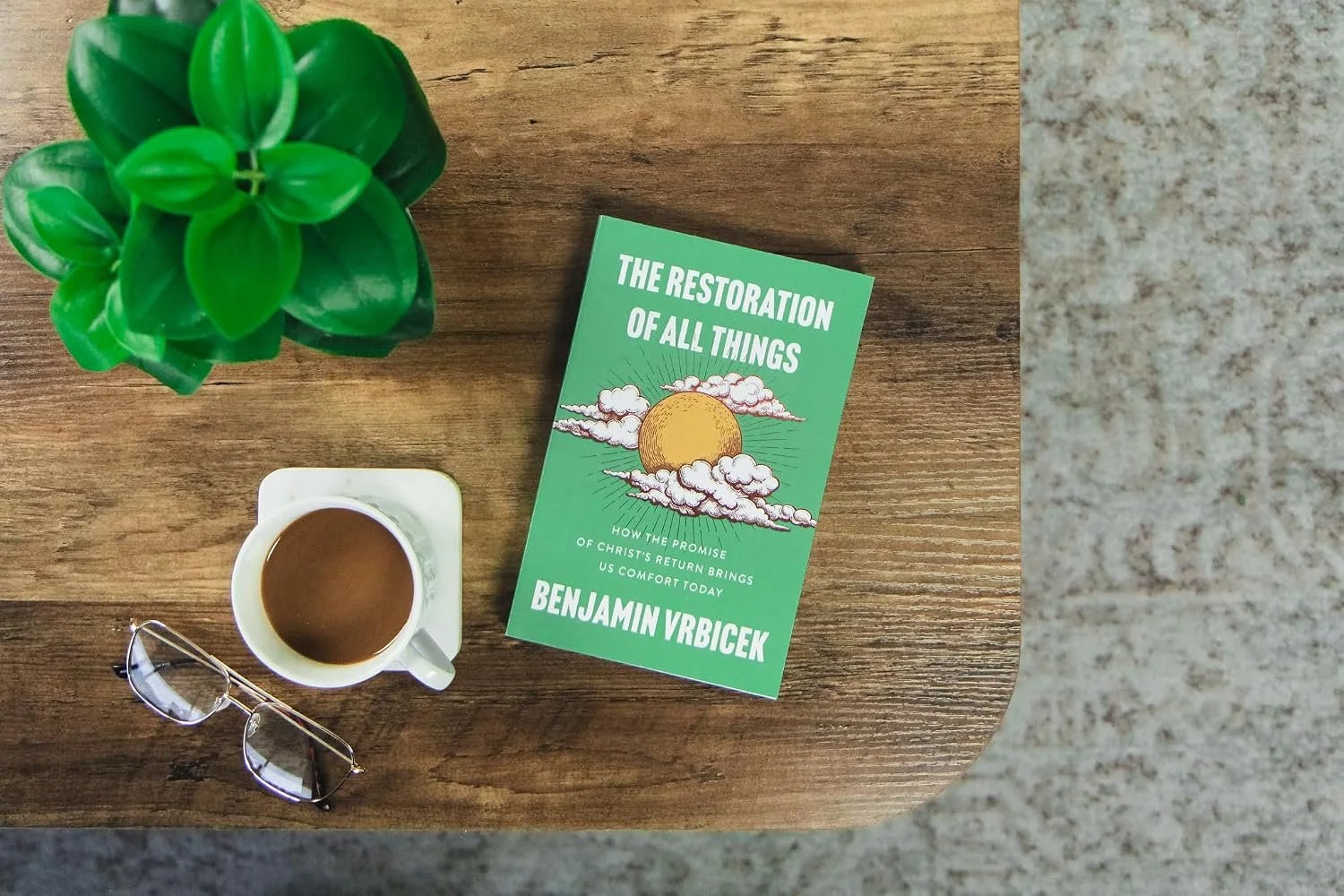
The Ultimate Happily Ever After: A Miscellany of Guest Posts and Interviews
This spring and summer, I had the opportunity to publish more guest posts and interviews than usual.
This spring and summer, I had the privilege of partnering with several organizations, writing guest posts and conducting radio and podcast interviews, as well as a full-studio interview that aired on television.
Many of the opportunities were related to the release of my new book, The Restoration of All Things: How the Promise of Christ’s Return Brings Us Comfort Today. In fact, I held a few “Return of Christ” seminars. I don’t have any audio or video from them, but they were so much fun. I affectionately called this my multi-state book tour. It had two stops, and one of the stops was at my own church. I’m hoping someone in Canada will invite me to speak. I’ll gladly go and gladly start advertising my “international book tour.”
But several of the partnerships weren’t about the book, such as the radio interview with Kathy Emmons, which I found delightful. That interview focused on an article I wrote for Christianity Today four years ago. For some reason, CT started resharing it, and it blew up, getting over 50k page views in August. I got a bunch of emails about it. Also, there’s a guest article on Desiring God about the pain of adultery.
I tend not to share these guest posts and interviews on my blog, at least not individually, but I thought the end of the summer would be a good time to group them together in case others might enjoy them.
Thank you to everyone who read and reviewed my book. If you read it, please leave a short Amazon review (here). It really helps. It only takes about five minutes. I’m currently at 37 reviews and really want to get over 50.
Thanks,
Benjamin
Podcast and radio interviews
“Hope Restored | Episode 95: Benjamin Vrbicek,” The Bright Side Podcast, a ministry of Live Faith First, September 2, 2026
“The Ride Home with Kathy Emmons,” The Ride Home with Kathy Emmons, August 31, 2026 (radio interview begins around 1:07)
“The Missions Podcast - Overtime Bonus Interview,” The Missions Podcast, a ministry of ABWE, August 18, 2026
“The Ultimate Happily Ever After: Christ’s Return and the Great Commission,” The Missions Podcast, a ministry of ABWE, August 18, 2026
“Living Like We Really Believe in the Return of Christ,” The Pastor-Writer Podcast, July 29, 2026
“‘Punchy Prose and Godly Promotion’ – J. A. Medders with GCD and Benjamin Vrbicek,” Gospel-Centered Discipleship, June 12, 2026
Guest post articles
“The Ultimate Happily Ever After,” Gospel-Centered Discipleship, June 26, 2026 (book excerpt)
“Benjamin Vrbicek on Why the Church Can’t Lose Sight of Christ’s Return,” Practicing Theology, June 23, 2026
“Communion Points Us Forward and Backward at Once,” Christianity Today, June 23, 2026 (book excerpt)
“The Terrible Possibility of Adultery,” Desiring God, June 13, 2026
“The Comfort of God’s Individual Care,” Gospel-Centered Discipleship, June 3, 2026
“When Christians Forget Their Bright Future,” EFCA Now, Evangelical Free Church of America Blog, May 28, 2026
“Join a Church Before It’s an Emergency,” Christianity Today, May 6, 2026

The Grand Façade, So Soon Will Burn
How the prospect of burning our fig leaves shifts from terrifying to desirable.
If memory serves, I wore blue jeans and a blue-striped shirt, and without missing a note, I sat on the gym stage and played Eric Clapton’s “Tears in Heaven” for the eighth-grade talent show. I killed it, the undisputed zenith of my guitar-playing career, except perhaps for when I played Jewel’s “You Were Meant for Me” the following year in the ninth-grade talent show. After these moments in the limelight, I retired early and never played in public again.
And for those wondering, I didn’t sing in either performance. No one wants to get booed by peers, especially in our young teenage years.
Thirty years have passed since middle school, and to say I tinker with the guitar these days feels generous. I play maybe thirty minutes a year. But I still know enough to help my youngest daughter learn the instrument. She’s the age I was when I played Clapton, Nirvana, and Michael W. Smith, so the artists she’ll want to imitate have changed. Still, she wants to learn, and I’m happy to help.
Playing guitar with her has led me to pull out some favorite songs from the past to see if I can still play them—or learn them. One of my favorite songs of all time is Peter Gabriel’s hit “In Your Eyes.” In an interview with Rolling Stone in 2012 when Gabriel rereleased the album, he described the basis of the song as “an ambiguous love song that can be human love, man to woman, or man to God.” Over the years, I’ve come to love this ambiguity of the song.
Sometimes, of course, intentional ambiguity of singing about God or singing about romantic love can go wrong. I’m a hard pass on sappy church worship songs that sing of Jesus as though he were our boyfriend. But in the hands of careful poets, the double referent of lovers and Lover can work. I think of the Song of Solomon and the lines about the flame of the Lord. “Love is strong as death, jealousy is fierce as the grave. Its flashes are flashes of fire, the very flame of the LORD” (Song 8:6). Is the author speaking about his love for his bride or God’s love for us? Both, I think.
The song “From Now On” from The Greatest Showman strikes me as another example of a song with a double referent. Sure, P.T. Barnum’s character, played by Hugh Jackman, sings his repentance to his wife, but could we not also hope that the anthem which starts in his heart is also sung—perhaps even more so—to his creator? Putting aside whatever the historical realities are, I like to think his words double as a song of repentance and coming home to the Lord.
Anyway, back to “In Your Eyes.” The version of the classic song that I love so much is a cover by Jeffrey Gaines. Gaines recorded a live version of “In Your Eyes” that became popular about twenty-five years ago, which, incidentally, paralleled the time I started coming back to following the Lord.
Indeed, I can still remember the exact moment I drove from one major city to another, rolled down the windows, and turned up the volume when the Gaines version came on the radio. I sang along like I was in the front row at the concert. At the time, I’m not sure how familiar I was with Gabriel’s original from ’86. I’m sure I knew it through cultural osmosis, but, to me, it might as well have been Gaines who wrote it first.
In recent days, I’ve been thinking a lot about a particular line, singing it over and over in my head. The pre-chorus goes,
All my instincts, they return
The grand façade, so soon will burn
Without a noise, without my pride
I reach out from the inside
The line I have in mind is, “The grand façade, so soon will burn.” It names all the fakery we erect between ourselves and God, and between ourselves and others, even those we love.
Twenty-five years ago, I don’t think I understood what I was singing when I sang those lines. I suppose that’s often the case. For some song lyrics, it’s probably better that way. Around that time I had also memorized songs by Nelly and the St. Lunatics, which I will most certainly not be teaching to my daughter, even if I could play them on the guitar.
The lines about burning down our grand façade would ordinarily be a dreadful and haunting prospect. We wear masks on purpose. Sure, part of us wants to be fully seen and fully known by others, lest we live with deep isolation and alienation. But we also most certainly do not want to be fully seen and fully known. We’ve placed our fig leaves, thin as they are, to hide shame. The isolation is intentional. What could be more dreadful than burning the façade we’ve so elaborately manicured? Who would want to be naked before those we’ve wronged, those from whom we legitimately have so much to hide?
But the song lyrics clearly ring with hope, even thankfulness, for the experience of burning. They sound nothing like the lamenting and bemoaning of arson.
The assumption must be that it is good for the façade, grand as we might consider it, to be scorched to ash. It’s good for a man to reckon with his maker. It’s good for us to give up the pretense.
More than when I first started singing the song, I see today how burning the façade is good. It’s good when there is such a thing as Christ. When we have a savior who is holy and happy, powerful and loving, just and good, then dropping the masks is good. Having the unconditional love of a savior means the façade can’t burn soon enough.
Writing about both marriage and the love of Christ, Timothy Keller says, “When over the years someone has seen you at your worst, and knows you with all your strengths and flaws, yet commits him- or herself to you wholly, it is a consummate experience.” He adds, “To be fully known and truly loved is, well, a lot like being loved by God. It is what we need more than anything. It liberates us from pretense, humbles us out of our self-righteousness, and fortifies us for any difficulty life can throw at us” (The Meaning of Marriage).
In recent days, as I find myself singing the lines, they still ring with hope and thankfulness in my heart. As I play the chords B minor followed by a quick A and a little riff on D, I look forward to the day when whatever façade yet remains will also fully and finally burn in the very flame of the Lord at the second coming of Christ. On that day we will be known even as we are fully known, a consummate experience. In the light and the heat in God’s eyes, we will be complete. In God’s eyes, we see the resolution of all our fruitless searches.
In the good news of Jesus, the future day of judgment and burning becomes a prospect more happy than haunting.
* Photo by Nivenn Lanos on Unsplash

Are You as Connected to the Church as You Want to Be?
God wants more for pastors and church members than a mere exchange of goods and services. He wants love to flow both ways.
The apostle Paul pastored the church in Corinth, not out of a sense of obligation, but out of openness and love. “We have spoken freely to you, Corinthians; our heart is wide open,” he tells them.
Yet issues existed between them that he needed to address. “You are not restricted by us, but you are restricted in your own affections.” It seems something, or perhaps many things, had restricted their love from returning to Paul. So he pleads, “In return (I speak as to children) widen your hearts also” (2 Cor. 6:11–13).
Calling them children could sound demeaning, but Paul means it in an endearing way. In a previous letter, Paul told them, “For though you have countless guides in Christ, you do not have many fathers. For I became your father in Christ Jesus through the gospel” (1 Cor. 4:15). Paul loved them as a loving father. Despite the many bumps in their relationship, he wanted their hearts not to be restricted.
This may surprise people, but I have found that the biggest wet blanket in pastoral ministry is not people who leave our church with a big stink, making all kinds of noise after all kinds of meetings. I mean, I don’t love that. But vocal departures have the advantage of bringing clarity; they don’t leave me wondering if restrictions existed and, if so, what they were.
The biggest wet blanket in ministry, in my experience, is being ghosted; it’s when people quiet quit and just disappear. Poof. That is what I find so hard.
Paul would have found that hard too. In fact, this seems to be the crux of the reason for his plea. The vision of ministry Paul has is not merely exchanging goods and services for a salary. Paul’s ministry among them was not like Facebook Marketplace: You want something? Great, I’ll give it to you for a price. If you want sermons, if you want leadership, if you want truth? Here’s the price. That works well enough on Facebook Marketplace, but it wasn’t the way Paul served churches. He lovingly labored among them as a father, longing for them to follow his loving example, even as he follows Christ (cf. 1 Cor. 11:1).
And yet, in return, they remain closed. “You are restricted in your own affections,” he writes. When I read that, I think of the human body, the heart and veins and arteries and cholesterol and plaque buildup. Your body needs open veins and arteries, not clogged ones. Restrictions can cause heart attacks and strokes. Paul is telling them that his affection flows one way, but it’s not coming back. He’s asking them to consider why, and take steps in the right direction—because this situation can’t abide long without serious consequences.
Once upon a time, I knew a guy I’ll call Steve. Steve attended the first church where I served as a pastor. We met shortly after I’d been hired, maybe only three weeks into the job. The church had hired me as their Associate Pastor of Teaching and Connections. I’d preach occasionally, but mainly I’d help people get connected.
On one of those first few Sundays, I found myself handing out bulletins at the sanctuary door. Steve walks in, and I hand him a bulletin. He says to me, “So you’re the new guy.” He has a sort of funny smirk on his face. He seems happy to see me. We talk for a minute, and he asks, “So what do you do here?” I return the smirk and say, “I help people get connected.”
Steve just raises his eyebrows and says, “Oh.” I smile back at him, give him a serious, overly dramatic look, and say, “So, Steve . . . do you feel connected?” It seemed like a funny thing to say.
He snaps the bulletin from my hand and says, “I’m as connected as I want to be.” Then he walks into church.
I thought I had made a terrible mistake. “That guy hates me,” I worried. “If I can’t hand out bulletins without making people mad, how can I be a connections pastor?”
Steve and I became friends over the next few years. What I didn’t know when Steve first told me he “was as connected as he wanted to be” was that he was attending our church while going through a period of intense healing from a difficult situation. He was still raw. I’ll leave the details aside, but at that time, Steve truly was as connected as he wanted to be. When I learned more about him, I didn’t blame him for owning his unconnected-ness.
But what I came to love about Steve was that he knew being restricted and guarded was not a viable long-term strategy. Steve never intended to remain permanently restricted, to remain intentionally casually connected to the body of Christ. Slowly, patiently, purposefully, he knew he needed to keep opening himself up to others. And as he did, he got better.
Sometimes, though, I wonder whether too many Christians view being “as connected as they want to be” as their permanent plan. Perhaps you even feel right now, as Steve did then, that you have all the connection you want, thank you very much.
Okay, fine, I get it. Still, I must ask: Is that your long-term strategy?
The heart of Christ for his children—as expressed in Paul’s heart for the Corinthian church—is an open heart that pumps love without restriction to all parts of the body and then back again. The heart of all local church pastors, when thinking and pastoring rightly, longs for more than Facebook Marketplace, more than a dispassionate, aloof exchange of religious goods and services. Such a thought would have been abhorrent to Paul. I think all pastors find it abhorrent too. And I think all Christians, when we’re thinking rightly, feel the same.
Has anything restricted your love for your own church, its leadership, and the people within it? Maybe those restrictions have a good explanation. Maybe you’ve been hurt. Maybe you’ve even hurt others. So maybe now is a time to be more withdrawn as you seek healing.
But I still ask: Is remaining aloof your ten-year plan for your relationship with the local church and the people you serve? God has created longings within his people for something more than mere attendance.
And to the pastors reading this, I don’t want to assume you’re not hurt as well. Perhaps it’s your love that’s become restricted. You might have good reasons for that blockage. But don’t let that be your long-term strategy either. Restrictions in the body rarely improve without intentional effort.
With the help of Christ, what concrete steps could you take today to move toward others? If you don’t know, start with prayer and ask a friend.
* Photo by Bruno BD on Unsplash

10 Good Books about the End Times and the Return of Christ
Most Christians don’t read books about the return of Christ. And that’s a shame.
Most Christians in most churches I’ve been part of over the past twenty years haven’t read a single book about the return of Christ and the end of everything. Our general affluence keeps us from thinking about the need for Jesus to come back. And long seasons of suffering can also make it difficult to think about the future, even though that’s often what we need.
But the main reason most people don’t read about the return of Christ is that the end-times market—if you want to call it a market—is dominated by books that focus on the weird and fantastical, the debatable and controversial. That’s a shame. It turns Christians off the topic completely, and thus many have never studied all the good stuff that happens when Christ comes back. And for the believer, the good stuff about the return of Christ is the main stuff.
As I’ve studied this topic, many books have given me hope and comfort, and I want to share a few with you and encourage you to consider reading them. But before I suggest ten books about the return of Christ and the end of everything, I need to mention the one book more important than all the others. The best book to read about the return of Christ and the end of everything is, of course, the Bible.
I don’t think most Christians realize how saturated the New Testament is with verses about the return of Christ. (There are a whole bunch of passages in the Old Testament too.) I put together an ebook that compiles a great list of passages in one place. You can get it by subscribing to my blog (subscribe here). When you do, I’ll send you what I call Lord, Haste the Day: 49 Bible Passages to Fill You with Hope about the Return of Christ. The other year, I printed out all these same verses and spent time each morning meditating on a couple of them.
As you look at the books on the list, if you notice that you’ve read some of them, let me know your favorites in the comments. And if you don’t see your favorite books on the list, be sure to share those with me too.
This book can be intimidating because of its size; the epic subtitle gives you that clue. If you’re holding the book or see the 560-page count on Amazon, you might feel the same way. But it’s super readable. One time, I heard a friend joke that Alcorn built too much on C. S. Lewis rather than on the Bible. And there is a lot of Lewis in his book. But there is far more Bible than there is Lewis—or any other author. My favorite takeaway is that in heaven there will be no idolatry, so we’ll be able to enjoy all of God’s gifts in a way that doesn’t compete with our love for him. I highly recommend the book.
Bright Hope for Tomorrow: How Anticipating Jesus’ Return Gives Strength for Today
by Chris Davis
I love Chris’s book. I’ve read it several times. When I began working on my book, Chris was kind enough to give me some time on the phone, and he’s encouraged me all along the way. Chris does a great job of highlighting the positive aspects of Christ’s return, especially through the Bible’s main motifs (the warrior king, the bridegroom, the judge, and the resurrecting one).
Come, Lord Jesus: Meditations on the Second Coming of Christ
by John Piper
This book is a classic example of Piper being Piper. He dives deep into the ocean of the Bible, then swims to the surface and holds up treasure for readers to see and savor. Grab this one if you want your head and heart expanded in such a way that you’ll find yourself echoing the prayer at the end of Revelation.
The Bible and the Future
by Anthony A. Hoekema
This book is more of a textbook, and it feels that way. I read it during seminary and then again the other year. During the reread, I found myself saying, “I forgot how good this book is.” The author writes from an amillennial perspective, but that emphasis is small compared to the overall focus on what happens when the end arrives. I think most readers will get to around page one hundred before they notice this specific view, which says something about the author but also about how much all the views share.
Always Longing: Discovering the Joy of Heaven
by Stephen R. Morefield
Stephen is my friend. He says that if Randy Alcorn’s book Heaven, which I highlighted first on this list, had been smaller, he wouldn’t have written his book. But Alcorn’s book is huge and Stephen’s isn’t. He structures the book in the form of questions and answers. Each of the seven chapters answers a common question about the end times and eternity. When I’ve suggested this book to others, they’ve loved it.
Blessed: Experiencing the Promise of the Book of Revelation
by Nancy Guthrie
I have always believed that God gave us the book of Revelation for our good. How could a Christian think otherwise? But all the imagery, all the debates, and all the confusion sometimes make that belief difficult and have given me hesitation from teaching the vision John received on Patmos. Guthrie’s book, however, made it easier to see how Revelation, with all its twists and turns, is not only eminently preachable by ordinary pastors to ordinary believers but also eminently believable and livable.
Are We Living in the Last Days?: Four Views of the Hope We Share about Revelation and Christ’s Return
by Bryan Chapell
Don’t be misled by the intensity of the cover design. I think the publisher is trying to appeal to readers who want end-times books to look like end-times books. Well, mission accomplished, I guess. But the book is actually a very even-handed explanation of the four main orthodox views of the return of Christ. If you often get confused with the different views (dispensational premillennialism, historic premillennialism, amillennialism, and postmillennialism), Chapell will help you navigate the issues, seeing the strengths and weaknesses of each view. He’s been both a professor and a pastor, so he knows how to make difficult concepts accessible. I was helped by the book.
A Case for Amillennialism: Understanding the End Times
by Kim Riddlebarger
Don’t hate me for including a book from my personal end-times theological camp. If that camp has always seemed sketchy to you, reading someone like Riddlebarger will hopefully help you understand that the biblical roots of amillennialism run deep. You could also read Sam Storm’s book Kingdom Come: The Amillennial Alternative, which I also recommend. But Storm’s book can be a bit spunky and goes way deep into details, such as Daniel’s prophecies and who “all Israel” is in Romans 9. But some people like to get into the weeds, which Riddlebarger, I suppose, does too.
Gilead: A Novel
by Marilynne Robinson
Okay, this is a sneaky pick. It’s not really about the end times or the return of Christ, but it is a novel that wrestles with death and eternity. Robinson casts the book as a long letter from a pastor to his son, set in the fictional town of Gilead in rural Iowa in the 50s. The pastor is so old and his son so young that he wonders whether he’ll live to see him grow beyond boyhood. The book won the Pulitzer Prize for fiction twenty years ago. (If the book sounds interesting to you, you might want to know that it became the first part of a four-part series, which I’m currently re-reading.)
The Restoration of All Things: How the Promise of Christ’s Return Brings Us Comfort Today
by Benjamin Vrbicek
Yes, I included my own book. If I were to rank the books on this list, I wouldn’t put my own book first; there are too many other, better books. But I also wouldn’t rank my book last. ;-)
* Photo by Slava Auchynnikauon Unsplash

Finding Contentment in the Restoration of Some Things
“Sufficient for the day is its own trouble,” said Jesus. And he was right.
My friend Jeff texted me the other day to say he’s working on the restoration of some things, not the restoration of all things. The accompanying picture showed his vehicle stuffed full of lumber. From the trunk of the van to the passenger armrest sat pressure-treated 2x6s ready to restore a deck.
His play on words—the restoration of some, not all, things—was a way to tease me about my book title and, I think, to let me know how busy his life felt with meaningful projects.
I loved his text and his gentle teasing. It made me realize that his humble perspective—faithful, God-ward attention to the restoration of some things—is exactly what God wants from his children. Knowing and believing that we were made finite and that the scope of our callings is thus also finite is a better way to live than scrambling, scrambling, scrambling, constantly frustrated, frustrated, frustrated, because we can’t fix it all before we die.
I feel this frustration even today. It’s supposed to be my day off from work at church, and yet I just made a list of ten tasks for the day, spanning writing tasks, ministry check-ins, and house chores. I’ll work on everything from writing a blog post and mailing books to mowing the lawn, installing an air conditioner, and cleaning my barbecue grill, which is super dirty. And none of these tasks approaches the glory of stopping the war in Israel or Ukraine, ending abortion, sending the gospel to an unreached people group, or fully training up my children in the way they should go so that when they are old they will not depart from it. I simply need to swing by Walgreens to pick up a prescription because sometimes my tummy hurts.
“Do not be anxious about tomorrow,” Jesus said, “for tomorrow will be anxious for itself” (Matt. 6:34). But you probably sometimes wonder, What if I’m anxious for today?
Remind yourself that we’ll never fix and restore it all. There’s too much broken in the world—and too much broken in us—to fix it all. The restoration of all things is a job for someone who can uphold the universe by the word of his power (Heb. 1:1–4). The restoration of all things is a job for the one who can destroy all evil at the end of time with the breath of his mouth (2 Thess. 2:8). The restoration of all things is a job for someone who created all things from nothing (Gen. 1:1; John 1:3; Col. 1:16).
One day, when God recreates the new heavens and the new earth, and the former things of death and daylight-savings time have passed away, we’ll have all the time we ever wanted to worship God, to fellowship with his people, and to work on meaningful projects without thorns and thistles getting stuck in our hands.
In the future, the artistic types among God’s people will have time to develop the skills to paint murals better than Michelangelo’s, and they will do so on buildings designed by architectural types who build them even better than the Sistine Chapel—and dare I say, even better than Bezalel’s tabernacle or Solomon’s temple. Perhaps the more adventurous among us will have time to explore the far reaches of our solar system. And we’ll all finally have substantive time for the crafts and hobbies we now squeeze into small pockets of our weeks. Gardens will grow without weeds, and our piano skills will improve without insecurity or envy. All while having time to fellowship with the redeemed of the Lord from across time and, of course, with the Lord himself.
The restoration of some things has begun. And for those who have tasted and seen the beauty of Christ, they will one day enjoy the restoration of all things. So, do not let the enormity of the remaining incompleteness of redemption either slow you down from loving people now or let it cause you to despair when you see all the work left undone.
Build your decks during the day; love your families and serve your neighbors; mow your yard in the summer sun. And lock your doors each night. But know that someday, when evil is no more, you’ll never need to lock them again.
Come, Lord Jesus.
* Photo by Andrew Pons on Unsplash

Jesus Didn’t Return Last Night, and That’s a Bummer
If you’re reading this, my book came out after seven years of work. But after almost two thousand years away, Jesus didn’t return—yet.
A few days ago, someone told me he looked forward to reading my book about the return of Christ. “But wouldn’t it be awesome,” he added, “if Jesus returned before its release?”
Indeed, it would have been awesome if Jesus had returned last night.
But I woke up this morning to the sound of my iPhone vibrating on the nightstand, not to the thunder of the rider on the white horse splitting the sky.
And that was a bummer.
Perhaps you’ve heard people say they want something to happen before Jesus comes back. Maybe you’ve even said it yourself. “Lord, please come back . . . but could you let me get married first?” “Please come back, Lord, but could you let me have a year of retirement after all these decades of work?” I’m sure some authors might even want their book to come out before Jesus returns, even if they wrote about the glorious return of Christ.
There are better and worse reasons to want Christ to delay. All of us have friends and family members who seem far from the Lord, and it would be right for us to want the Lord to give them more time so that the people we love could find repentance and faith. This is a good reason to want the Lord’s return to delay.
The apostle Peter describes the Lord’s patience in his return for this very reason: “But do not overlook this one fact, beloved, that with the Lord one day is as a thousand years, and a thousand years as one day. The Lord is not slow to fulfill his promise as some count slowness, but is patient toward you, not wishing that any should perish, but that all should reach repentance” (2 Peter 3:8–9).
Still, Peter adds to this reason for delay that “the day of the Lord will come like a thief, and then the heavens will pass away with a roar, and the heavenly bodies will be burned up and dissolved, and the earth and the works that are done on it will be exposed” (2 Peter 3:10). That will be a better fireworks show than anything that will happen in Washington, D.C., on America’s two hundred and fiftieth birthday.
I’m so thankful for the partnership with Baker Books on The Restoration of All Things: How the Promise of Christ’s Return Brings Us Comfort Today. From the beginning to the end, they saw what I hoped to do and made it better. After nearly seven years of work, I’m thankful it’s finally available for purchase.
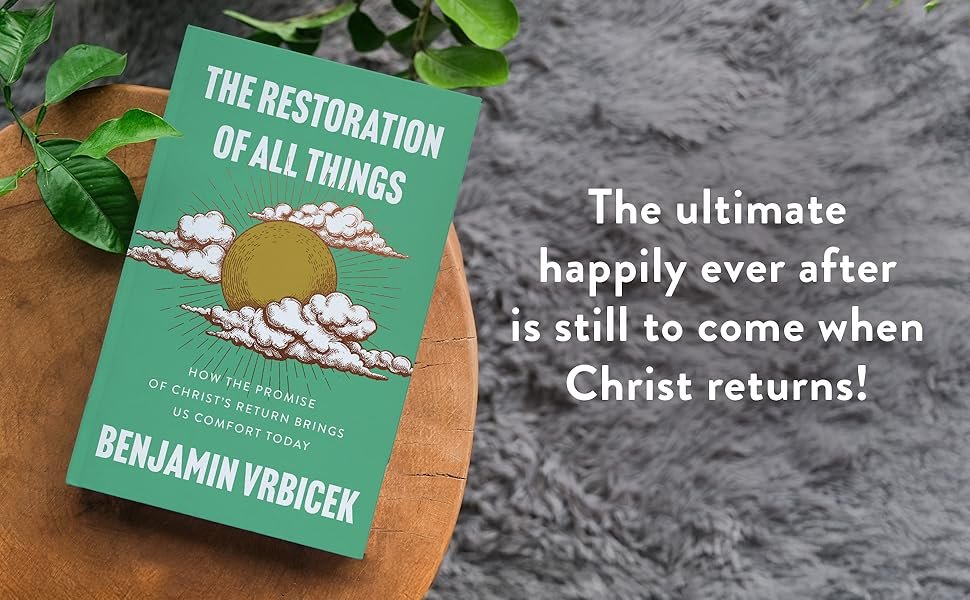
Recently, I did an interview with Baker about the book, talking some about why I wrote it. “For many years,” I said, “Christian teaching about the return of Christ has tended to focus on the controversial matters of the end times. The average Christian now mainly associates the return of Christ with debates, as though the Bible’s clear and repeated teaching on the return of Christ were actually a fuzzy, peripheral doctrine. The writers of the New Testament couldn’t have seen it more differently. They confidently saw Christ’s return as bringing Christians the ultimate happily-ever-after: all of God’s people finally and fully glorifying him and enjoying him forever in a recreated and perfected paradise.” Then I mentioned that when we “relegate the return of Christ to controversy, we lose Christian hope and comfort.”
And it’s this comfort that I want you to have. I believe it’s the comfort God wants you to have, especially if you are suffering. When we suffer, it tends to pull our gaze downward and inward. But God wants us to look up. And when we look up in faith to his return, a resilient hope comes from knowing that if the worst happens in this life—if the shaking building really does fall and collapse on you while you’re inside—there is a life coming with no more sorrow, no more pain.
That will be a wonderful day. Come, Lord Jesus.
* You can read the full interview about the book on Baker’s new practicing theology website, and you can buy the book at most online retailers, including, of course, Amazon. I’d love for you to check it out.
** Photo by Clint Patterson on Unsplash

An Encouraging Seminar about the Return of Christ
Details about an event hosted by our church. We’d love to have you attend and get a book . . . for free.
Invitations to destination weddings have always seemed to me like not-real invitations. I’m not trying to be mean, but only your closest family and your very closest friends can come to your wedding on an exotic white sandy beach in Maui. When you invite a hundred people, sure, it would be neat if they came, but I always felt those invitations weren’t real because it’s so much effort to travel so far for a single weekend.
And that’s okay. It’s still nice to get the invite, know about the wedding, and feel like you were thought of by the couple, even if your attendance can’t happen.
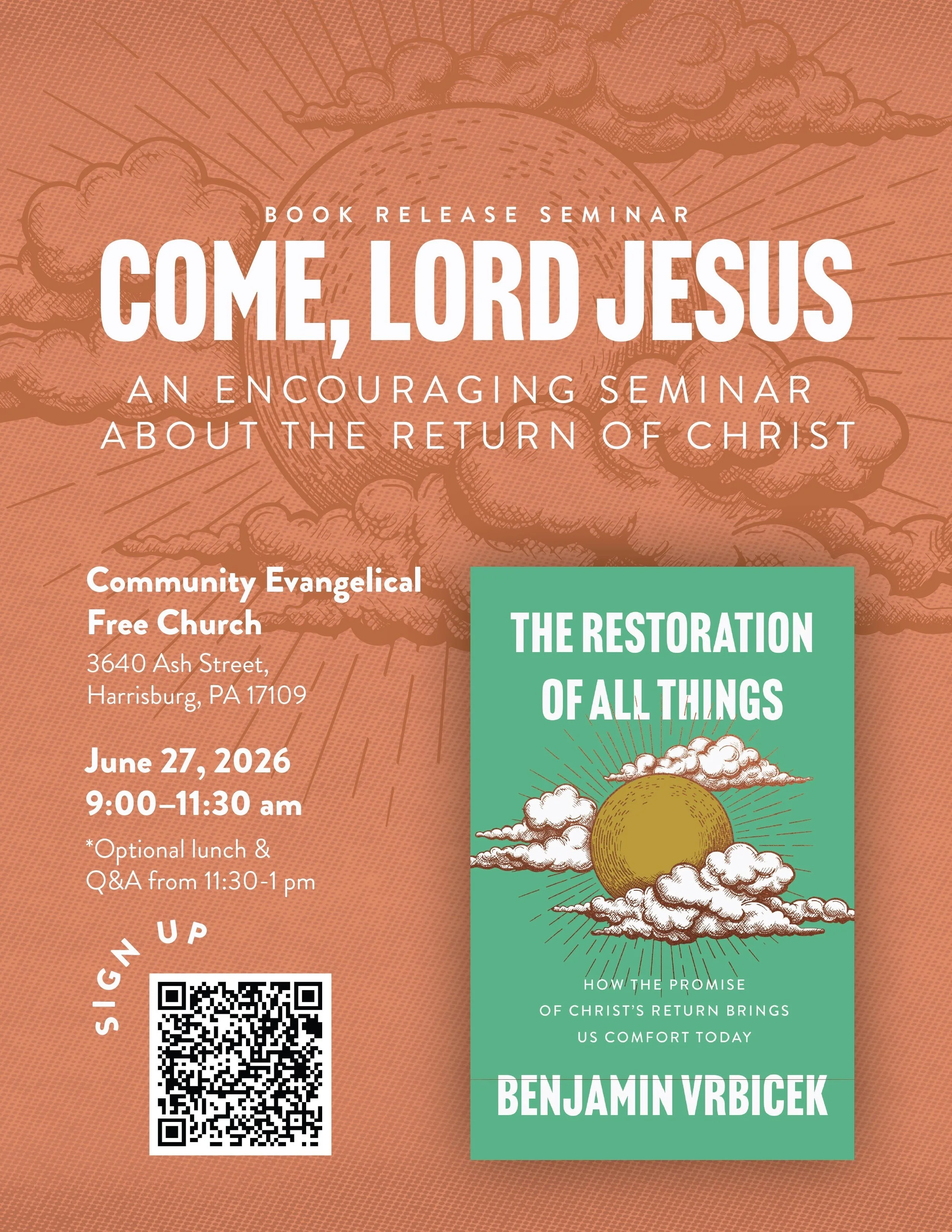
I’m afraid I might do something similar with the invite I’m about to make. On Saturday, June 27 from 9:00–11:30 am, our church is hosting “Come, Lord Jesus: An Encouraging Seminar about the Return of Christ.”
At the seminar, we’ll have light refreshments, I’ll be teaching about the return of Christ, and we’ll sing songs and hymns about the return of Christ. There’s no cost, and we’re giving away free books to anyone who registers (signup link here). So, this seminar isn’t about our church getting anything; we’re trying to give. There’s also an optional lunch for those who want to stay for a Q&A.
I should mention that in the two teaching sessions I won’t be teaching any particular view of the end times. Instead, we’ll be celebrating the wonderful truths that all Christians believe. I really do hope that we titled the seminar appropriately and that it will be encouraging. My conviction about the seminar is the same as in the book: we often spend so much time on the debatable details that we hardly get to the good stuff we all believe.
I know several people who subscribe to my blog know me from church as one of their pastors. And that’s great. That means you already know about this event, and maybe you’ve already signed up. Thank you for doing that!
For others, you live in Iowa or Missouri or Arizona or… Malaysia, and this is kind of like a non-invite to a destination wedding. If it feels that way, you don’t need to send a wedding present. You can just sign up for the book’s launch team (here). ;-)
But if you happen to live near Community Evangelical Free Church in Harrisburg, Pennsylvania, and you’re free on Saturday, June 27, we’d love to have you. Indeed, I’d love to have you. The invitation is real.

Join the Launch Team for “The Restoration of All Things”
I’d love your personal touch in sharing my book with the world.
The other day I saw an Instagram clip of Ann Patchett being interviewed about writing and book marketing. Patchett is an accomplished author and the owner of a large, independent bookstore in Nashville. The interviewer mentioned conventional forms of promoting a book, such as book tours, podcasts, and radio interviews. Then he asked Patchett, “What actually sells a book?”
“I can give you the definitive answer to that question,” she said. “It is not a book tour, an ad, a radio show, a television show, a celebrity book club pick. The only thing that actually sells books is a person reading a book and turning around to their friend and saying, ‘Oh my,* you have to read this book.’ Books are a word-of-mouth product like nothing else.” Then she added the insightful observation that she believes “the experience of loving a book is not complete until you have turned around and said to someone, ‘You have got to read this.’”
It’s interesting how similar her last line is to a famous C. S. Lewis quote. “I think we delight to praise what we enjoy because the praise not merely expresses but completes the enjoyment . . . . It is not out of compliment that lovers keep on telling one another how beautiful they are.” Then he added, “The delight is incomplete till it is expressed” (Lewis, Reflections on the Psalms). Lewis gives several examples of completing joy by expressing joy, and the first example is about a book: “It is frustrating to have discovered a new author and not to be able to tell anyone how good he is.”
Fascinating, right? In all our ways of marketing our books and gaming the algorithms, the most important step in actually selling books is word-of-mouth: when one human likes something so much that they complete their joy by expressing it to other humans.
I think about this a lot in the context of promoting church events. Ministry leaders want their pastors to announce their events from the stage. And I understand why. It does help. But the main way it helps, I think, is by making the event legitimate in people’s minds. Knowing an event exists, however, is not the main reason people go to an event. I can tell you that the definitive reason that people go to a Bible study, a men’s breakfast, an evangelism seminar, or a women’s retreat is not an announcement from the stage or a blurb in the bulletin, but when one person turns to another person and says, “Will you go with me?”
And I guess, according to Patchett, this is what also gets people to buy books.
So, here’s my question: Would you be willing to help me get others to buy my book, The Restoration of All Things, by joining the launch team? I wrote the book to help offer more hope to people’s lives. And I don’t know anyone who couldn’t benefit from more hope.
I’m setting up a launch team to spread the word. You can sign up here.
When you join some book launch groups, the authors or publishers often give away copies of the book. I’m sorry, but I’m not in a place to buy books for fifty people. I want to do that! I just can’t.
Instead, I thought of two different “giveaway” options that I think most people might enjoy better. Everyone who joins the launch team will get either 1) a phone call to chat with me or 2) a personally recorded section of the audiobook.
If you choose the phone call, there will be no official agenda for the call. If you want to tell me something you liked about the book or didn’t like—or ask something about the book—then that’s great. I’ll be up for that. And if you just want us to get to know each other or catch up and talk about life and ministry and writing or whatever, that’s great too.
I know some of you who read my blog are friends and family, so a phone call might not be that special. Indeed, I know I’m not that special to anyone! That’s why I also have the option of a personally recorded section of the audiobook. Just pick your favorite section, and I’ll send you a recording of it with a personal note about that section. You can build a fire and sit and listen, if you like. Doesn’t that sound pleasant? (By the way, the publisher Baker Books hired a professional voice actor, as they are called, to read the book, which is why a reading of the whole book by me doesn’t exist. So you’ll have something no one else has.)
In summary, here are the requirements to join the launch team: A willingness to…
Buy and read the book
Share about the book on social media (and tag me if you want to)
Write a super short Amazon review
Most importantly, tell a real human about the book in a real, in-person conversation
Once you do that, we’ll just set up a 15-20 minute phone call to talk or I’ll ask you for your favorite section of the book so I can send you an audio file of me reading it.
Are you up for joining the team to spread the word? It would mean a lot to me if you did.
* If you watch the Patchett clip, know that she says OMG, which I omitted when I typed her answer.
** Photo by Dominic Kurniawan Suryaputra on Unsplash

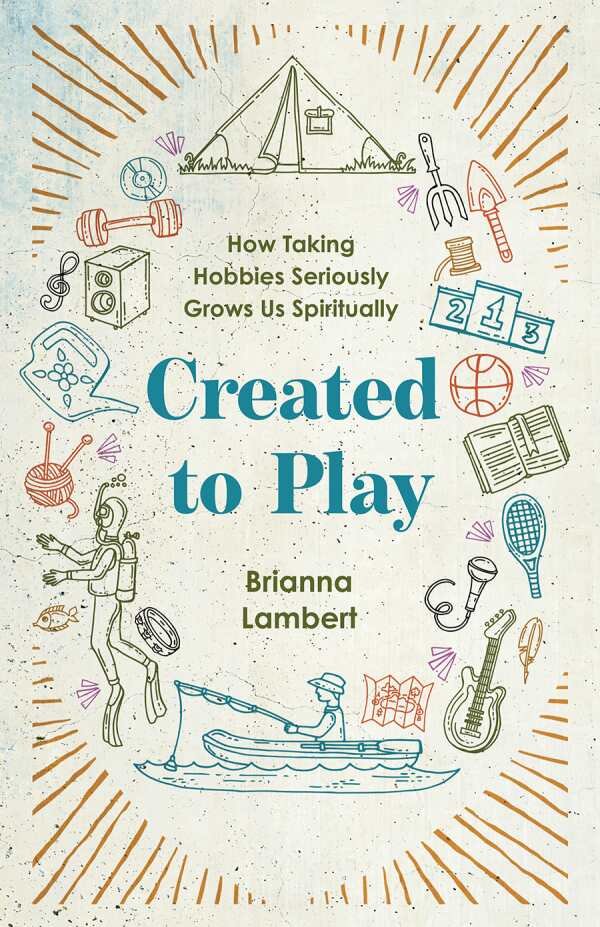
Hobbies Should Be More Than Envy Incubators: 12 Quotes from “Created to Play”
I want to have a healthier relationship with hobbies and play, and a new book by Brianna Lambert helped me see this more clearly.
A few of my daughters have become so good at watercolor that I’ve taken it up myself. Wanting to be better than they are at art is probably not the best reason to start a hobby.
Actually, I’m sure it’s not the best reason. In fact, it’s a lousy one. But it’s funny how much of my life is driven by envy. Well, maybe not full-blown, ugly envy, the kind that makes a person go mad with discontent, but more low-grade envy, the kind that makes you annoyed by how easily some skill seems to come to someone else.
This has happened with my running, too. My oldest son is now three inches taller than me, and he has been an all-state cross-country runner for the last three seasons. But before he was so ridiculously, obviously better than me, he and I would jaw at each other about what distance I could still beat him. Anything that required endurance was his, but I still claimed I could beat him in short sprints. But then last track season, we somehow ended up next to each other in a race during practice. These things tend to happen when I coach. Anyway, he beat me . . . in a sprint. I wasn’t happy. It wasn’t the kind of unhappiness that made me go mad with discontent, but it was a low-grade unhappiness.
This makes me think of a verse in Ecclesiastes where the preacher soberly observes how much of life is driven by envy. “Then I saw that all toil and all skill in work come from a man’s envy of his neighbor.” How much? All, he says. He then adds, “This also is vanity and a striving after wind” (Eccles. 4:4).
Why am I blabbing about all my striving after wind? As healthy as I want to be—both as a human and as a Christian—I still feel I have so many unhealthy tendencies when it comes to play (and probably work, for that matter). It’s hard for me to play simply because play is fun, play relieves stress, play creates something beautiful, play reflects the image of our creator. If I made sourdough bread, you better believe I’d score that bread like no one has ever scored bread before.
For the past week, I’ve been reading Brianna Lambert’s book, Created to Play. I’ve been chuckling at the subtitle, How Taking Hobbies Seriously Grows Us Spiritually. The practice of seriously training and lifting weights and working out is what sometimes tends to grow me unspiritually. But when I really slow down to think, it’s not that I’ve thought too much about sport and play and training and hobbies, but that I haven’t thought about them deeply enough, at least from a biblical framework.
This is one of the reasons I’m thankful for her book. Brianna occasionally gave me updates as she wrote and even let me read bits and pieces along the way, so I knew I’d like the whole book. But I didn’t realize I needed it too. In each chapter, she identifies clusters of hobbies (Makers, Beholders, Movers, etc.). She explains how these hobbies bring glory to God and blessings to others. She also highlights key temptations and how to work through them.
To encourage you to consider buying the book, I grabbed a dozen of my favorite passages and included them below.
* * *
Hobbies quietly remind us that life isn’t all about productivity or our curated identity. We exist in Yahweh’s world—recipients of his rule, his order, his tender mercies, his plan, and his beauty. This reality exists independent of our effort; we only need to step into it. (12)
Notice God didn’t materialize this dwelling [the tabernacle] into existence; instead, he invited his people to create it. He filled men like Bezalel and Oholiab with his Spirit and the ability, intelligence, and knowledge to craft (Exodus 31:2–6). (23)
We might be tempted to believe the impulse to share stems from our social-media-saturated environment. . . . However, our motivations to express and amplify beauty run deeper. I realized this after a social media fast a few years ago. While my compulsory reach for the phone diminished with time, I couldn’t shake my hunger to share good news. Part of me still longed to tell someone about the delicious recipe I made or the witty show my husband and I discovered. Instead of news feeds, I simply found an outlet in family members and friends who received my excited messages. (35)
Nothing is wrong with satisfying hunger or thirst with a frozen pizza or cheap cup of coffee. I’ve done both and more. Yet when Nourishers get the opportunity, we delight in using our free time to nourish to the brim. Could I make a brisket as tender and flavorful as the one at the restaurant? Could I perfect the foam on my latte and make it not only good but also beautiful? (51)
In every expertise and niche food sits the overflow of affection and joy that fills the earth with the glory of God. Nourishers prove within their play that food isn’t merely fuel but the opportunity for extravagant delight, even if it lasts only a moment. (62)
We don’t have the body of Usain Bolt, Serena Williams, or even the guy on the treadmill next to us—we tend our own body with all its thorns. Our arthritic wrist, sore legs, and history of injuries tag along with our every step, and if were honest, most of us would like to participate in an exchange policy. Even here, in places of real disappointment and struggle, our play as Movers reorients us toward worship. Our play becomes the vehicle of remembering God’s faithfulness inscribed onto our broken body. (67)
We can adopt a similar indulgent attitude in our play as Movers. The joy of challenging and pushing our body is addicting, after all. Movers can easily find themselves hungering for more. We might push even harder, add another workout day, and ignore our body’s cries to stop and rest. Instead of striving with our body, we beat it and damage it to fulfill our gluttonous desires for bragging rights or accomplishment. In doing so, we forsake the call to rightly tend to the body God gave us. Every good athlete must navigate the thin line between pushing their body and exasperating it. Gluttony entices us to ignore this line, caring only for the next hit of satisfaction, the next data point in our exercise app, or the next completed workout. (76)
Bees carefully buzzing in and out of their hives with pollen and goats who crinkle their noses and playfully butt their heads against each other in their stall worship in the same manner. Our pepper plants and chickens proclaim the excellences of their God with each bloom and every chirp. Bending low to creation through our hobbies quickens our heart to see the reality that we aren’t the only creatures to proclaim God’s glory. Though we express our worship and reflect God very differently, we still join, as Bauckham notes, “a continuous anthem of glory, happening all around us if we choose to notice it.” (84)
No, [our treasured collections] won’t last forever. They can’t hold the weight of our hopes; yet, at the same time, they are some of our Lord’s gifts amid the darkness. Their discovery preaches the heart of our searching Father and reminds us of the glories of collected beauty. For God has scattered beauty across this broken earth, and we get to gather it up. (104)
I felt this thrill the summer my husband and I spent a few weeks restoring my grandfather’s old telescope. For hours I suited up with a face shield and gloves to sandblast every piece of metal smooth. We resurfaced the mirror, spent time cleaning and painting, and eventually pieced it back together looking brand new. When we rolled it out the first night to catch a glimpse of the craters on the moon and the rings of Saturn, I thought of the way my grandpa once did the same in the mountains of California. Instead of losing one more object to decay, we rescued this one. We infused it with life and time to shore up even more memories. (108)
This ability emboldens us Restorers to skirt past the brand-new factory-made desk and choose the old-fashioned oak monstrosity at the thrift store. While the new one looks trendy and stylish, we know its cheap particle board won’t hold up for long, but the sturdy planks of oak will continue to weather through generations of use. We understand there is more than what we see on the surface. (112)
Decay never has the last say. Our clean baseboards and sanded floors give us glimpses of hope for the day renewal will spread across every piece of this world—to stay. In the meantime, we’ll pick up our sandpaper and wrench and tell the story of hope one more time. (119)
* Photo by Renee Hughes on Unsplash

Soon and Very Soon: The Restoration of All Things
Soon and very soon my book about the return of Christ will be published.
A gospel song from the 1970s belts out the lines, “Soon and very soon we are goin’ to see the King.” I’ve been singing it over and over for the last few months. It’s super catchy and happy and reminds me of the goodness of the return of Christ.
If you also want it stuck in your head, you can listen to the original singer and songwriter, Andraé Crouch, perform it live here, or you can watch another more modern version here, still featuring Crouch, but also with CeCe Winans. “No more dyin’ there, we are goin’ to see the King, Hallelujah, Hallelujah, we are goin’ to see the King!
Try to sing that and not smile. You can’t do it.
This is a topic I’ve been thinking about a lot—not just for the last few months, but for the last few years. Soon and very soon, the book I wrote on this topic, The Restoration of All Things, will finally be released by Baker Books. Launch day is less than a month away. But I actually wrote the first chapters of this book over six years ago! It took a while to get it published, but that’s another story.
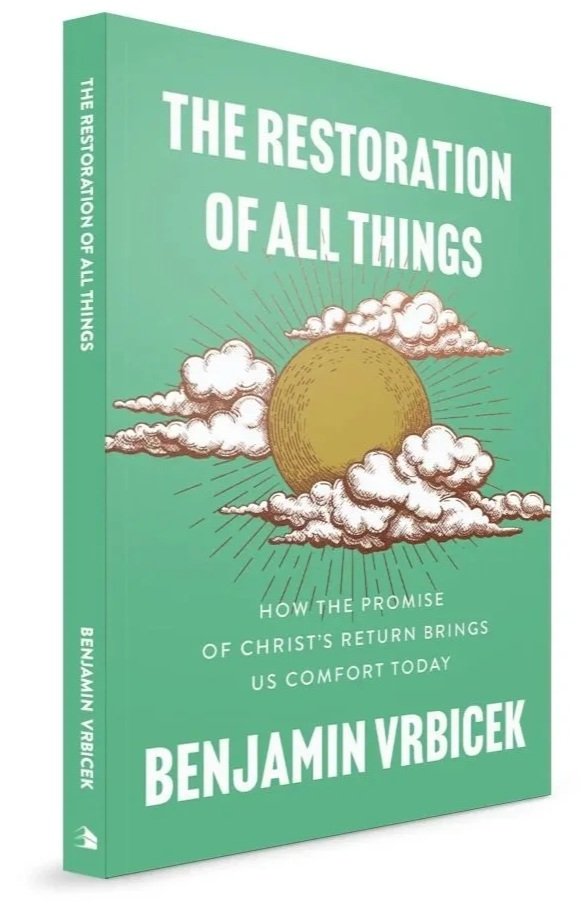
Today, I’d love to invite you to pre-order the book. I know that’s a few dollars, and I feel weird asking. But I really believe in the book’s theme, specifically that remembering the return of Christ pours hope into a Christian’s life. And who couldn’t use more hope in their life?
You can pre-order the book at a number of places, Amazon or Baker Books, for example. The book releases on June 23, but pre-orders likely ship early, maybe even a week. And this might not be apparent to the average reader, but I’m told that the Amazon algorithm gets a lot of “juice” from pre-orders, so if you’re going to get it anyway, buy early and often, as they say.
On the Baker Books website, you can click the “look inside” button to read the entire first chapter. I have also listed the table of contents below. Most books tend to get less engaging as the pages and chapters progress. I think this book gets better and better toward the end.
And if you’d like to learn more about a seminar we’re hosting at church on this topic, we built an information page with all the details (here). It’s on Saturday, June 27. We’ll sing together some of the old hymns about the return of Christ, along with some of the best new ones. I’ll also teach two sessions about it. There’s an optional lunch and Q&A for those who have time. If you live in Harrisburg, Pennsylvania or want to take a road trip, registering for the seminar is a great way to get a free copy of the book (register here). If you’ve already pre-ordered, then you’ll have two copies: one to keep and one to give away!
Thank you,
Benjamin
Table of Contents
Introduction: This Train Is Bound for Glory 9
1. Feasting for the Famished 35
2. Rest for the Weary 51
3. Bodies for the Broken 71
4. Family for the Forsaken 93
5. Justice for the Wronged 111
6. Glorification for Strugglers 131
Conclusion: Loving His Appearing 151
Discussion Questions 161
* Photo by Martin Adams on Unsplash (with Baker Books cloud image added)
You Are Free to Weep Because Jesus Did
A new book I’d love you to consider buying.
This weekend a copy of Free to Weep: Finding the Courage to Grieve and Embracing the God Who Heals arrived at my house in an Amazon bubble bag. It’s a new book by my friend Brittany Allen (Substack, Instagram). Brittany also authored Lost Gifts: Miscarriage, Grief, and the God of All Comfort. When that came out last year, I bought five copies to give to suffering moms in our church and community.
Because I wrote an endorsement for Free to Weep, I know the publisher (Moody) would have gladly sent me a free copy, but I bought my own copy anyway. I have a pet peeve about my author friends buying me copies of their books. I don’t like letting them do this and try to avoid it whenever possible. After three hundred hours or more of work writing the thing, you shouldn’t then have to buy your own art and give it to others. It feels wrong. Laboring over words is the giving of expensive resources. By the time the book becomes available for purchase, the author has already given so much.
Probably, however, another reason influences this conviction. I don’t let my friends give me their books because deep down inside me there’s a belief that thinks that if I always buy copies of my friends’ books, then maybe they’ll do that for me. In fact, maybe lots of people will do that for my books.
And in a strange way, this quirky, subconscious belief is part of why Brittany’s book is so necessary.
Good, Bible-believing Christians, pastors, and churches know how and why to denounce the prosperity gospel, which promises that God blesses his children in proportion to their faith. Big faith, prosperity preachers say, means big blessings. And when those blessings come to God’s children, they often—perhaps primarily—come in the form of material blessings.
Again, good, Bible-believing Christians, pastors, and churches recognize the problems with this. We know the prosperity emperor has no clothes.
Sometimes God does make a Christian’s life excruciatingly hard. And sometimes the hardship and suffering have little to do with the believer’s little faith. The suffering might even have nothing at all to do with a lack of faith.
We must always keep before us the interaction Jesus had with the man born blind. “It was not that this man sinned, or his parents,” Jesus said, rebuking his disciples who thought otherwise (John 9:1ff). And we must always keep before us the actual life of our Lord and Savior, not the sanitized version. The most faithful child of God who ever walked the earth was a man of sorrows, acquainted with grief. How easily we forget this. How easily I forget this. If we had been alive to experience the weeping ministry of Jesus, some of us might have looked at all his afflictions and said to him something like, “O ye of little faith. If your father loved you, he’d turn these stones to bread.”
This is why I’m thankful for Brittany’s book. She helps us remember. She helps me remember a better way and a better gospel. We should probably call that way the true gospel.
I’ll include my endorsement for the book below. I’d love for you to pick it up. You can have it delivered to your house in an Amazon bubble bag.
Oh, if you don’t particularly love Amazon and want to get a copy in person, you can do that at Barnes & Noble. The other day, Brittany posted some pictures of herself at Barnes & Noble with her own book. That was so cool to see. I’m really happy for her.
I’m also happy that the words I wrote as an endorsement for the book are now at Barnes & Noble too. It must be because I’m a very faithful and good pastor that the Lord would bless me in such a significant way.
Endorsement
In Free to Weep, Brittany Allen mounts a compelling case against the abuses of what she calls the “emotional prosperity gospel,” the idea that a mature believer would handle suffering in ways the Christian subculture considers healthy—but are actually deeply unhealthy.
Allen, instead, presents believers with a better vision for life in a broken world, focusing especially on Jesus, the Man of Sorrows and one acquainted with grief. As I read her personal and theological reflections, I immediately thought of a dozen people in our church who would benefit from this book.
Benjamin Vrbicek, pastor and author
There Will Be One Thousand Compensations for Pastors
Reflections on the sobering and encouraging words about pastoral ministry from John Piper and his father, Bill Piper.
The other week I wrote a psalm about the cost of pastoral ministry. I wish those sober reflections came more from a theoretical place than a present experience. But, alas, here we are.
Listening to a recent interview with one of my pastoral heroes both validated these struggles and encouraged me to persevere. At the Coram Deo Pastor’s Conference, Justin Taylor interviewed John Piper (conference link to all sessions; YouTube link to interview).
I know well the heart of Piper’s ministry and key moments within it. I could share his calling from Romans 9 and talk about the God who demands not merely to be analyzed but proclaimed. I could tell you about the origins of what Piper calls Christian hedonism and how God is most glorified when we are most satisfied in him. I know how much Piper loves hyphenated phrases like Christ-exalting, prayer-soaked, and Spirit-wrought. And I remember the moment I first heard the Passion Conference sermon mentioning a retired couple from Punta Gorda, Florida, and how they spent their days collecting shells in the final chapter of their lives before they stood in the presence of God to give an account.
But some of the stories Piper shared in the interview were unfamiliar to me, such as the super rough patch at his church in the mid-90s after their worship leader confessed to a seven-year affair with the organist—only after weeks of confrontation. In the end, 230 people left the church, this at a time when the church was much smaller than when he retired.
At one point Justin Taylor asked Piper to read a letter his father wrote him. The letter aimed to dissuade his son from leaving teaching to become a pastor. And if not to dissuade, to encourage Piper to enter local church ministry with sobriety. Piper just read an excerpt of the letter, but I found the full letter in a blog post from Taylor. I’ll share the full letter below or you can watch Piper read the excerpt and respond to it here:
Now I want you to remember a few things about the pastorate. Being a pastor today involves more than merely teaching and preaching. You’ll be the comforter of the fatherless and the widow. You’ll counsel constantly with those whose homes and hearts are broken. You’ll have to handle divorce problems and a thousand marital situations. You’ll have to exhort and advise young people involved in sordid and illicit sex, with drugs and violence. You’ll have to visit the hospitals, the shut-ins, the elderly. A mountain of problems will be laid on your shoulders and at your doorstep.
And then there’s the heartache of ministering to a weak and carnal and worldly, apathetic group of professing Christians, very few of whom will be found trustworthy and dependable.
Then there a hundred administrative responsibilities as pastor. You’re the generator and sometimes the janitor. The church will look to you for guidance in building programs, church growth, youth activities, outreach, extra services, etc. You’ll be called upon to arbitrate all kinds of problems. At times you will feel the weight of the world on your shoulders. Many pastors have broken under the strain.
If the Lord has called you, these things will not deter nor dismay you. But I wanted you to know the whole picture. As in all of our Lord’s work there will be a thousand compensations. You’ll see that people trust Christ as Savior and Lord. You’ll see these grow in the knowledge of Christ and his Word. You’ll witness saints enabled by your preaching to face all manner of tests. You’ll see God at work in human lives, and there is no joy comparable to this. Just ask yourself, son, if you are prepared not only to preach and teach, but also to weep over men’s souls, to care for the sick and dying, and to bear the burdens carried today by the saints of God.
No matter what, I’ll back you all the way with my encouragement and prayers.
Several lines stand out to me in this letter, especially the parallel lines about the cost of ministry and the compensation from the Lord. Bill Piper, himself a traveling evangelist and very familiar with the hardships in local churches, told his son that pastors will “have to handle divorce problems and a thousand marital situations. . . . [But] As in all of our Lord’s work there will be a thousand compensations.”
I read that and I concur. The costs abound but so do the compensations.
Only a small percentage of readers are in full-time vocational pastoral ministry, but I believe the entire interview is worth considering for more than just pastors. To highlight another moment, as Piper shares his philosophy on preaching, he says, “It’s sin to be boring about non-boring things. It's okay to be boring about boring things, but it's a sin to be boring about the word of God” (around 42:27 minutes). Indeed, Piper, it is.
Thank you, Pastor Piper, for giving your life to being blood-earnest about the least boring story in the universe. I am a life that was changed.
* Picture from YouTube screenshot
Writing Updates
Some of you might like to know, so I’ll say that…
I’ve been working on some guest posts for other websites. They will appear in the next few months. There’s one on church membership at Christianity Today, there’s one on adultery and the local church at Desiring God, and a reflection on a strange and wonderful verse in Revelation at Gospel-Centered Discipleship. When they publish, I’ll let you know. Also, I hope to do some podcast interviews and guest posts related to the release of my book: The Restoration of All Things. (If you happen to have a podcast or have a friend who needs guests, let me know!)
Speaking of my book, if you haven’t pre-ordered it, I’d love for you to do that. I’ll stop mentioning this after June, but I need to keep being the squeaky wheel. I’m not sure I fully understand it, but my impression is that pre-ordering sets in motion the arc of a book’s impact. Or, to think about it differently, it’s like pushing someone on a swing, and starting with one giant push. The Amazon algorithm juice tends to notice all that commotion, and it helps. A crowd draws a crowd. So they tell me. And, so, I ask you for help.
Oh, one more detail, Baker Books started the process on the audiobook. No, they didn’t ask me to read the book. But it sounds like they got a cool reader who is, I’m sure, a way better reader than me. I’m actually kind of dyslexic, so not reading the book takes away a lot of pressure.
Thanks for reading, friends!
- Benjamin

The Cost of Pastoral Ministry: A Psalm
A psalm of lament for those low in the trenches of local church leadership.
A PSALM OF BENJAMIN WHILE RESTING IN A CAVE. TO THE SEMINARY CHOIRMASTER. TO THE TUNE OF DO NOT DESTROY.
A few years ago, I read the book Diary of a Pastor’s Soul, a fictionalized account of a pastor’s final year at his church before retirement. Each week the main character, the soon-to-retire pastor, writes a short reflection about what he learns during his last year.
The author of the book, Craig Barnes, had recently retired after thirty-seven years in ministry. In the preface he wrote lines I keep thinking about even now several years after reading his book. The lines relate to the cost of pastoral ministry. He writes,
What most pastors are thinking about as they drive home from their retirement party is not how excited they are to be free from working for the church. They’re thinking that it all went pretty fast, cost so much more than they could have anticipated, and profoundly changed them along the way. And they’re reassuring themselves that they made a difference with this use of their lives.” (M. Craig Barnes, Diary of a Pastor’s Soul, 12)
Oh, how ministry decades all went by pretty fast, he writes.
Oh, how ministry cost so much more than anticipated, he writes.
Oh, how ministry profoundly changed us, he writes.
And I get it. Sometimes, oh Lord my God, all that ministry commotion and chaos, all that ministry cost, all that deep heart and life change that come with local church leadership, all the bulls of Bashan, make me wish I made widgets for a living. The experience of grains of wheat falling to the ground and dying hurts so much, even if we know dying daily is the only way we live.
Selah.
I confess, Heavenly Father, a dark daydream often pops into my head when ministry gets challenging, and it’s about that time of year when I get a visual reminder. Each spring in our neighborhood, huge street-cleaning trucks come by to clear away the winter salt and other debris. I see someone driving the trucks at three miles an hour for eight hours a day for five days a week. I can literally see the difference they make in the world; everywhere they go, they leave behind visible blessings. And I imagine while the drivers work they can listen to audiobooks. Oh, how I envy them, Lord.
I want to be one of those drivers because sometimes I feel like I drive in ministry slower than three miles per hour and work more than eight hours a day and don’t get to listen to any audiobooks or hold an actual book and when I’m done with a day’s work I struggle to see a single area of the world that’s demonstrably cleaner and better for all that effort. I find myself even now resonating with the author’s comment in the preface about retiring pastors and how they reassure “themselves that they made a difference with this use of their lives.” We have to reassure ourselves because it’s not always obvious.
Selah.
Near my house, there’s a certain street that I drive almost daily. On that street live several families who no longer attend our church. Now that years have gone by, you’ve helped me get to the place where I can drive to the four-way stop on that street and pull away and not think as often as I used to about how they found other churches or no churches, and how we might have done things differently together to make it work.
Yes, Lord, the people who continue to attend a church continue to abide in a pastor’s heart. Yet so do those people who leave.
Selah.
But then, as in the psalms of lament, this I call to mind, and I have hope. I remember your kindness, oh God. I remember the people you have changed, and I remember that I am one of them. In all the doing of ministry stuff for others, I remember you are also doing stuff to me, in me, for me.
During one low moment or another, I remember and reaffirm my trust in 1 Corinthians 15:58 that, in light of the resurrection of Jesus, no labor in the Lord is in vain. One day the heavenly records will show that a single cup of cold water given to the least of these was done unto you.
This also I try to remember: the kindness and courage of other friends and leaders who know me and care for me and pull me back from the despair of walking fifty miles barefoot along the smoldering edge of burnout, how they remind me of what is most true, of who I am in Christ and who I’m not and what really matters most, both now and in the end of everything.
I call to mind these truths, and I have hope.
Inside and through and despite all the pain, all the sorrow, all the tears, all the depression, all the wormwood and gall, and all the sin of others—and all my own sin and insecurity—I sit still and know that you are always God and you are always working all things for good and always building your church and calling that which does not exist to exist even when what exists seems as good as dead. Your steadfast love never ceases; your mercies never come to an end. They are new every Sunday morning. And Mondays too.
The Lord has torn us, that he may heal us; he has struck us down, and he will bind us up, and his going out is as sure as the dawn.
So I press on. We ministers, we press on in our calling, loving widows and widowers more than widgets and taking hold of Christ for that which he took hold of us, becoming like him in his death. And like him in the power of his resurrection.
Behold, in dying we live, having nothing and possessing everything.
Selah.
* Photo by Madara Moroza on Unsplash

Jesus As Master Sermon Illustrator
The variety Jesus employed in his illustrations leaves no aspect of life outside of his gaze.
A joke about preachers says that whatever the preacher’s stage of life and whatever his hobbies, the whole church will certainly know as well. Every sermon illustration and every application comes from the preacher’s wheelhouse. If he has young children, you’ll hear about diapers and sleepless nights and the weight and joy of fatherhood. If Sparky went to the vet for a mystery illness, he’ll tell you. Is he a history buff? Guarantee you’ll hear about the latest Ken Burns documentary and how the Allied forces almost lost the war. And if he hurt his back in a pickleball tournament, oh brother. The updates will last for weeks.
We can laugh about this, but we’d probably prefer the rut of personal stories and applications from what the preacher knows best than the other extremes. Some preachers use no illustrations and make no applications to everyday life. Other preachers have undergrads in the humanities but make complicated allusions to astrophysics that they read about on Wikipedia. No thanks and no thanks.
Recently, two people noted that over the years our church has done little teaching and preaching about spiritual warfare and parenting. I understand why someone might say I don’t preach much about spiritual warfare. In part, it’s because I neither think about it much nor understand it as well as I should. It’s an area of growth for me.
But I’m not sure why I haven’t preached more about parenting. For the last two decades, raising six children has dominated our lives, so I have no shortage of material. Maybe part of my limited applications to parenting come from my intentional choice to only rarely tell stories about my own family. It’s hard enough being a teenager and growing up in the church, let alone being the son or daughter of the lead pastor. I might also be too afraid of losing a limb if I make a misstep as I walk through our cultural parenting minefield. I’m not sure. Or, perhaps deep down, I sense that I’m making up godly parenting as I go, a kind of Spirit-led, Bible-informed winging it. I envy those parents who always have ten solid, wise reasons for everything they do.
Regardless for the reasons I do and do not cover certain subjects, I contrast my own limited preaching with the expansive preaching of Jesus, and I marvel at his ability to address issues and experiences outside of his carpenter and rabbi experiences. We’re all aware of the agricultural material, stuff about sowing and reaping and grains of wheat, but when you really stop to notice, there’s so much more. Even though I’ve read through the Gospels a few dozen times and preached through most of them, it still amazes me to reflect on the variety Jesus employed in his teaching.
John Broadus highlights this variety in his book On the Preparation and Delivery of Sermons. He was an American Baptist preacher who lived through most of the 1800s. In preaching lore, Broadus is called “the father of the expository sermon.” Reading Broadus the other week, I marveled afresh at the breadth of illustrations Jesus employed. It’s a long quote, but look at what Broadus observes about Jesus’s preaching:
One should not forget that many of the best illustrations are derived from the most common pursuits and the most familiar experiences of life. The great mass of our Lord’s illustrations are drawn from ordinary human life.
Jesus referred to sowing wheat and various circumstances which help or hinder its growth, to harvesting, winnowing, and putting in barns, to the management of fig trees and vineyards, and to bottling the wine.
In domestic affairs, he speaks of building houses, various duties of servants and stewards, leavening bread, baking, and borrowing loaves late at night, of dogs under the table, patching clothes and their exposure to moths, lighting lamps, and sweeping the house.
As to trade, he mentions the purchase of costly pearls, finding hidden treasure, money entrusted to servants as capital, lending on interest, creditors and debtors, imprisonment for debt, and tax-gatherers.
Among social relations, he tells of feasts, weddings, and bridal processions, the judge and the widow who had been wronged, the rich man and the beggar, the good Samaritan.
Of political affairs, he alludes to kings going to war; and the parable of the ten pounds (Luke 19) corresponds in every detail to the history of Archelaus as it occurred during our Lord’s childhood. The story of the prodigal son contains beautiful pictures of real life.
And who can think without emotion of Jesus standing in some marketplace and watching children at their games, from which he afterwards drew a striking illustration?
All these form only a part of the illustrative material which, in the brief records of his teaching, he derived from the observation of human life, and in nearly every case from matters familiar to everyone. The lesson is obvious, and it should be emulated. (John A. Broadus, On the Preparation and Delivery of Sermons, 4th edition revised by Vernon L. Stanfield in 1979, 186–7, paragraphs added for readability)
Spending a day reading all four Gospels, noting this variety for ourselves, would open our eyes to the fullness and diversity of the world and the people God created—all of which Jesus saw and noted. When the Bible says that he saw the crowds, and that they were harassed and helpless, like sheep without a Shepard, he really saw them.
The book of Hebrews even speaks of Jesus being tempted “in every respect” (4:15). This doesn’t mean Jesus experienced every single possible temptation but that he did experience enough of the cross-section of life that he can identify and even sympathize with us. And apparently not only can he sympathize with us, but he can preach to us—all of us. Indeed, his “I am” statements appeal to all our senses. Just the statement, “I’m the bread of life,” hits sight, taste, smell, and touch.
Preachers will never have this kind of kaleidoscopic variety, not the way Jesus did. But as preachers grow in godliness and experience, would that congregations could also notice preachers growing in variety. And would that congregations could say that a pastor’s sermons became richer and more layered over time, rather than becoming myopic and narrow, another old, blowhard preacher riding his hobbyhorses into retirement. May it never be.
* Photo by Haylee Marick on Unsplash

Naked Books Come into This World, and Naked They Return
Some sobering reflections about book endorsements: Your life and your books are like a vapor, here today and gone tomorrow.
Before I bought, read, and loved Andrew Peterson’s book Adorning the Dark, I held the book and admired it. What I admired most—before even reading it—was not the cover, wonderfully and gloriously stunning as the cover is. What I admired most was that Peterson had sent the book into the world without a foreword, an afterword, or a single endorsement.
I stood there, puzzling and pondering, feeling a little like the Grinch, looking at every Who down in Whoville and mumbling, “It came without ribbons! It came without tags! It came without packages, boxes or bags!”
The book almost seemed naked. Even though I had bought it, I wondered how a book so improperly clothed would reach readers and how offensive it was that Peterson could be so comfortable in just his own skin while the rest of us want-to-be authors would feel so insecure.
This was the summer of 2020. Peterson’s book had been published the previous year by B&H. Surely I’ve read many books that came into the world without endorsements and forewords. But Peterson’s is the first book I consciously recall noticing the absence of endorsements and forewords. This was over five years ago, but I can remember exactly where I stood in my church office, how I stood looking out the window, and how I thought about what courage it must have taken him to make this choice.
I say “courage,” but let me be clear that I don’t really know. I don’t know Peterson, and I don’t know how the conversation with his publisher went. Courage is the virtue I like to think bubbled up from his faith in God. But maybe Peterson asked every famous person he knew, and they all said no. (I’m confident this didn’t happen.) Or maybe the publisher told him not to seek endorsements for their own reasons, as a kind of experiment. Or maybe forgoing endorsements was just an idea Peterson had because he’s concerned about how fleeting and shallow the praise of men can be.
I don’t know which combination of the many possible reasons it happened. But what I’m highlighting is that it did happen. I stood there, looking at the book and thinking how thankful I was that the decision had been made. Maybe, I wondered, if in the future more authors and publishers would follow their example. Maybe endorsements don’t move the needle on book sales the way publishers once thought they did.
At this point, I’ve read so many endorsements that I even know the tropes. I call one of them the “whether you” statement. “Whether you’re a single mother or a Wall Street tycoon, this book about the prophet Ezekiel is for you.” And it’s not just beginning authors who use them. They look different for established authors, but they too seek blurbs from organizations they hope will confer credibility with their potential readers, credibility they hope will translate into buyability. “A heartwarming book,” says the LA Times. “A must read,” says the Washington Post.
In the future probably everyone will read fewer endorsements, and tropes will become less obvious. Last January, The Guardian ran a story about how one major publishing company would stop the practice of endorsements on some of its imprints. Sean Manning, president and publisher at Simon & Schuster, noted the time and effort endorsements drain from everyone—authors, editors, agents, and publishers. New authors should be working on their craft, and established authors should be writing the next book. Manning even noted that the kind of favor-trading involved in blurbs “creates an incestuous and unmeritocratic literary ecosystem that often rewards connections over talent.” Yuck.
Another reason the trend of seeking endorsements is fading, particularly in a Christian context, is that publishers have had to scrap so many books because the authors of the forewords and endorsements have since discredited themselves. I think of the book Dangerous Calling by Paul Tripp, which addresses the many dangers, toils, and snares of pastoral ministry. Ironically, of the original five endorsements on the back cover, three of the men have been removed from pastoral ministry for moral failure. I also think of the images that circulated online years ago showing a dumpster full of books by Mark Driscoll.
For the last few years, I’ve chuckled at the annual “Christian Book Endorsement Awards” Adam Thomas posts on X. I have no idea how he gathers this information, but he somehow does enough research to bestow awards for endorsements in super quirky, humorous categories. At the start of the long thread in 2024, he reminds readers that the all-time record for the most endorsements is still held by John Frame’s Systematic Theology, which has an incredible 69 endorsements. He notes other categories, such as “Most Endorsements from Australians” and “Most Endorsements from Immediate family members.”
I laughed out loud when I saw who won this year’s “Most Impressive Endorsement-to-Pages Ratio” title. It was Will Dobbie’s short but helpful book, A Time to Mourn: Grieving the Loss of Those Whose Eternities Were Uncertain. I laughed because I was one of the endorsers! Apparently, there were fifteen others, which, Thomas tells readers, meant one endorsement for every 4.38 pages.
When beginning authors seek endorsements, whether they are aware of it or not, something like “cantilevering” occurs. A cantilever is a beam that extends from a structure but is supported on only one side. Picture laying a beam of wood across a tabletop. You can keep scooting the beam further off the edge of the table until nearly half of the beam hangs over the edge. You can push the beam even further off the table if you press down on the table-side of the beam to anchor it.
When I use the idea of “endorsements as cantilevering,” I mean that authors try to cantilever as far as possible through their social networks—their tabletop, if you will—to reach people further along in their careers. And if you have a friend who knows a friend, it’s like anchoring the beam on one side to extend how far you can reach. Sometimes you can reach far enough to get a great endorsement, and sometimes they are too far out of reach.
Most authors I know find the process all so stressful. About a year ago, I teased an author friend about getting endorsements for her next book. This time, she told me, the publisher didn’t want endorsements, which made her very glad.
The stress of reaching for the stars, however, isn’t the only dynamic that happens with endorsements, and it’s not always the main dynamic. There’s also the sweetness of friendships. Sometimes an endorsement becomes precious to an author, not because it will potentially sell another book or because it stokes the author’s ego, but rather because a dear friend of the author took hours to read his book and another hour to write something nice, and all that time and effort became an expression of kindness beyond words.
This is a long post to say that later this summer, when my first traditionally published book releases, The Restoration of All Things: How the Return of Christ Brings Promise for Today, the book won’t have a single endorsement or foreword. And just to be clear, I did try to cantilever toward someone to write the foreword. Even with the anchor of a friend of a friend, I reached too far and heard, “Thanks, but no.”
After that attempt, my publisher told me endorsements wouldn’t be needed for the book, and that made me sad. Sure, I was sad that I might lose some potential sales, and that scared me. So much fear swirls around the publishing wilderness that even strong relationships between authors and publishers can seem fragile, making it impossible not to be affected. So that kind of “will my book ever sell” sadness hit me.
Far more than a loss in potential sales, however, I was sad because for a dozen years I’ve been writing and making author friends, and it would have been a kindness beyond words to receive their encouragement.
And yet the longer I’ve thought about it, the less sad and the more thankful I’ve become. I’m not wasting my time chasing endorsements, and neither are more established authors. So there’s that. But beyond the time saved, I’m thankful for the sobering reminder that all books are like grass, here today and out of print tomorrow. Only the one book that needs no endorsements remains forever.
In a few months, the publisher will mail me my first box of author copies. Maybe I’ll post a video of me opening that box, a trope I might just embrace. Or maybe I won’t post that video and leave the sacred moment to be just that.
Regardless, one day my new, shiny book will go out of print. I hope and pray it’s not after the first printing. But all of that is in the Lord’s hands now. And it always was. Because—in truth—with or without endorsements, books come into the world and return as people do: naked.
* Photo adapted from Eduardo Barrios on Unsplash


Reading List 2025
A list of every book I read last year and some reasons you might want to read a few of them too.
My first post of each new year always lists the books I read the previous year. If you’d like to see the previous posts—and I’m not completely sure why—you can find them here: 2014, 2015, 2016, 2017, 2018, 2019, 2020, 2021, 2022, 2023, and 2024. Mostly I do this for accountability, but I also know a few other book nerds who enjoy these sorts of posts. This year I got through 64 books, some longer and some very short. For what it’s worth, my Excel spreadsheet shows that my reading log from 2013–2025 includes 868 books and 225,849 pages.

As is typically the case, several of the books cluster around themes. For example, I read several books on heaven, preaching, writing, prayer, 1 Corinthians, and a few in a cluster we could call “books by Ray Ortlund.”
The books in the “prayer cluster” and “1 Corinthians cluster” were closely related to our preaching at church. The cluster of books by Ray Ortlund was included because he is awesome. His book The Death of Porn is fantastic. Still, my favorite of his comes from several years ago, his biblical theology of marriage called Marriage and the Mystery of the Gospel (see my review from 2017). And there’s also the cluster related to freelance book design and other writing work, which probably accounts for five books this year.
I’ll offer a few comments below, starting with some of the standouts from a few of the clusters.
From the “writing cluster” . . .

I read two reference books not meant to be read: The Christian Writer’s Manual of Style: 4th Edition by Robert Hudson and The Chicago Manual of Style, 18th Edition by The University of Chicago Press Editorial Staff, also known as CMOS. Together these books are almost 2,000 pages. I posted a picture of CMOS on social media when I finished, and the responses were hilarious to me. A bunch of friends had questions about why anyone would do that. I can only say that in this reading quirk I’m a mystery to myself and that I resonate with the apostle Paul: “I do not always do what I want to do but what I hate I do.” (On a serious note, CMOS is the gold standard for editing and formatting, and I need to be familiar with it for my freelance work.)
I also read several books on the craft of writing, three of which are worth brief highlights. Two were re-reads, and one was new. The first was The Writer’s Diet: A Guide to Fit Prose by Helen Sword. It’s so short, but so good. The second was Stein On Writing: A Master Editor of Some of the Most Successful Writers of Our Century Shares His Craft Techniques and Strategies by Sol Stein. This one is good, too, but readers should be advised that it has some adult content and language. The new book was The Storied Life: Christian Writing as Art and Worship by Jared C. Wilson. I’m always a fan of Wilson’s books, and it was delightful to have Wilson writing about writing.
From the “heaven cluster” . . .

My favorite book from this cluster, and maybe my favorite book all year, was Nancy Guthrie’s Blessed: Experiencing the Promise of the Book of Revelation. I have always believed that God gave us the book of Revelation for our good. How could a Christian think otherwise? Yet all the imagery, all the debates, and all the confusion sometimes make that belief difficult and have given me hesitation about teaching the vision John received on Patmos. Guthrie’s book, however, made it easier to see that Revelation, with all its twists and turns, is not only eminently preachable by ordinary pastors to ordinary believers but also eminently believable and livable.
I enjoyed Heaven: A Comprehensive Guide to Everything the Bible Says About Our Eternal Home by Randy Alcorn. The book is huge. A friend once complained to me about it, claiming that Alcorn makes too many extrapolations from the Bible text into mere inference and relies too much on C.S. Lewis. I was ready for these criticisms. There is a lot of Lewis, but I find the criticism overstated.
Another book, The Bible and the Future by Anthony A. Hoekema, was a reread for me. It’s a bit more technical and thus not as easy, but it’s really good too. I’m not sure whether Hoekema includes any Lewis quotes, but he will gently show you why the amillennial view of the end times best fits the Bible.
From the “prayer cluster” . . .
One of our church’s goals was to pursue a culture of prayer. Our church leaders felt we had people who prayed, but we weren’t sure we could be described as a church that prayed. So I tried to help our church in this regard and also grow in prayer personally. I think we did all right, and I think I did too.

My favorite book from this cluster was Praying Like Monks, Living Like Fools: An Invitation to the Wonder and Mystery of Prayer by Tyler Staton. I do need to flag that a few of his comments about the Bible could be worded better. So for me, it’s a qualified recommendation for discerning readers already established in their faith. Still, I see why so many people like the book. He’s a great storyteller. (Older readers might not like this book as much.)
And of course, Timothy Keller brought conviction and heat in his book Prayer: Experiencing Awe and Intimacy with God. We found his definition of prayer so helpful: “Prayer is continuing a conversation that God has started through his Word and his grace, which eventually becomes a full encounter with him” (48).
Against the Machine . . .

I don’t know what to think of Against the Machine: On the Unmaking of Humanity by Paul Kingsnorth. I keep seeing others talk about it, and my friend Joe recommended it. To get me excited about the book, my friend even read me a paragraph over coffee. In that paragraph, from the end of the nearly four-hundred-page book, Kingsnorth fumes about how much he wants to break all the screens that so transfix us, especially when he sees children at restaurants hypnotized by them. The whole book is one long, sophisticated, and enjoyable rant. I’m not sure he convinced me. You’ll still find me on the grid and even online. But I am sure I am more disturbed about where humanity has been and where it is heading. We should all use our phones less.
A Little Theology of Exercise . . .
Twice this year, I listened to A Little Theology of Exercise: Enjoying Christ in Body and Soul by David Mathis. It’s so short and so good. A particular benefit is his focus on connecting the stewardship of our bodies with greater delight in God, a classic David Mathis and DesiringGod theme.
Unpublished books . . .
I always read a few unpublished books (or, hopefully, yet-to-be-published books). Some of them are my own, and some are from friends.

After I finished the manuscript and two rounds of editing on my book about the return of Christ, I went back to a passion project I’ve had in the background for the last five years. The title has changed over the years, but it’s something like Writing Through the Wilderness: What Abraham Teaches Us About the Writing Life (A Memoirish Essay to Encourage Christian Writers). I hope to make publishing decisions about it in the next few months. Let me just say that it’s been tricky. But after this rewrite of the whole book, it feels more cohesive and compelling. I hope someday a reader or two will be able to say the same.
The Bible . . .
This year was something like the twentieth time I’ve read the Bible in a year. If pressed, I’d say it was number twenty-two. But I can’t be sure because I’m not sure when I started doing this. Still, I plan to keep it up.
Yes, because I move through this quickly, I’m sure I miss stuff. But we all still miss stuff, even when we slow down and zoom in. The Bible is just that big and rich. Also, as a pastor, I get plenty of chances to zoom in and slow down, so I tend to like that my personal Bible reading covers the full story.
I’m not sure if you’ve read the Bible cover to cover before, but you can do it. If you skip one day a week (as I do on Sundays), you still only have to read about 3–5 chapters a day. That probably takes twenty minutes a day and two hours a week. You probably have two hours in your weekly schedule. And don’t be afraid to hold a physical Bible and let an audiobook read the story to you. That can be really helpful for keeping you going at a steady pace and staying focused. I didn’t do this last year, though I have in years past.
Reading the Bible cover-to-cover might change everything about everything for you in just that first year. And it might not. But I’m banking on the fact that reading the Bible cover-to-cover every year will certainly change a person.
Did you have any favorites from last year? Let me know in the comments below.
* * *
Books per Year
Pages per Year
* * *
In order of completion, this year I read . . .
The Toxic War on Masculinity: How Christianity Reconciles the Sexes by Nancy R. Pearcey (352 pages)
Walking with God through Pain and Suffering by Timothy Keller (368 pages)
Heaven: A Comprehensive Guide to Everything the Bible Says About Our Eternal Home by Randy Alcorn (560 pages)
Embodied Hope: A Theological Meditation on Pain and Suffering by Kelly M. Kapic (205 pages)
Heaven: Priceless Encouragements on the Way to our Eternal Home by J.C. Ryle (105 pages)
Creation Regained: Biblical Basics for a Reformational Worldview by Albert M. Wolters (155 pages)
Work and Our Labor in the Lord (Short Studies in Biblical Theology) by James M. Hamilton Jr. (128 pages)
Broken But Beautiful: Reflections on the Blessings of the Local Church by Edited by Benjamin Vrbicek (144 pages)
Green Zone: Attachment and Flourishing for Christian Leaders by Jesse Gill (208 pages)
The Visitation by Frank E. Peretti (528 pages)
The Case for Amillennialism by Kim Riddlebarger (336 pages)
The Blessed Hope: A Biblical Study of the Second Advent and the Rapture by George Eldon Ladd (167 pages)
Creationland (a currently unpublished play) by Stuart Reese (150 pages)
The Bible and the Future by Anthony A. Hoekema (354 pages)
Heaven Is a World of Love by Jonathan Edwards (128 pages)
The Bible: Romans to Revelation, Part 6 of 6 by God (300 pages)
The Nehemiah Way: Mobilize a Church Full of Leaders by John Wilson and Amy Lynch (240 pages)
Reflections on the Psalms by C. S. Lewis (192 pages)
Flannery O’Connor and the Scandal of Faith (Audiobook course) by Jessica Hooten Wilson (128 pages)
The Writer’s Diet: A Guide to Fit Prose by Helen Sword (88 pages)
A Week in the Life of Corinth (A Week in the Life Series) by Ben Witherington III (159 pages)
The Cross and Christian Ministry: Leadership Lessons from 1 Corinthians by D. A. Carson (160 pages)
The Christian Writer’s Manual of Style: 4th Edition by Robert Hudson (624 pages)
The Bible: Genesis to Deuteronomy, Part 1 of 6 by God (300 pages)
Praying Like Monks, Living Like Fools: An Invitation to the Wonder and Mystery of Prayer by Tyler Staton (272 pages)
A Praying Life: Connecting with God in a Distracting World by Paul E. Miller (304 pages)
Preaching and Preachers by D. Martyn Lloyd-Jones (352 pages)
Prayer: How Praying Together Shapes the Church by John Onwuchekwa (144 pages)
Praying in Public: A Guidebook for Prayer in Corporate Worship by Pat Quinn (176 pages)
Four Seasons in Rome: On Twins, Insomnia, and the Biggest Funeral in the History of the World by Anthony Doerr (224 pages)
Praying Backwards: Transform Your Prayer Life by Beginning in Jesus’ Name by Bryan Chapell (208 pages)
Why Johnny Can’t Preach: The Media Have Shaped the Messengers by T. David Gordon (112 pages)
Prayer: Experiencing Awe and Intimacy with God by Timothy Keller (336 pages)
Tim Keller on the Christian Life: The Transforming Power of the Gospel by Matt Smethurst (240 pages)
Good News at Rock Bottom: Finding God When the Pain Goes Deep and Hope Seems Lost by Ray Ortlund (160 pages)
Stein On Writing: A Master Editor of Some of the Most Successful Writers of Our Century Shares His Craft Techniques and Strategies by Sol Stein (320 pages)
Writing Through the Wilderness: What Abraham Teaches Us About the Writing Life (Not Yet Published) by Benjamin Vrbicek (176 pages)
Known and Loved: Experiencing the Affection of God in Psalm 139 by Glenna Marshall (176 pages)
The Bible: Joshua to Esther, Part 2 of 6 by God (300 pages)
Essentials: Five Core Beliefs of the Christian Faith by Guy Kneebone (192 pages)
The Restoration of All Things: How the Promise of Christ’s Return Brings Us Comfort Today by Benjamin Vrbicek (192 pages)
The Death of Porn: Men of Integrity Building a World of Nobility by Ray Ortlund (144 pages)
Offering and Embracing Christ: The Marrow Theology of John Colquhoun of Leith (1748–1827) by John C. Biegel (304 pages)
Synapse (a novel) by Steven James (384 pages)
Writing Through the Wilderness: What Abraham Teaches Us About the Writing Life (Not Yet Published) by Benjamin Vrbicek (176 pages)
A Little Theology of Exercise: Enjoying Christ in Body and Soul by David Mathis (128 pages)
On the Preparation and Delivery of Sermons by John A. Broadus (368 pages)
Help! I’m Married to My Pastor: Encouragement for Ministry Wives and Those Who Love Them by Jani Ortlund (128 pages)
Christ-Centered Preaching: Redeeming the Expository Sermon by Bryan Chapell (448 pages)
The Bible: Psalms to Song of Solomon, Part 3 of 6 by God (300 pages)
To Live Is Christ to Die Is Gain by Matt Chandler with Jared C. Wilson (224 pages)
The Storied Life: Christian Writing as Art and Worship by Jared C. Wilson (224 pages)
You’re Not Crazy: Gospel Sanity for Weary Churches by Ray Ortlund and Sam Allberry (176 pages)
Blessed: Experiencing the Promise of the Book of Revelation by Nancy Guthrie (272 pages)
Free to Weep: Finding the Courage to Grieve and Embracing the God Who Heals by Brittany Lee Allen (176 pages)
Minister’s Tax & Financial Guide by Michael Martin (206 pages)
The Philosophy of Composition by E. D. Hirsch (216)
Against the Machine: On the Unmaking of Humanity by Paul Kingsnorth (368 pages)
The Chicago Manual of Style, 18th Edition by The University of Chicago Press Editorial Staff (1192 pages)
The Bible: Isaiah to Malachi, Part 4 of 6 by God (300 pages)
Spirit-Filled Singing: Bearing Fruit as We Worship Together by Ryanne J. Molinari (208 pages)
A Little Theology of Exercise: Enjoying Christ in Body and Soul by David Mathis (128 pages)
Lost Gifts: Miscarriage, Grief, and the God of All Comfort by Brittany Lee Allen (200 pages)
The Bible: Matthew to Acts, Part 5 of 6 by God (300 pages)